
Alfa Romeo 166 (1998–2007)
The Alfa Romeo 166 was the last of Alfa’s traditional large sedans — a full-size executive car with elegant Giugiaro styling, the magnificent Busso V6 in 2.5 and 3.0-litre forms, and a driving character that challenged BMW and Mercedes on dynamics while exceeding them on emotional content. Built for nine years from 1998 to 2007, the 166 remains one of the most beautiful large Italian sedans of the modern era and is now entering collector territory in top V6 specification.
Overview
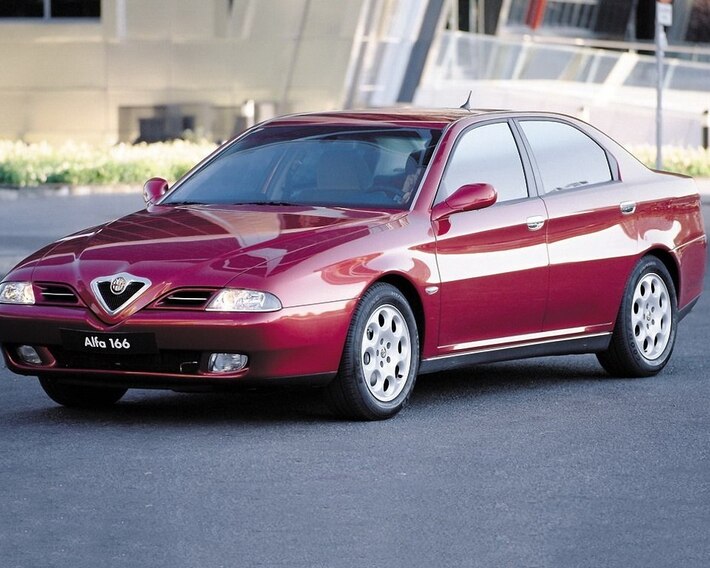
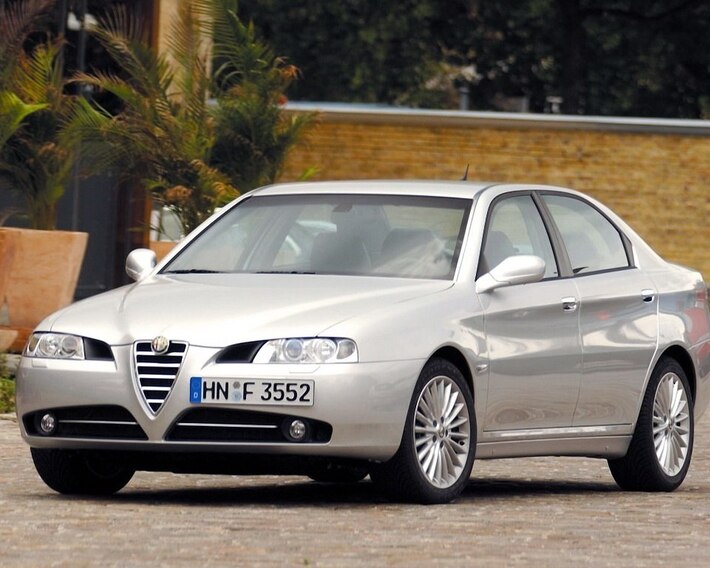
The Alfa Romeo 166 arrived in 1998 as the replacement for the celebrated 164 and as Alfa’s most ambitious attempt to compete at the top of the European executive sedan market. Designed by Giorgetto Giugiaro — the same designer who created the 105/115 GTV in 1963 — the 166 wore bodywork of considerable elegance, with a low roofline, long bonnet, and clean flanks that gave it a distinctly Italian character in a segment dominated by German conservatism. The Alfa shield grille, the sweeping waistline, and the carefully proportioned rear haunches made the 166 one of the most visually distinctive executive sedans of its era.
Mechanically, the 166 was built on an evolution of the platform used by the 156 and shared its front-wheel-drive layout with double-wishbone front suspension and a multi-link rear — the same sophisticated suspension geometry that made the 156 a benchmark for front-drive handling. In the 166’s longer, heavier body, this architecture delivered an executive sedan that was both comfortable and genuinely engaging to drive; a combination that the BMW 5 Series and Mercedes E-Class of the same era achieved through precision engineering, but which the 166 achieved through Italian passion.
The engine range was headed by the Busso V6 in two configurations: the 2.5-litre unit producing 190 hp and the 3.0-litre flagship producing 226 hp. Both versions of the Busso V6 produced an engine note between 4,000 and 6,500 rpm that enthusiasts consider one of the finest sounds ever produced by a six-cylinder road car. The 3.0 V6 in particular gave the 166 performance that could genuinely challenge the BMW 5 Series straight-six for driver satisfaction, if not for outright dynamic competence.
The 2.0 Twin Spark four-cylinder provided an accessible entry point, and the 2.4 JTD common-rail diesel — an inline-five unit — offered the practical long-distance alternative. The diesel was technically advanced for its era and became the most popular variant in European markets where company car tax was calculated on CO2 emissions. It gives the 166 a useful economic argument that the petrol variants cannot match for high-mileage users.
Production continued until 2007, and despite a mild facelift in 2003, the 166 was never replaced by an equivalent large sedan. Alfa Romeo’s subsequent product strategy moved toward the Giulia (952) as its flagship sedan from 2016 — a nine-year gap that left the 166 as the last of Alfa’s full-size traditional sedans. This historical position gives the 166 a significance that goes beyond its market performance: it is the final chapter of a lineage that began with the 6C and 1900 in the post-war period and continued through the Giulia, 1750, Alfetta, Alfa 6, 90, and 164.
Alfa Romeo 166 in Pictures
Giugiaro’s 166 body achieved an elegance that German executive sedans of the same era rarely matched — long, low, and unmistakably Italian.


Key Specifications
- Platform: Alfa Romeo Type 903 platform, shared with the Lancia Thesis. Front-wheel drive with double-wishbone front suspension — more sophisticated than MacPherson struts used by BMW and Mercedes at the front; multi-link rear suspension. The double-wishbone front geometry gives the 166 a steering feel and front-end precision that is one of its key dynamic strengths.
- Busso V6 (3.0, 2959cc): 226 hp at 6,200 rpm; 283 Nm at 4,800 rpm. The larger of the two Busso V6 configurations in the 166; DOHC 24-valve architecture; multi-point injection; naturally aspirated. The 3.0’s sound between 4,500 and 6,500 rpm is among the finest in automotive history; it transforms the 166 from a capable executive car into a genuinely exciting machine.
- Busso V6 (2.5, 2492cc): 190 hp at 6,200 rpm; 221 Nm at 4,800 rpm. The more accessible V6; still the definitive character engine for the 166; manual transmission strongly preferred over automatic for driver engagement. The 2.5 V6 was the more popular V6 variant in most markets.
- 2.0 Twin Spark (1970cc): 155 hp; the entry-level petrol; available with 5-speed manual or 4-speed automatic. Adequate performance for a large executive sedan but lacks the V6’s character; sensible choice for buyers who want 166 styling and handling on a reduced budget.
- 2.4 JTD turbodiesel (2387cc): 150 hp; inline-five cylinder common-rail diesel; available from launch with progressive improvements throughout production. Technically advanced for its era; strong low-rpm torque; excellent motorway economy. The most economical 166 to run; the most common variant in the used market.
- Transmission: 5-speed manual (base for V6 and diesel); 4-speed automatic available on 2.0 TS and 2.5 V6; 5-speed automatic (Aisin) available on 3.0 V6 from 2003 facelift onward. Selespeed sequential manual option on some markets for the V6.
- Dimensions: Length 4,672 mm; wheelbase 2,688 mm; width 1,800 mm. A full executive D-segment sedan by the standards of its era; genuinely spacious inside with good rear legroom and a 460-litre boot.
- Weight: Approximately 1,545–1,620 kg depending on variant (diesel and V6 heavier than base four-cylinder). The 3.0 V6’s power-to-weight ratio was approximately 140 hp/tonne — competitive with the BMW 528i of the same era.
- Safety: Dual front and side airbags standard on all variants; ABS with EBD; traction control on V6 variants. Euro NCAP four stars (2000 test). Electronic stability control (VDC) available on higher specifications from the facelift.
- Facelift (2003): Updated front fascia, revised interior with Alfa’s then-new instrument cluster design, additional specification upgrades. The facelift cars are generally preferred for their more modern interior and additional safety features.
Variant Comparison
| Variant | Engine | Power | Gearbox | Best For |
|---|---|---|---|---|
| Alfa Romeo 166 2.0 Twin Spark (155 hp) | 1970cc Twin Spark inline-four, multi-point injection | 155 hp at 6,200 rpm | 5-speed manual or 4-speed automatic | The accessible entry point into 166 ownership; the Twin Spark 2.0 provides adequate performance for a large executive sedan and is the most economical variant; pairs best with the manual gearbox for a more engaging driving experience |
| Alfa Romeo 166 2.5 V6 24v (190 hp) | 2492cc Busso DOHC 24-valve V6 | 190 hp at 6,200 rpm | 5-speed manual or 4-speed automatic | The ideal balance of character, performance, and cost; the 2.5 Busso V6 transforms the 166 from a capable executive car into a genuinely exciting large sedan; the manual version is the driver’s choice; the automatic suits long-distance touring; most commonly encountered V6 variant in the used market |
| Alfa Romeo 166 3.0 V6 24v (226 hp) | 2959cc Busso DOHC 24-valve V6 | 226 hp at 6,200 rpm | 5-speed manual or 5-speed automatic (Selespeed sequential on some) | The flagship road car; 226 hp from a naturally aspirated 3.0 V6 gave the 166 performance that challenged BMW 5 Series and Volvo S80 directly; the 3.0 V6’s sound at high revs is spectacular; the rarest and most desirable 166 specification for enthusiast collectors |
| Alfa Romeo 166 2.4 JTD (150 hp) | 2387cc common-rail turbodiesel inline-five | 150 hp at 4,000 rpm | 5-speed manual | The practical long-distance choice; the inline-five common-rail diesel was technically advanced for its era and provides excellent torque from low revs; most economical to run; suited to high-mileage users who prioritise economy over the V6’s emotional character; the most common variant in European used markets |
What Makes the 166 Stand Out
The 166 made a compelling case for Italian executive cars in a segment where Germany had dominated for decades. In V6 specification especially, it offered something no German competitor could replicate.
- The last great Busso V6 sedan: The 166 was the final large sedan to receive the magnificent Busso V6 in its 2.5 and 3.0-litre forms. When production ended in 2007, Alfa Romeo’s flagship sedan carrying this celebrated engine was gone. Owning a 166 3.0 V6 is owning the final expression of a lineage of V6-engined Alfa Romeo sedans that began with the 75 in the mid-1980s.
- Giugiaro styling of enduring elegance: The 166’s body has aged exceptionally well. Twenty-five years after its launch, the clean flanks, the low roofline, and the refined rear quarter still read as genuinely elegant. The pre-facelift 1998–2003 car in particular has a purity of line that the 2003 facelift did not improve upon.
- Double-wishbone front suspension: The Type 903 platform’s double-wishbone front suspension gave the 166 a dynamic precision that most front-drive large sedans cannot achieve. Combined with the multi-link rear, the 166 handles with a confidence and accuracy that rewards drivers who want to exploit an executive sedan.
- Remarkable used value: The 166 depreciated enormously from its new price, making it one of the most affordable ways to access executive sedan space, Giugiaro styling, and the Busso V6 sound. Well-maintained 3.0 V6 examples are available at prices that represent extraordinary value for the experience they offer.
- Historical significance as the last traditional Alfa flagship: After the 166, Alfa Romeo did not produce another full-size traditional sedan for nine years. The 166 represents the conclusion of a continuous lineage of large Alfa sedans and its historical position is becoming more appreciated as time passes.
Maintenance & Repairability in Azerbaijan
The 166 is a large, complex executive car that demands appropriately capable maintenance. In Azerbaijan, the Busso V6 can be serviced by European-trained mechanics with access to the correct parts from Italian and German suppliers.
- Busso V6 timing belt (critical): The 2.5 and 3.0 V6 are both interference engines. Timing belt replacement at 60,000 km intervals is essential; include the water pump and all tensioners. For a car imported to Azerbaijan without full service history, immediate belt replacement is the first priority. Budget approximately $500–900 for the complete kit and labour.
- Busso V6 spark plugs: Six plugs on the V6; use NGK or Denso to the manufacturer specification. The V6’s 24-valve architecture means plug access on some cylinders requires removal of the intake plenum — a more involved job than a four-cylinder; budget for 2–3 hours labour at a specialist.
- 2.4 JTD diesel maintenance: The inline-five JTD diesel requires timing belt service (also interference engine, same criticality as petrol V6); diesel injector inspection at 100,000 km intervals; EGR valve cleaning on high-mileage examples; glow plug replacement. The JTD is robust when properly maintained but poorly maintained examples can suffer injector or turbocharger issues.
- Electrical systems: The 166’s electrical architecture is more complex than smaller Alfa models; the body control module (BCM) and associated multiplex wiring can develop faults with age. Diagnosis requires Alfa Romeo-specific diagnostic equipment (EXAMINER or equivalent); a generic OBD scanner may not read all 166-specific fault codes. Establish a relationship with a specialist who has the correct diagnostic tools before purchase.
- Suspension maintenance: The double-wishbone front suspension has more components than MacPherson struts and more points of potential wear (inner and outer ball joints, wishbone bushes, anti-roll bar links). On a 166 with high mileage or poor road history, a full front suspension refurbishment — new bushes, ball joints, and track rod ends — dramatically transforms the car’s dynamic character. Parts from FAP, TRW, and Bilstein are available from European suppliers.
- Parts availability from Europe: Alfa Romeo 166 parts are available from Italian (FAP, OEM), German (FEBI, Brembo, Bilstein), and UK suppliers. The 166 shared many components with the Lancia Thesis, which broadens the supply base. Mechanical parts are generally available; some electrical items and interior trim are becoming harder to source. International shipping to Azerbaijan takes 1–2 weeks.
Alfa Romeo 166 vs. Contemporaries
| Model | Core Strength | Main Compromise |
|---|---|---|
| Alfa Romeo 166 3.0 V6 | The Busso V6 at 226 hp in an executive sedan — Alfa’s finest large sedan; Giugiaro styling more elegant than BMW or Volvo; engaging driving character; Italian prestige in the executive segment; now entering classic territory with genuine collector appeal | Reliability record below German rivals; the 166 had a reputation for electrical issues; resale values collapsed dramatically, leaving many neglected; parts and service require European import or specialist in Azerbaijan |
| BMW 5 Series E39 (1995–2003) | The benchmark executive sedan of the era; rear-wheel drive; outstanding engine range including straight-six and V8; superb build quality; comprehensive BMW dealer network globally; strong resale values; one of the finest BMWs ever made | Significantly more expensive than the Alfa 166 in comparable specification; German character is competent and refined rather than passionate; no V6 engine note to match the Busso’s sound; heavier than the 166 |
| Mercedes-Benz E-Class W210 (1995–2002) | Outstanding build quality; comprehensive safety equipment; excellent diesel range; superb interior quality and refinement; strong long-term durability; wide body range including wagon and coupe | Conservative styling compared to the Giugiaro-designed Alfa; heavier and less agile than the 166; significantly more expensive to acquire in good condition; the W210 had a reputation for early rust on the pre-facelift models |
| Volvo S80 (1998–2006) | Outstanding safety record; comfortable and refined; the 2.8T turbo version quick; practical and reliable; distinctive Swedish design; good long-term value; strong safety reputation still relevant | No emotional content whatsoever compared to the 166 V6; the Volvo prioritises comfort and safety over driver engagement; less prestigious badge in Mediterranean/Middle Eastern contexts |
| Lancia Thesis (2001–2009) | Italy’s other executive sedan of the era; shared Alfa 166 platform; sophisticated air suspension option; Lancia brand prestige; Italian luxury cabin; even rarer than the 166 | The Thesis was not a commercial success; parts and support are even more challenging than the Alfa 166; the Lancia brand carries less recognition in Azerbaijan than Alfa; values lower and collector interest limited outside Italy |
Cost-of-Ownership Calculator (Azerbaijan)
Annual running cost estimates for an Alfa Romeo 166. V6 variants consume more fuel than the diesel; service budget reflects executive car maintenance complexity and European parts import costs.
- Estimated annual fuel use: 1200 litres
- Estimated annual fuel cost: $960
- Total annual ownership estimate: $5260
- Average monthly ownership estimate: $438
Used Buying Checklist
The 166 is now 19–28 years old and the combination of Italian electrics, complex suspension, and V6 timing belt requirements demands thorough pre-purchase assessment.
- V6 or diesel timing belt (non-negotiable): Verify documented belt replacement within the last 60,000 km. Both V6 and JTD diesel engines will be destroyed by a snapped belt. If history is absent, budget for immediate service before driving the car beyond the test drive.
- Electrical systems check: Use Alfa Romeo-specific diagnostics to check all modules for stored fault codes. Common issues include BCM faults, airbag module errors, and instrument cluster anomalies. A car with multiple fault codes in critical safety systems (airbag, ABS) requires investigation before purchase.
- V6 engine assessment: Listen for the Busso V6 at full operating temperature. The engine should be notably quiet at idle; any clicking or ticking above idle speed may indicate valve clearance issues. A compression test before purchase is strongly recommended for any high-mileage V6.
- Suspension inspection: The 166’s double-wishbone front suspension should be inspected by a specialist for worn bushes, ball joints, and track rod ends. A worn front suspension gives the car imprecise steering and a vague front end — very different from a properly set-up 166’s precise response.
- Body rust: Inspect sills, lower doors, and the rear wheel arches. The 166’s larger body has more surface area to rust; southern Italian examples are preferable to northern European cars for reduced rust exposure. Check the boot floor and spare wheel well for water ingress.
Alfa Romeo 166 FAQ
Is the 166 the last true Alfa Romeo flagship sedan?
In terms of a full-size, executive-segment sedan with a large-displacement V6 engine, yes — the 166 was the last traditional Alfa flagship sedan. The Alfa Romeo Giulia (952) launched in 2016 as a premium mid-size sedan but sits in a smaller segment. The 166 remains the last Alfa with the combination of full executive size, Busso V6 power, and a design brief to challenge BMW 5 Series and Mercedes E-Class directly.
Which 166 should I buy: 2.5 V6 or 3.0 V6?
The 3.0 V6 is the superior car in every V6-related dimension: more power, more torque, and a slightly more free-revving character above 5,000 rpm. The 2.5 V6 is more common and slightly less expensive to run (marginally better fuel economy). For a driver who will use the engine enthusiastically, the 3.0 is worth the premium. For a buyer who primarily wants the V6 character for occasional spirited driving, the 2.5 is entirely sufficient and more affordable to insure.
Is the 166 reliable enough for Azerbaijan use?
A well-maintained 166 can serve as a reliable daily driver in Azerbaijan, but it requires a proactive maintenance approach. The timing belt must be current, the electrical systems must be healthy, and the cooling system must be in excellent condition. The 166’s size means it is well-suited to Azerbaijan’s roads and is a comfortable car for longer journeys. Budget for European parts imports and accept that diagnosis will require specialist equipment.
Should You Buy an Alfa Romeo 166?
The Alfa Romeo 166 in 3.0 V6 or 2.5 V6 specification is one of the great bargains of the current used car market: Giugiaro executive styling, the magnificent Busso V6, double-wishbone suspension, and genuine Italian character at a fraction of the price of an equivalent BMW E39 or Mercedes W210. It is not the most reliable or the cheapest to maintain, but for drivers who value the emotional experience of an Italian V6 executive car, it is incomparable.
In Azerbaijan, the 166 makes most sense for buyers who appreciate its unique combination of history, character, and value — and who are prepared to invest in proper maintenance and accept the cost of European parts sourcing. Find a post-2003 facelift car with a documented timing belt history and sound electrical systems, and the 166 V6 will be one of the most rewarding executive cars in the Baku used car market.
BakuWheels uses cookies to improve your experience, analyse site traffic, and personalise content. By clicking Accept All, you consent to our use of cookies. Learn more in our Cookie Policy.