
Alfa Romeo 33 Stradale (1967–1969 & 2023–)
The Alfa Romeo 33 Stradale exists in two distinct eras separated by 56 years. The original (1967–1969) — just 18 examples built by Franco Scaglione — is widely regarded as the most beautiful car ever designed, a mid-engine berlinetta that embodied Italian coachbuilding at its absolute peak. The new 33 Stradale (2023) is Alfa Romeo’s breathtaking reinterpretation: 33 units total, combining modern hypercar performance with the spiritual legacy of the original.
Overview
The name “33 Stradale” carries more weight in automotive history than almost any other model designation. In 1967, Alfa Romeo’s racing department was campaigning the Tipo 33 prototype racer — a purpose-built racing car with a 2.0-litre V8 engine producing 270 hp in full race form. The idea emerged to create a road-going version of this racing machine: a car that would bring the technology, the excitement, and the visual drama of the racing programme to the road. The result, named 33 Stradale (“road-going”) was placed in the hands of designer Franco Scaglione.
What Scaglione produced has been described in almost every superlative the automotive press has available. The 33 Stradale’s body — with its impossibly low roofline, the butterfly doors that swung upward and forward, the smooth, sculpted flanks with no visible air intakes, and the perfect proportion of every surface — achieved something that car designers have spent the following 56 years trying to emulate without success. The Museum of Modern Art in New York acquired a 33 Stradale for its permanent design collection; the Louvre in Paris displayed one; it has been featured in every significant survey of great industrial design. The consensus of designers, critics, and historians is consistent: the Alfa Romeo 33 Stradale is among the two or three most beautiful objects ever made.
Under the body, the engineering was equally exceptional. The mid-engine 2.0-litre V8 was derived directly from the racing car’s engine, detuned from 270 hp in race form to 230 hp in road-going specification — still an extraordinary output for 1967. The engine was mounted behind the driver and ahead of the rear axle; a six-speed transversely mounted gearbox sat ahead of and below the engine in a configuration designed to minimise the car’s wheelbase while maximising driver proximity to the engine. The entire car weighed approximately 700 kg — less than a modern city car.
Only 18 examples were built. The car was never intended for volume production; it was a demonstration of what was possible, a statement of Alfa Romeo’s engineering and design capability at the height of the Italian “beautiful years.” All 18 are believed to survive; they appear at the world’s most prestigious concours events and auction rooms, consistently achieving prices between $3 million and $5 million, with exceptional examples potentially higher.
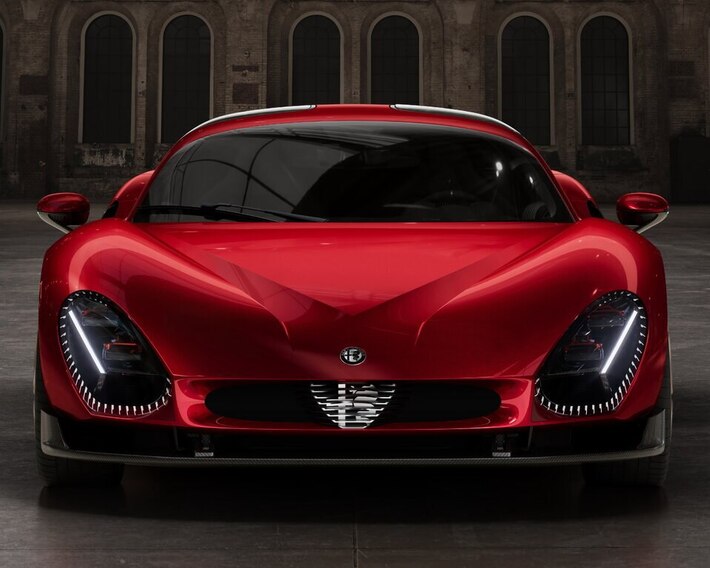
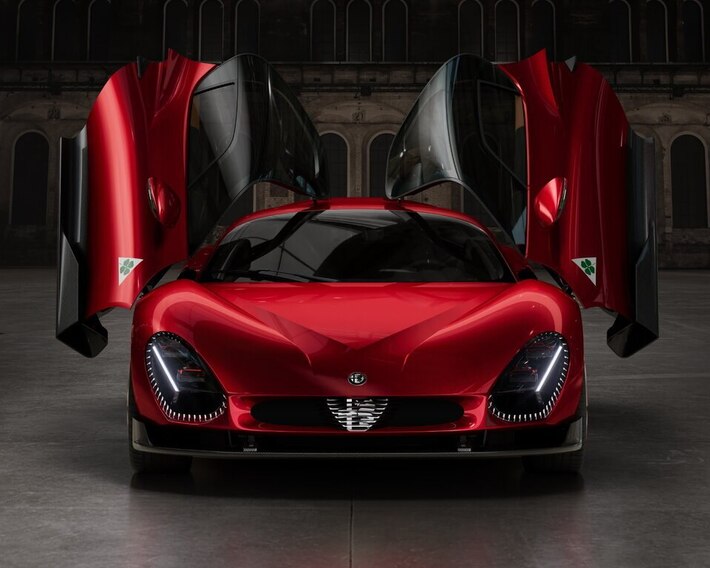
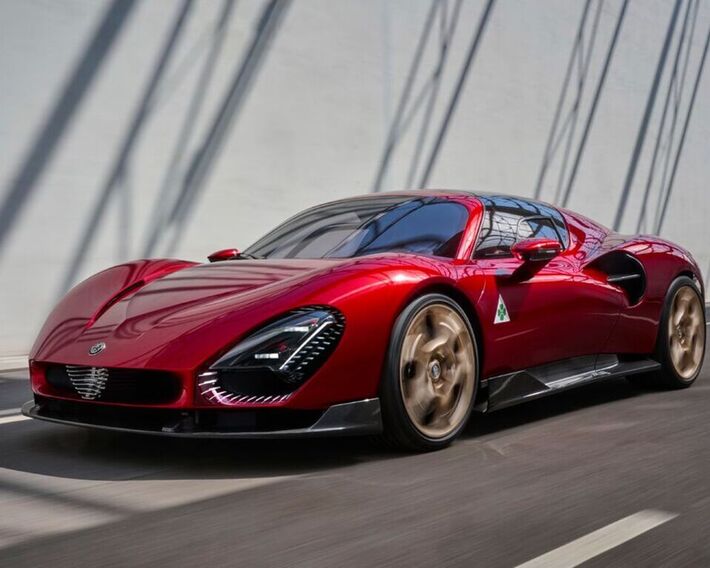
In 2023, Alfa Romeo announced the new 33 Stradale — a car that does not attempt to replicate the original but rather to honour it with contemporary technology. Thirty-three units were produced (a deliberate reference to the original’s internal designation), available in either a combustion version with a twin-turbocharged V6 producing approximately 620 hp, or a full electric version producing approximately 750 hp from dual motors. Like the original, the new 33 Stradale uses butterfly doors, a mid-engine layout, and a body design that attempts to achieve visual purity through reduction rather than addition. At approximately €1.5 million new, all 33 examples were allocated to buyers from Alfa Romeo’s collector customer database before the public announcement was made.
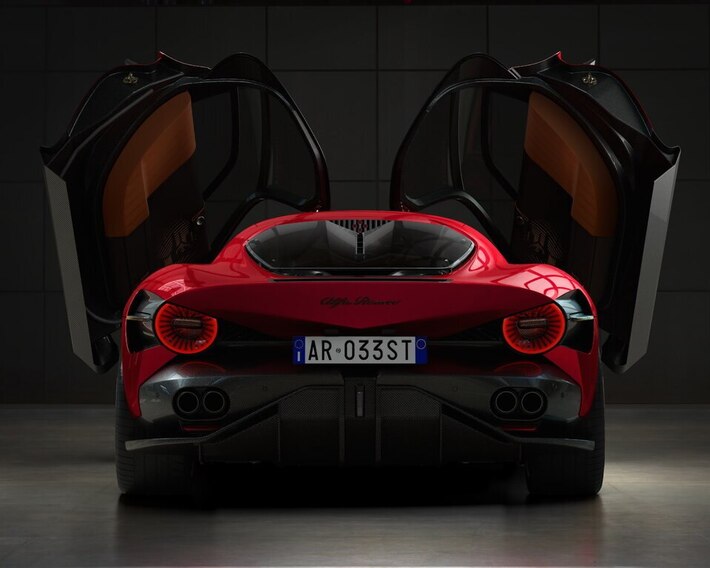
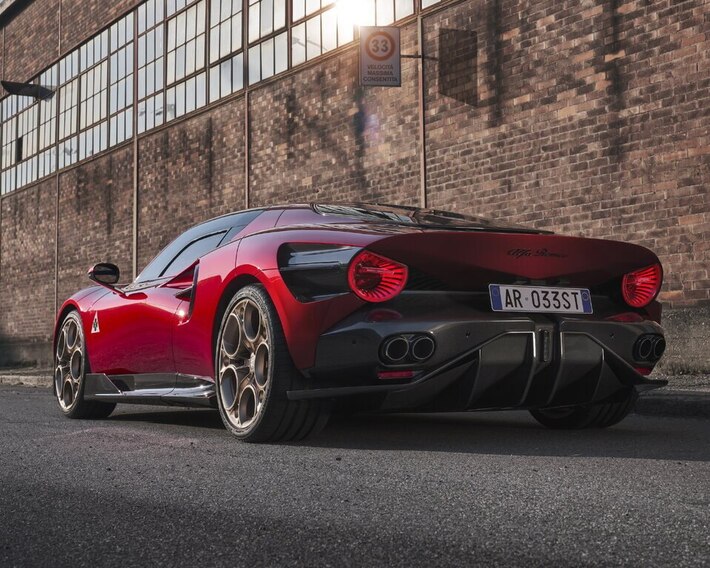
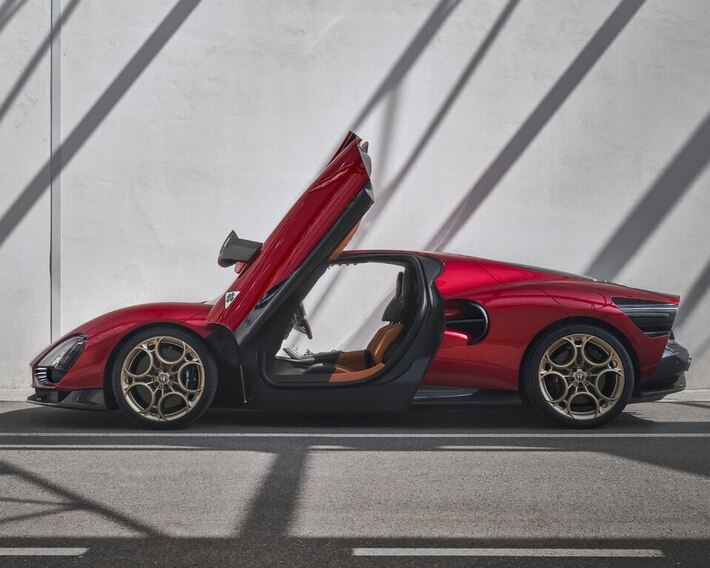
33 Stradale in Pictures
Both eras of the 33 Stradale share a commitment to visual perfection through the most demanding constraints: low, clean, and free of unnecessary surfaces.
Key Specifications
- Original engine (1967): 1995cc DOHC V8 derived from the Tipo 33 racing car; twin overhead camshafts per bank; fuel injection; 230 hp at 8,800 rpm in road form (racing versions produced 270 hp+). The V8’s sound at high revs is described by those who have driven original 33 Stradale examples as one of the most extraordinary engine experiences in existence: high, complex, and unlike any other small V8.
- Original layout: True mid-engine rear-wheel drive; engine mounted longitudinally behind the cockpit, ahead of the rear axle; 6-speed transverse gearbox; all-independent suspension with coil springs and wishbones; dry weight approximately 700 kg. The power-to-weight ratio exceeds 300 hp/tonne; a figure that most modern production sports cars cannot match.
- Original body: Designed by Franco Scaglione; hand-formed aluminium panels over a steel tube space frame; butterfly doors (upward-swinging, hinged at the A-pillar); low, ventilated rear deck; engine visible through glass rear window; overall height below 1,000 mm. The body has been displayed in the permanent design collections of MoMA New York and other major international design institutions.
- New 33 Stradale (2023) — combustion: 2891cc twin-turbocharged V6 (evolved from Giulia GTA unit); approximately 620 hp; 8-speed automatic with Alfa Romeo DNA selector; mid-engine RWD; body designed by Centro Stile Alfa Romeo under the direction of Alejandro Mesonero-Romanos; butterfly doors; dry weight approximately 1,250 kg (significantly heavier than original); production 33 units total (combustion + electric combined).
- New 33 Stradale (2023) — electric: Dual electric motor all-wheel drive; approximately 750 hp combined output; single-speed reduction on each axle; 0–100 km/h in under 3.0 seconds; same body and butterfly door design as combustion version. The electric variant’s performance profile is dramatically different from both the original and the combustion new edition, prioritising instant torque over the combustion version’s more progressive power delivery.
- Original collector values: Authenticated original 33 Stradale examples: $3,000,000–$5,000,000 depending on condition and provenance. The most significant examples (museum-displayed, fully documented, with continuous ownership history) may exceed $5M. All 18 are believed to survive; none are believed to be held anonymously — each is known in the collector community.
- New edition allocation: All 33 new-edition examples were allocated to buyers from Alfa Romeo’s established collector customer list before the public announcement. A waiting list exists for any future similar project but no additional new 33 Stradale production has been announced.
Variant Comparison
| Variant | Engine | Power | Gearbox | Best For |
|---|---|---|---|---|
| Original 33 Stradale (1967–1969) | 1995cc Tipo 33 racing V8, 2.0L, DOHC | 230 hp at 8,800 rpm (road tune) | 6-speed transverse manual (behind cockpit) | The original and ultimate — 18 examples built by Alfa Romeo; body by Franco Scaglione; mid-engine V8; the most beautiful Italian sports car ever made by many measures; values $3–5M+ for authenticated examples; a museum-grade acquisition for the most serious collectors |
| New 33 Stradale – Combustion (2023–) | 2891cc twin-turbocharged V6 (from Giulia GTA), tuned | 620 hp (estimated) | 8-speed automatic (Alfa DNA selector) | The modern interpretation for the serious hypercar buyer; limited to 33 combustion units worldwide; mid-engine layout; Alfa Romeo’s homage to the original; the only way to buy a new mid-engine Alfa Romeo; expected values stable or appreciating given extreme rarity; approximately €1.5M new price |
| New 33 Stradale – Electric (2023–) | Dual electric motors, full BEV | 750 hp (combined) | Single-speed reduction (front and rear axle) | The electric variant for buyers interested in the 33 Stradale concept as an expression of future Italian performance; same 33-unit production limit as combustion version (total 33 cars combining both powertrains); peak acceleration advantage over combustion version; not for purists who want the sound of the original; for collectors who see electric hypercar ownership as the frontier |
What Makes the 33 Stradale Stand Out
The 33 Stradale stands apart from every other car in automotive history through the combination of extreme rarity, extraordinary beauty, and genuine technical achievement in both its original and contemporary forms.
- Acknowledged by design institutions as the most beautiful car ever made: The original 33 Stradale is the only car to have been acquired by the Museum of Modern Art in New York as a permanent design exhibit. The Louvre in Paris, the Villa d’Este concours, and every major international design survey consistently place it among the two or three most beautiful objects ever created by human hands. This is not hyperbole; it is the consensus of the design world over 56 years.
- Only 18 original examples in existence: The 33 Stradale is one of the rarest road cars ever built by a major manufacturer. All 18 examples are believed to survive; all are known to the collector community; authenticated examples are among the most valuable Italian road cars at auction. The extreme rarity guarantees its position as a landmark collector car for all time.
- Direct lineage from a championship racing car: The V8 engine in the original 33 Stradale is derived directly from the Tipo 33 racing car that competed at the Targa Florio, Sebring, and Nurburgring. This is not a road car with a racing engine loosely inspired by competition; it is a racing engine with a road car loosely built around it. The direct motorsport connection gives the 33 Stradale a credibility that purpose-built road hypercars cannot claim.
- The new edition maintains the original’s spirit: The 2023 33 Stradale does not attempt to replicate the original but honours it through the same commitment to extreme rarity (33 units), butterfly doors, mid-engine layout, and visual purity. The deliberate choice of 33 units as the production number is a respectful acknowledgement of the original’s legacy.
- Both editions represent investment-grade acquisitions: Original 33 Stradale values have appreciated consistently and show no signs of weakening; the combination of extreme rarity, MoMA provenance, and perfect design ensures permanent collector significance. New edition values are expected to appreciate given the 33-unit limit and Alfa Romeo’s revived performance credibility under Stellantis leadership.
Maintenance & Acquisition in Azerbaijan
Neither edition of the 33 Stradale is a practical proposition for routine Azerbaijan use. Both require specialist custodianship appropriate to their value and significance.
- Original 33 Stradale acquisition: Any original 33 Stradale acquisition should be conducted only through Alfa Romeo Classiche (official Alfa Romeo heritage certification programme), the major specialist Italian auction houses (RM Sotheby’s Italy, Bonhams, Artcurial), or through private treaty with full provenance verification. Budget $3M–5M+ for acquisition; import duties and customs compliance in Azerbaijan must be assessed with a specialist import agent.
- Original V8 engine maintenance: The Tipo 33 V8 is a racing-derived engine requiring specialist maintenance by mechanics with specific experience in the engine type. Alfa Romeo’s Centro Documentazione e Museo, specialist Italian classic racing car preparers, and a very small number of international specialists are equipped to service these engines. Regular running is recommended over extended storage to maintain oil film on critical components.
- New 33 Stradale: All new examples are allocated; secondary market purchases will require dealing with established hypercar brokers (Romans International, HR Owen, specialist Ferrari/Alfa dealers). Alfa Romeo provides factory service support for new 33 Stradale owners through its Sauber-based performance engineering partnership. Service must be conducted at authorised service points; dealer network in Azerbaijan is limited and factory service in Italy or designated centres is the realistic option.
- Storage and insurance: Both original and new edition 33 Stradale examples require climate-controlled storage, agreed-value specialist classic car insurance (Lloyd’s market or equivalent), and regular condition monitoring. Azerbaijan-based insurance for a vehicle of this value requires a specialist international broker; standard local insurance policies are entirely insufficient.
- Concours preparation and display: The original 33 Stradale is appropriate for the world’s premier concours events (Pebble Beach, Villa d’Este, Chantilly Arts & Elegance); the new edition may appear at similar events. Preparation for concours participation requires specialist detailing and mechanical preparation beyond routine service.
- Alfa Romeo Classiche programme: For any original 33 Stradale, Alfa Romeo Classiche certification is mandatory for establishing provenance and value. The programme was established specifically to certify and document Alfa Romeo’s most historically significant models and the 33 Stradale is among its most celebrated subjects.
33 Stradale vs. Contemporaries
| Model | Core Strength | Main Compromise |
|---|---|---|
| Alfa Romeo 33 Stradale (original, 1967–1969) | Arguably the most beautiful car ever made; Franco Scaglione’s body achieved a perfection of form that has not been surpassed; mid-engine V8 from the racing Tipo 33; butterfly doors; only 18 built; values among the highest for any Italian road car; a transcendent collector experience | Entirely impractical; requires museum-level custodianship; $3M+ purchase price; import, insurance, and customs complexities for Azerbaijan are extreme; no modern safety equipment |
| Ferrari 275 GTB (1964–1968) | Contemporary Ferrari GT with front V12; Pininfarina styling; competition history; Ferrari brand prestige; one of the most celebrated production Ferraris; values $2.5M–4M for exceptional examples | A front-engine GT versus the 33 Stradale’s mid-engine berlinetta; Ferrari V12 versus Alfa V8 character; the Ferrari is celebrated but the 33 Stradale is widely considered the more visually perfect car |
| Lamborghini Miura (1966–1973) | The world’s first production mid-engine supercar; Bertone styling; V12; 350+ hp; Italian exotic prestige; direct contemporary of the 33 Stradale; values $2M–4M for excellent examples | The Miura was a series-production car (762 built) versus the 33 Stradale’s 18 examples; the Miura is famous and valuable but not as rare; different character — touring GT versus pure racing road car |
| New 33 Stradale vs. Ferrari 296 GTB | Contemporary Ferrari V6 hybrid mid-engine; 830 hp combined system output; Ferrari badge; more powerful than the 33 Stradale combustion; established Ferrari hypercar infrastructure; better dealer network globally | The Ferrari is a production car with over 1,000 units; the 33 Stradale is limited to 33 examples; Italian Alfa Romeo heritage and design mission are entirely different; the 33 Stradale will be rarer and more significant historically |
| New 33 Stradale vs. McLaren Artura | McLaren’s hybrid V6 mid-engine; 680 hp; lighter than most rivals; pure performance focus; more accessible than the 33 Stradale at approximately £200,000; better dealer infrastructure globally | The McLaren is a production car available in reasonable numbers; the 33 Stradale is a 33-unit special; Alfa Romeo’s Italian heritage and the 33 name’s meaning to automotive history give it a significance McLaren cannot match |
Cost-of-Ownership Calculator
This calculator is included for reference; the 33 Stradale in either edition is an investment-grade acquisition where the annual running cost is a small fraction of the car’s value and custodianship costs dominate.
- Estimated annual fuel use: 1200 litres
- Estimated annual fuel cost: $960
- Total annual ownership estimate: $5260
- Average monthly ownership estimate: $438
Acquisition Checklist
Any 33 Stradale acquisition in either era requires the highest level of specialist due diligence.
- Original: Classiche certification mandatory: The Alfa Romeo Classiche programme is the only officially recognised authentication mechanism for the original 33 Stradale. Any original offered without current Classiche documentation should be subjected to independent specialist authentication before purchase. Consult the programme directly (Alfa Romeo Museum, Arese, Italy) for current certified examples.
- Original: SAAP registration and chassis verification: The Societá Alfa Romeo Archive Programme maintains chassis records for all 18 original 33 Stradale cars. Cross-reference the chassis number against these records. Any discrepancy between offered chassis number and archive records is a critical red flag.
- New edition: Allocation documentation: New 33 Stradale purchases must be confirmed through the official Alfa Romeo allocation process with full factory documentation. Verify that the car’s build specification matches the allocation document; any discrepancy should be investigated with the factory directly.
- International legal and customs advice: Both original and new edition 33 Stradale acquisitions for import to Azerbaijan require specialist legal and customs advice. The vehicle’s declared value for customs purposes must reflect market reality; undervaluation to reduce customs duty is illegal and invalidates insurance coverage.
- Specialist transport: Transport must use enclosed premium automotive transport (enclosed trailer or enclosed sea freight container). Any vehicle of this value shipped in open transport or driven on public roads without specialist supervision risks irreplaceable damage that cannot be adequately compensated.
33 Stradale FAQ
Why is the original 33 Stradale considered the most beautiful car ever made?
Franco Scaglione’s design achieved a combination of qualities that very rarely coexist: the body appears to have no unnecessary surface, no decoration added for its own sake, and no proportion that is not perfectly balanced against every other proportion. At the same time, it is not minimal or austere — it is richly three-dimensional, with surfaces that change character in moving light. The butterfly doors integrate into the body without creating a visual break; the low roofline is structurally pure and aerodynamically coherent. MoMA’s acquisition of the car for a design collection (not an automobile collection) confirms that its beauty transcends automotive history.
Is the new 33 Stradale a worthy successor?
No successor could be “worthy” of the original in any literal sense — the original is a unique historical object. The new 33 Stradale is a worthy tribute: it demonstrates that Alfa Romeo understands what the name means, that it is capable of producing a genuinely significant performance car in the hypercar era, and that it respects the original’s visual commitment to purity. The 33-unit production limit and the butterfly doors are the most deliberate references to the original; the decision to offer an electric variant acknowledges that the 33 Stradale’s legacy must extend into the future, not merely celebrate the past.
Could I buy a new 33 Stradale if I were not on the original allocation list?
All 33 new-edition examples were pre-allocated. Secondary market purchases are the only route for buyers who were not on the original allocation list. Given the 33-unit limit and the international collector demand for Alfa Romeo special editions, secondary market prices are expected to be at or above new list price for the foreseeable future. Contact specialist hypercar brokers for secondary market access.
Should You Acquire an Alfa Romeo 33 Stradale?
The original Alfa Romeo 33 Stradale is not a purchase — it is a custodianship. To own one is to take responsibility for one of the 18 most significant automobiles in existence, a car whose beauty, rarity, and cultural impact place it among the permanent monuments of human creative achievement. If you have the financial resources, the specialist support network, and the genuine understanding of what the car represents, acquiring a 33 Stradale is one of the most significant things a collector can do.
The new 33 Stradale represents a different but equally compelling proposition: a hypercar that will be historically significant precisely because of its rarity and its explicit reference to the most celebrated Italian sports car ever made. Secondary market acquisition for a buyer in Azerbaijan is realistic with the right specialist support. Both editions will appreciate; both deserve custodianship rather than mere ownership.
BakuWheels uses cookies to improve your experience, analyse site traffic, and personalise content. By clicking Accept All, you consent to our use of cookies. Learn more in our Cookie Policy.