

Ariel Atom
The Ariel Atom is one of the most extreme road-legal sports cars ever built — a bare exoskeleton spaceframe carrying a screaming Honda engine, capable of reaching 100 km/h in 2.4 seconds with no roof, no doors, and no apologies.
Overview
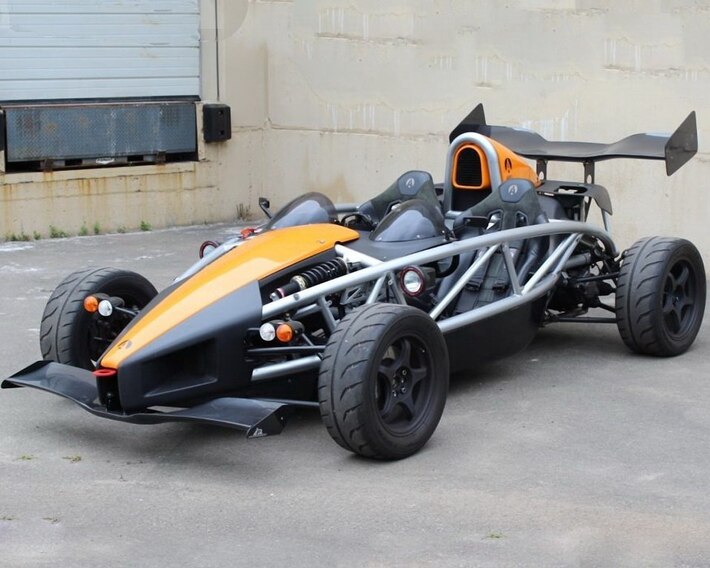
The Ariel Atom was conceived in the mid-1990s as a university design project and entered production in 1999 through Ariel Motor Company in Somerset, England. The car dispensed with every conventional automotive convention — no bodywork panels, no windscreen, no doors, and no roof — in pursuit of a single goal: the most direct, unfiltered driving experience possible on four wheels. The exoskeleton spaceframe chassis, a lattice of welded steel tubes, is the body itself, exposing the mechanicals and occupants to the elements in a way that is simultaneously alarming and utterly liberating.
Throughout its production life, the Atom has been powered by Honda engines — a deliberate choice that combines Honda's outstanding reliability and parts availability with performance credentials proven in motorsport. Early Atom 3 variants used the naturally aspirated Honda K20 producing 245 bhp, while supercharged versions pushed output to 310 and then 350 bhp. The 2018 Atom 4 introduced the turbocharged K20C from the Civic Type R, producing 320 bhp in a car weighing only 563 kg — a power-to-weight ratio that places it in hypercar territory. The Atom 4S raises this further to 335 bhp.
For enthusiasts in Azerbaijan, the Ariel Atom represents the absolute pinnacle of track-day and weekend sports car ownership. It is not a practical proposition for Baku's daily traffic or winters, but as a dedicated machine for driving events, hillclimbs, and circuit sessions, nothing else offers this combination of performance intensity and Honda-based mechanical simplicity. Parts for the K20C engine are available through Honda networks globally, and the Atom's own chassis components can be obtained directly from Ariel in the UK.
Gallery
Key Specifications
| Production Years | 1999 – Present |
|---|---|
| Body Style | Open exoskeleton spaceframe roadster (2-seat) |
| Chassis | Welded steel tube exoskeleton spaceframe |
| Engine (Atom 4) | 2.0L Honda K20C turbocharged 4-cylinder (Civic Type R) |
| Power | 320 bhp (Atom 4); 335 bhp (Atom 4S) |
| Torque | 420 Nm (Atom 4) |
| 0–100 km/h | 2.4 seconds (Atom 4) |
| Top Speed | approximately 260 km/h (Atom 4) |
| Dry Weight | approximately 563 kg |
| Power-to-Weight | approximately 570 bhp per tonne |
| Transmission | 6-speed manual (Honda sourced) |
| Drive | Rear-wheel drive |
| Suspension | Double wishbone front and rear with pushrod actuation |
| Brakes | AP Racing 4-piston callipers, ventilated discs |
| Fuel consumption | approx. 9–11 L/100 km (track use higher) |
Variant Comparison
| Variant | Engine | Power | 0–100 km/h | Top Speed | Best For |
|---|---|---|---|---|---|
| Atom 3 (245 bhp) | 2.0L Honda K20 naturally aspirated | 245 bhp | 3.4 sec | 233 km/h | Purist naturally aspirated experience |
| Atom 3 (310 bhp) | 2.0L Honda K20 supercharged | 310 bhp | 2.9 sec | 249 km/h | High-performance track days |
| Atom 3.5 (350 bhp) | 2.0L Honda K20 supercharged (uprated) | 350 bhp | 2.7 sec | 257 km/h | Maximum supercharged performance |
| Atom 4 (320 bhp) | 2.0L Honda K20C turbocharged (Civic Type R) | 320 bhp | 2.4 sec | 260 km/h | Current model — best balance of power and driveability |
| Atom 4S (335 bhp) | 2.0L Honda K20C turbocharged (uprated) | 335 bhp | 2.3 sec | 265 km/h | Top-specification Atom — track weapon |
What Makes the Ariel Atom Stand Out
Exoskeleton Architecture
The Atom's bare steel tube chassis is both the structure and the visual identity. There are no body panels concealing the engineering — the radiator, suspension geometry, engine, and exhaust are all visible and tactile. It is engineering as art, and no other production car presents itself this way.
Honda K-Series Reliability
By using Honda's K-series engine, Ariel gave the Atom a mechanical heart that is genuinely reliable and globally supported. Honda K20 and K20C components are available through Honda dealers worldwide, making the Atom far more maintainable long-term than a bespoke motorsport engine.
Extraordinary Power-to-Weight Ratio
At approximately 570 bhp per tonne, the Atom 4 exceeds many supercars costing ten times as much. The absence of mass means every horsepower is felt immediately — acceleration is visceral, steering response is instant, and braking is ferocious by any road-car standard.
Double-Wishbone Suspension on All Four Corners
The Atom uses racing-derived double wishbone suspension at all four corners with pushrod actuation — a layout found in Formula One cars. This provides exceptional wheel control and allows for precise handling balance that no MacPherson strut road car can replicate.
Television and Media Fame
The Atom became globally famous through multiple appearances on Top Gear, where Jeremy Clarkson's face-distorting acceleration run became one of the most viewed automotive television moments in history. This cultural impact has made the Atom an icon recognised far beyond the enthusiast community.
Maintenance & Repairability in Azerbaijan
The Ariel Atom occupies a unique position in the Azerbaijani automotive context. It is not a car that any conventional workshop will be familiar with, but its mechanical components are largely drawn from Honda's production parts catalogue — which changes the maintenance equation substantially in the owner's favour.
The K20C engine used in the Atom 4 is the same unit found in the Honda Civic Type R FK8, a car sold globally and well-supported by Honda's international dealer network. Oil changes, filter replacements, spark plugs, coolant service, and brake components are all standard Honda items available through Honda dealers in Baku and via parts importers. Any mechanic familiar with turbocharged four-cylinder Honda engines can perform routine maintenance on the Atom's powerplant without issue.
The chassis, suspension, and bespoke Ariel components are a different matter. Ariel builds in very small numbers and all chassis-specific parts must be ordered directly from the factory in Somerset. Shipping times of two to four weeks to Azerbaijan should be anticipated for any structural or specialist components. The Atom is best treated as an event car — comprehensively inspected before and after each session, with consumables replaced on a proactive schedule rather than reacting to failure. AP Racing brake components are available through motorsport suppliers in Turkey and Georgia.
Competitor Comparison
| Model | Strength vs. Ariel Atom | Compromise vs. Ariel Atom |
|---|---|---|
| Caterham Seven 620R | Lighter weight, classic British sports car pedigree, strong motorsport heritage | Less modern engineering, more exposed to weather, less power than Atom 4S |
| Lotus Exige Sport 410 | Enclosed bodywork, more comfortable for road use, Toyota V6 option | Significantly heavier, much higher purchase price, less raw |
| KTM X-Bow GT | Austrian engineering, windscreen option for GT variant, Audi TT engine | Harder to source globally, KTM parts less available than Honda |
| BAC Mono | Single-seat layout, purpose-built track machine, advanced materials | Single-seat only limits road usability, substantially more expensive |
Cost-of-Ownership Calculator
Estimate your annual running costs for an Ariel Atom in Azerbaijan. Adjust the values to match your driving profile. Note: annual mileage for an Atom is typically very low — primarily track days and weekend events.
Used Buying Checklist
- Chassis inspection — Examine all welded tube joints for cracks, distortion, or signs of previous crash repair. The exoskeleton is the car's structure; any frame damage must be assessed by Ariel directly.
- Honda K-series engine health — Check for oil leaks, coolant condition, and turbo boost pressure. Request service history for oil change intervals — turbocharged K20C engines are sensitive to neglected lubrication.
- Suspension wear — Check all four wishbone bushings and ball joints for play. The Atom sees hard use and suspension components work extremely hard in track conditions.
- Brake system — Inspect AP Racing callipers for fluid weeping, check disc thickness, and verify brake fluid has been changed within two years (critical for track use).
- Track use history — Request a log of track days. Hard track use accelerates wear on all drivetrain and chassis components significantly faster than road use.
- Specification verification — Confirm the exact build spec with Ariel: engine variant (NA, supercharged, or turbo), suspension tune, and any factory options fitted. Aftermarket modifications should be disclosed.
- Gearbox and clutch — Engage all gears under light load and check for any crunch, reluctance, or unusual noise. Clutch condition is important given the aggressive low-speed torque of the turbocharged K20C.
Frequently Asked Questions
Should You Buy the Ariel Atom?
Reasons to Buy
- Extraordinary 0–100 km/h performance of 2.4 seconds — supercar territory
- Honda K-series engine means genuine long-term reliability and global parts support
- The most direct, unfiltered driving experience available on a public road
- Iconic, globally recognised design — an automotive cultural landmark
- Bespoke factory build — every Atom is individually specified for its owner
- Double-wishbone racing suspension on all four corners
- Lightweight construction means tyres and brakes last well in spirited road use
Reasons to Consider Alternatives
- No weather protection — completely impractical in rain or winter
- No storage, no boot, no practical carrying capacity
- Chassis parts require ordering directly from the UK factory
- Not suitable for Baku's daily commuting or winter driving conditions
- Very limited used market — finding the right example may take time
- New purchase price is substantial; a second Atom is needed if the first is off the road
Verdict: The Ariel Atom is one of a kind — a car that exists not to transport you from A to B, but to deliver the most intense driving experience available without a racing licence. For the committed Azerbaijani enthusiast with access to circuit events or private roads, and who can keep a conventional daily car for everything else, the Atom is an extraordinary and deeply rewarding ownership proposition. The Honda engine ensures it will not let you down mechanically. Nothing else offers this combination of performance, purity, and mechanical simplicity at any price.
BakuWheels uses cookies to improve your experience, analyse site traffic, and personalise content. By clicking Accept All, you consent to our use of cookies. Learn more in our Cookie Policy.