

Auburn Speedster
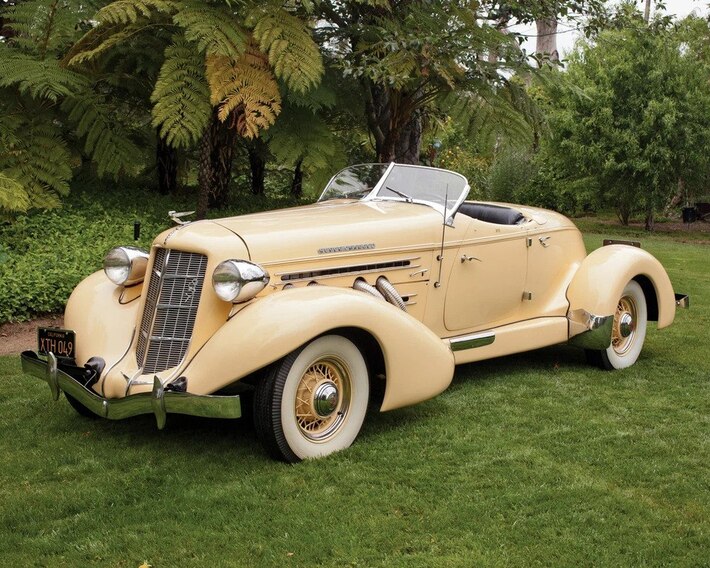
The Auburn Speedster is one of the most breathtaking automobiles of the Art Deco era — a supercharged, boattail American sports car guaranteed by the factory to exceed 100 mph, with the test driver's signature in the glovebox to prove it.
Overview
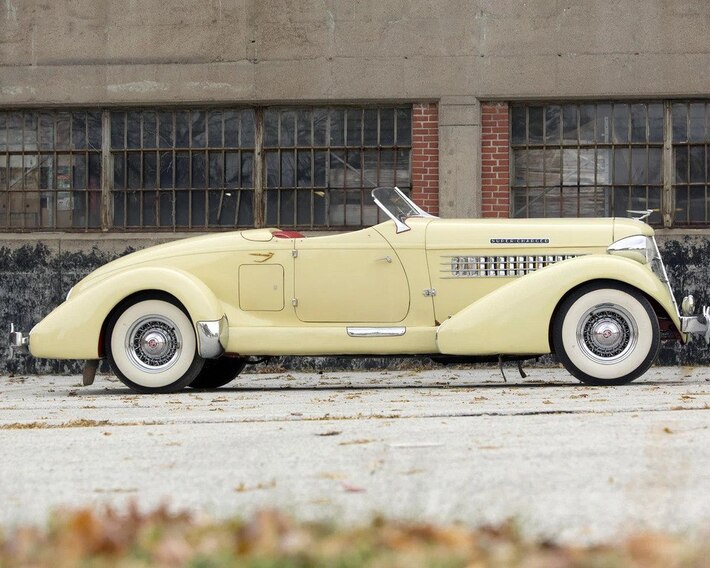
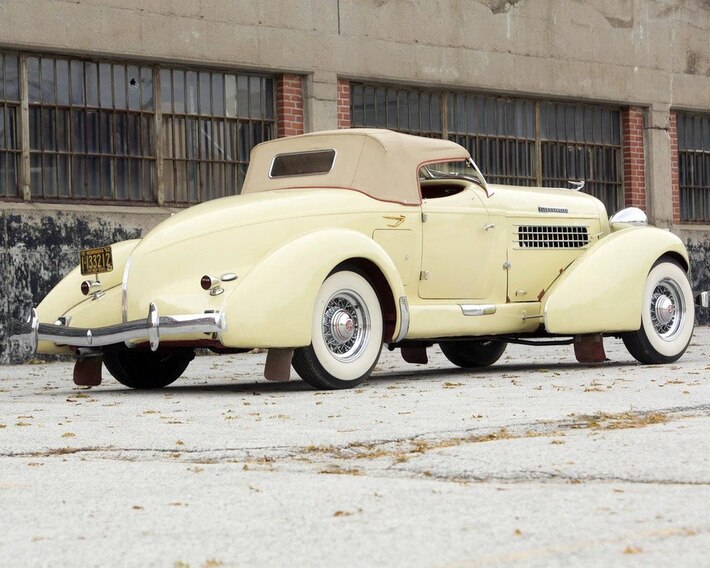
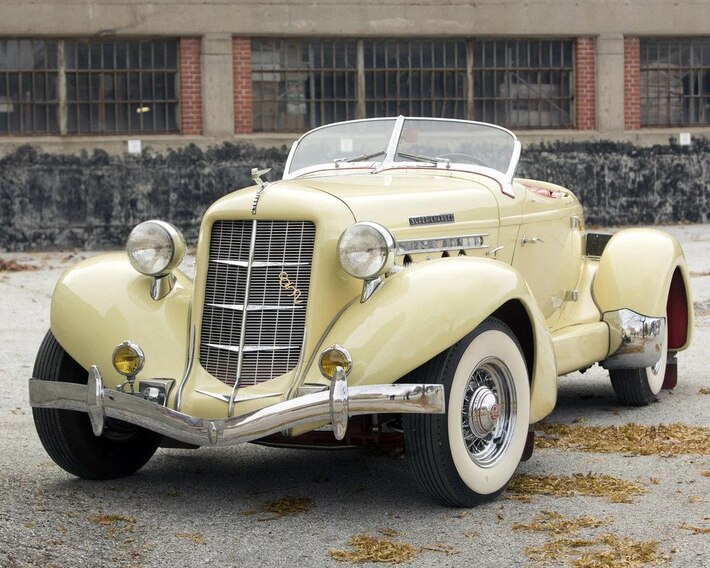
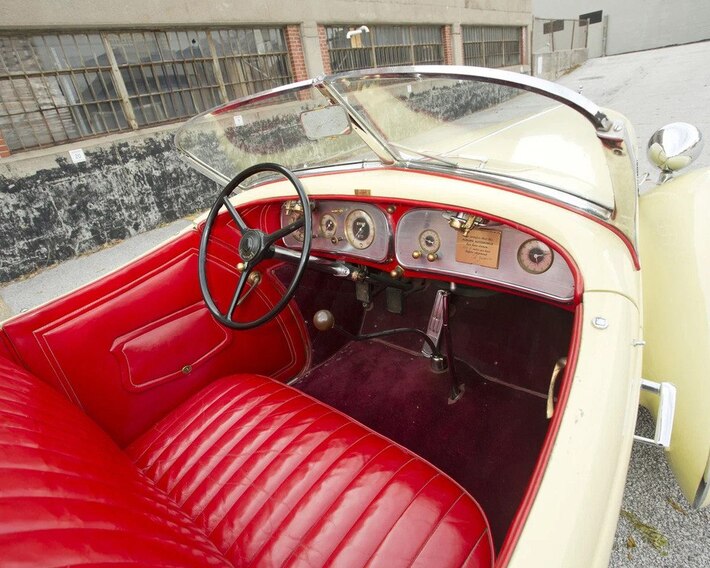
The Auburn Speedster was produced by the Auburn Automobile Company of Auburn, Indiana from the late 1920s until the brand's collapse in 1937. It reached its definitive form in 1935 with the Model 851 — a supercharged boattail roadster styled by Gordon Buehrig that became one of the most admired American automobiles of the pre-war era. The 851 was powered by a 4.6-litre Lycoming straight-eight engine fitted with a Schwitzer-Cummins centrifugal supercharger, producing approximately 150 hp — exceptional for a road car of 1935. External chrome exhaust pipes ran along the bonnet sides, and the sweeping Art Deco body with its distinctive boattail rear and pontoon fenders created a visual statement that no contemporary American car could match.
The factory made an extraordinary promise: every Auburn 851 Speedster was test-driven at Indianapolis Speedway at a certified speed of over 100 mph before delivery, and a signed card from the test driver — often legendary racing driver Wade Morton — was placed in the glovebox as proof. This guarantee, at a time when genuine 100 mph road cars were exceptionally rare, was both a marketing masterstroke and a testament to the car's engineering. The Speedster was priced at approximately $2,245 in 1935 — making it one of the most affordable 100 mph cars ever offered to the American public.
Auburn Automobile Company was controlled by industrialist Errett Lobban Cord, whose empire also included the Cord and Duesenberg marques. When the E.L. Cord organisation collapsed financially in 1937, all three brands ceased production simultaneously. Today, the original Auburn factory in Indiana houses the Auburn Cord Duesenberg Automobile Museum — a National Historic Landmark preserving some of the finest examples of pre-war American automotive design. For collectors in Azerbaijan, an authentic Auburn Speedster would represent one of the rarest and most significant classic American automobiles in the Caucasus region.
Gallery

Key Specifications (Auburn 851 Speedster, 1935)
| Production Years | 1935 (851); 1936 (852); Speedster variants from 1928 |
|---|---|
| Body Style | 2-seat boattail roadster (open sports car) |
| Engine | 4.6-litre Lycoming straight-eight with Schwitzer-Cummins supercharger |
| Power | approximately 150 hp |
| Torque | approximately 325 Nm (estimated) |
| 0–60 mph | approximately 8–10 seconds (period contemporary reports) |
| Guaranteed top speed | over 100 mph (160 km/h) — factory tested at Indianapolis |
| Drivetrain | Rear-wheel drive |
| Gearbox | 3-speed manual with Columbia two-speed rear axle |
| Chassis | Separate steel ladder frame |
| Suspension | Beam front axle with transverse leaf spring; live rear axle |
| Brakes | Hydraulic drum brakes all round |
| Designer | Gordon M. Buehrig |
| Original price (1935) | $2,245 USD |
Variant Comparison
| Variant | Engine | Power | Drive | Best For |
|---|---|---|---|---|
| Auburn 8-98A Speedster (1931) | Lycoming straight-eight, 4.6L | 98 hp | Rear-wheel drive | Early supercharged-era styling — pre-Cord era Auburn performance |
| Auburn 851 Speedster (1935) | Lycoming straight-eight supercharged, 4.6L | ~150 hp | Rear-wheel drive | The definitive Auburn — guaranteed 100 mph, factory-signed card |
| Auburn 852 Speedster (1936) | Lycoming straight-eight supercharged, 4.6L | ~150 hp | Rear-wheel drive | Final-year Auburn — essentially identical to 851, minor updates |
What Makes the Auburn Speedster Stand Out
Gordon Buehrig's Masterwork
The 851 Speedster is universally recognised as one of the finest automotive design achievements of the Art Deco period. Buehrig's combination of the boattail rear, sweeping pontoon fenders, exposed chrome exhaust pipes, and long bonnet line created a car whose proportions and detail remain astonishingly beautiful nearly ninety years after it was drawn.
The Factory Speed Guarantee
No other production car manufacturer in history has provided a signed personal guarantee from the test driver confirming that your specific car exceeded 100 mph before delivery. This combination of marketing brilliance and engineering commitment to performance makes the 851 Speedster unique in automotive history.
Supercharger at a Mass-Market Price
In 1935, supercharging was the preserve of exotic European racing machinery and extraordinarily expensive American luxury cars. Auburn offered a supercharged 150 hp automobile at $2,245 — accessible to a far wider market than a Duesenberg or a Packard Twelve, yet with performance that embarrassed cars costing twice as much.
E.L. Cord's Automotive Empire
Auburn sat within Errett Lobban Cord's remarkable automotive enterprise that also included Cord and Duesenberg — three of the most admired American car brands of the pre-war period, each distinctly positioned from the others. The Speedster represents the sporting heart of this exceptional industrial ambition.
Art Deco Automotive Landmark
The Auburn 851 Speedster is a permanent fixture in major automotive museum collections worldwide — from the Smithsonian to the Petersen Automotive Museum — and has appeared on more covers of classic car publications than almost any other American pre-war automobile. Its cultural recognition transcends the collector car community.
Maintenance & Repairability in Azerbaijan
Maintaining an authentic Auburn Speedster in Azerbaijan is a proposition that requires both significant financial resources and access to a global network of pre-war American automotive specialists. These are not vehicles that any local workshop can service — they require deep knowledge of 1930s American automotive engineering and access to specialists with direct experience of Lycoming straight-eight engines and period mechanical systems.
The Lycoming straight-eight engine is a relatively straightforward side-valve (flathead) unit by the standards of its era. Experienced pre-war specialists in the United States, United Kingdom, and Germany are able to overhaul and rebuild these engines, and an active community of Auburn enthusiasts maintains knowledge and parts supply for these powertrains. The supercharger is a Schwitzer-Cummins centrifugal unit — less common than the Roots-type superchargers of the period — but specialised rebuilders exist in the American classic car community.
Parts must be sourced almost exclusively from the United States. The Auburn-Cord-Duesenberg Club (ACD Club) and associated specialists maintain a catalogue of reproduction parts, NOS (new old stock) items, and sourced original components. For an Azerbaijani owner, establishing a relationship with a trusted US-based specialist is essential before any serious maintenance or restoration work is attempted. Shipping times of two to six weeks for major components should be expected. The vehicle should not be driven extensively before a comprehensive mechanical assessment has been completed by someone with genuine pre-war American car experience.
The cost of maintaining an authentic Auburn Speedster in running and preserved condition is substantial. Annual costs for storage, insurance, and periodic specialist attention will dwarf fuel costs. The reward, however, is ownership of one of the most admired automobiles in the history of the craft.
Competitor Comparison
| Model | Strength vs. Auburn Speedster | Compromise vs. Auburn Speedster |
|---|---|---|
| Cord L-29 | Front-wheel drive — technically revolutionary for its era, coffin-nose styling | Mechanically more complex, fewer surviving examples, Cord L-29 drivetrain issues notorious |
| Duesenberg Model J | The ultimate American pre-war automobile — far more powerful, more prestigious, custom coachwork | Cost was ten times an Auburn Speedster — beyond almost any buyer's reach even at the time |
| Stutz Bearcat | Legendary American performance car heritage, strong motorsport record | Earlier era than the 851 — less sophisticated body design, harder to find well-preserved examples |
| Packard Super Eight | More powerful engine options, superior build quality, stronger long-term reliability, prestige brand | More conservative styling, aimed at luxury rather than sporting character |
Cost-of-Ownership Calculator
Estimate your annual running costs for an Auburn Speedster in Azerbaijan. Note: this calculator reflects ownership costs for a carefully maintained collector car driven only on special occasions. Annual mileage is typically very low — 1,000–3,000 km per year for most collector car owners.
Used Buying Checklist
- Authenticity verification — The Auburn 851/852 Speedster has been extensively reproduced. Verify chassis number, body stampings, and engine number against Auburn factory records. Engage the Auburn-Cord-Duesenberg Club (ACD Club) for research assistance before any purchase.
- Factory signed card provenance — If the vehicle claims to have its original glovebox card, verify its authenticity with ACD Club experts. Original cards dramatically increase a car's collector value and historical significance.
- Lycoming straight-eight condition — A cold start test with oil pressure verification is essential. Listen for main bearing rumble, piston slap, and valve train noise. A compression test across all eight cylinders should be conducted before any purchase commitment.
- Supercharger function — With the engine running, verify the supercharger engages correctly and produces expected boost. Supercharger drive belt and coupling condition should be inspected visually.
- Body and paint originality — Assess whether the body is original or a replacement/restoration. Original bodies carry significant premium. Check for evidence of accident damage repair, rust treatment, or panel replacement.
- Interior authenticity — Original upholstery, instruments, and trim contribute enormously to collector value. Assess any restoration work critically — incorrect materials or colours reduce concours eligibility.
- Documentation and history file — Request the complete ownership history, restoration invoices, and any show results or concours certificates. A well-documented Auburn commands significant premium over an undocumented example.
- Import and legal status — Verify the vehicle has correct export documentation from its country of origin and all import duties and registrations in Azerbaijan have been properly completed.
Frequently Asked Questions
Should You Buy the Auburn Speedster?
Reasons to Buy
- One of the most beautiful pre-war automobile bodies ever created — Gordon Buehrig's masterpiece
- The only production car in history with a signed factory guarantee of 100 mph in the glovebox
- Supercharged 150 hp Lycoming straight-eight — genuinely exciting pre-war performance
- Major international classic car collector appeal with strong global auction results
- Permanent museum-quality significance — featured in the world's finest automotive collections
- Active ACD Club provides owner community, technical support, and marque research
- Long-term value appreciation in the classic car market as a recognised icon
Reasons to Consider Alternatives
- Acquisition cost is extremely high — significant collector car investment required
- All specialist parts and expertise must be sourced from the United States
- No local workshop in Azerbaijan can be expected to service these cars
- Reproduction examples exist — rigorous authenticity verification essential
- Climate-controlled secure storage essential — not a daily or occasional-use car
- Annual maintenance costs are substantial even for limited-use collector cars
Verdict: The Auburn 851 Speedster is not a car you buy for transportation — it is a car you acquire as the custodian of one of the finest expressions of American automotive artistry ever created. In Baku, an authentic Auburn Speedster would be without doubt the most remarkable pre-war American automobile in the Caucasus region. For the serious collector with the resources to acquire, properly store, and maintain it through the right specialist network, the Auburn Speedster offers ownership of an automotive masterpiece that belongs in the same conversation as the finest pre-war European collector cars. Nothing about this ownership proposition is practical — and everything about it is extraordinary.
BakuWheels uses cookies to improve your experience, analyse site traffic, and personalise content. By clicking Accept All, you consent to our use of cookies. Learn more in our Cookie Policy.