

Studebaker
Studebaker Corporation was one of America's most storied independent automakers, producing vehicles from 1902 until 1966. Founded in 1852 as a wagon manufacturer, Studebaker became synonymous with forward-thinking design under the influence of industrial designer Raymond Loewy, producing some of the most distinctive American automobiles of the mid-20th century.
Origins & Heritage
Studebaker was established in 1852 in South Bend, Indiana, by the Studebaker brothers as a manufacturer of wagons and carriages. At its peak, Studebaker was one of the largest vehicle manufacturers in the world — supplying wagons to the Union Army during the Civil War, to homesteaders crossing the Great Plains, and eventually to the United States government during both World Wars. The transition from horse-drawn vehicles to automobiles came in 1902, when Studebaker produced its first electric car, followed by petrol-powered models in 1904.
The postwar years brought Studebaker its finest design moment. In 1947, Studebaker became the first American manufacturer to introduce a completely new postwar design — the distinctive 'coming or going' Champion and Commander models, whose symmetrical front-rear styling prompted debate about which direction they were travelling. Industrial designer Raymond Loewy became deeply associated with Studebaker, and his influence culminated in the spectacular 1953 Studebaker Starliner coupe — widely considered one of the most beautiful American cars ever produced.
Despite producing remarkable vehicles — including the 1962 Avanti sports coupe, a design so timeless it remained in production under different ownership until 2006 — Studebaker could not compete on cost with the Big Three Detroit manufacturers. The South Bend factory closed in 1963, production moved briefly to Hamilton, Ontario, and the last Studebaker rolled off the line in March 1966. The name remains one of the most evocative in American automotive history — a reminder that independent manufacturers could produce vehicles of genuine artistry and innovation.
Key Milestones
Iconic Models in Pictures
The Studebaker story is told through some of America's most striking designs — from Raymond Loewy's 1953 Starliner to the immortal Avanti coupe, a car so distinctive it outlived the company that created it.
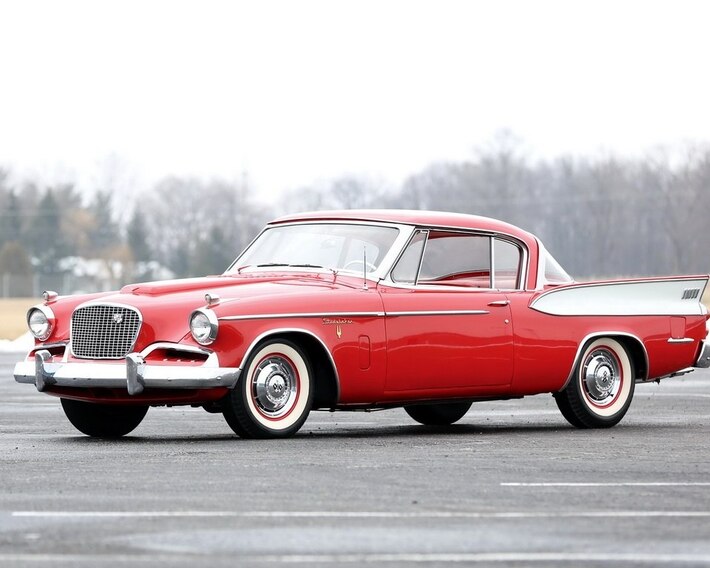
Model Lineup
Studebaker's model range spanned affordable economy cars, mid-range family sedans, and distinctive sports coupes — with a consistent emphasis on forward-looking design that set it apart from mainstream Detroit manufacturers.
Engineering & Technology
Studebaker was consistently at the front of American engineering innovation — producing the first American postwar car design, the first American fibreglass sports coupe with a production supercharged engine, and setting land speed records that demonstrated genuine performance credentials alongside its design leadership.
- 1947 Champion — first completely new American postwar design; semi-fastback body that anticipated European styling trends by several years
- 1953 Starliner coupe — Raymond Loewy design that influenced American and European sports coupe design for a generation
- Avanti (1962) — fibreglass body for weight saving; 289 cu in supercharged V8 producing 289 hp; set 29 speed records at Bonneville in 1962
- Champion economy engineering — consistently achieved the best fuel consumption figures of any comparable American production car throughout the late 1940s and 1950s
- Automatic transmission adoption — Studebaker was an early adopter of automatic transmissions in the late 1940s, recognising their importance to customer appeal ahead of many competitors
Studebaker in Azerbaijan
Studebaker vehicles are rare but not unknown in Azerbaijan — classic American automobiles have been collected and cherished by Azerbaijani enthusiasts since the Soviet era, when American cars represented a powerful symbol of Western prosperity and design freedom. A Studebaker Avanti or Champion surviving in Azerbaijan would be an extraordinary find — as rare as any equivalent classic car from this era.
For Azerbaijani collectors of classic automobiles, Studebaker represents one of the finest chapters in American automotive history — a company that competed with the Big Three not on volume, but on design distinction and engineering innovation. Any surviving Studebaker in Azerbaijan deserves expert care; American-specification classic cars require specialist sourcing for parts, but the Avanti's fibre glass body is far more tolerant of Azerbaijan's climate than equivalent steel-bodied classics from the same era.
Why Consider a Studebaker?
- American design history at its finest: The Studebaker Avanti and Starliner represent American automotive design at its most ambitious — cars that were genuinely ahead of their time and are still appreciated today as masterworks of industrial design.
- Raymond Loewy legacy: The association with Raymond Loewy — the designer who shaped the look of 20th-century America — gives Studebaker a cultural significance that transcends mere collector interest.
- Independent spirit: Studebaker's story as an independent manufacturer fighting against the Big Three resonates with anyone who values individuality over conformity — the brand's vehicles were never generic.
- Avanti immortality: The Avanti's design was so timeless that it remained in independent production for 44 years after Studebaker's closure — a rare distinction that confirms the quality of its original conception.
- Investment potential: Well-preserved Studebaker Avanti and Hawk models are increasingly recognised by international collectors as genuinely significant American classics — values have risen consistently as the post-war generation of collectors has matured.
BakuWheels uses cookies to improve your experience, analyse site traffic, and personalise content. By clicking Accept All, you consent to our use of cookies. Learn more in our Cookie Policy.