

Caterham Cars
The purest driving machine on four wheels — Caterham has perfected the Lotus Seven formula for over 50 years.
Origins & Heritage
Caterham Cars traces its origins directly to the Lotus Seven, a minimalist sports car designed by Colin Chapman and introduced by Lotus Cars in 1957. The Lotus Seven was built on a philosophy of extreme lightness — eliminating everything unnecessary and focusing every engineering decision on the driving experience. When Lotus discontinued the Seven in 1973 to focus on higher-margin products, Graham Nearn of Caterham Cars in Surrey acquired the manufacturing rights and continued production.
Under Caterham's stewardship, the Seven design has been progressively refined over five decades without ever deviating from its essential character. The car remains extremely light — the entry-level Seven 170 weighs just 440 kg — extraordinarily agile, and completely uncompromising in its focus on driver engagement. Caterham has resisted every temptation to add weight, complexity, or comfort features that would dilute the car's fundamental purity.
Today, Caterham sells the Seven in a wide range of configurations, from the entry-level 170 with a turbocharged three-cylinder engine to the 620R — a 310 hp, supercharged variant capable of 0–100 km/h in under 2.8 seconds. The cars are available in factory-built form or as self-assembly kits, the latter qualifying for reduced UK vehicle tax. Caterham also operates a successful motorsport programme, with the Caterham Motorsport academy providing single-make racing across Europe.
Key Milestones
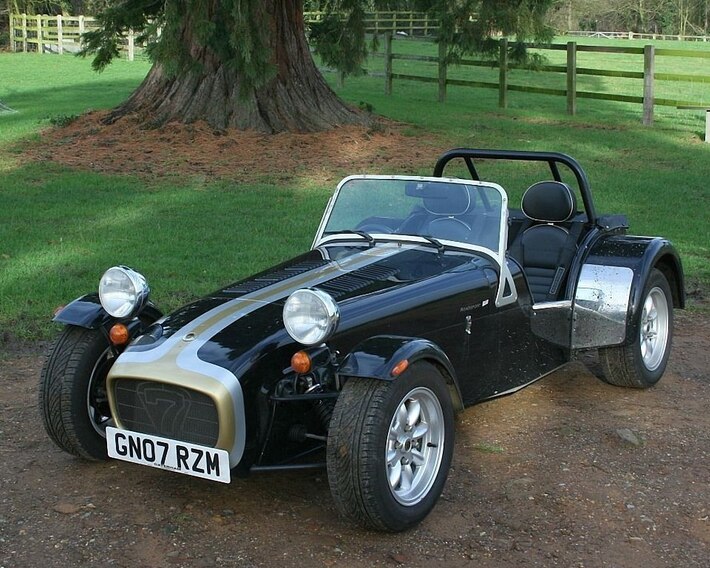
Caterham Seven in Images
The Caterham Seven's appearance has remained almost unchanged for over 60 years — a testament to the timeless rightness of Colin Chapman's original design.
Current Model Range
Caterham's range spans from approachable entry-level variants to extreme track-day weapons, all sharing the Seven's essential character.
Technology & Engineering
Caterham's engineering philosophy is defined by the relentless elimination of unnecessary weight. The Seven's space frame chassis, aluminium body panels, and complete absence of electronic driver aids create a vehicle that communicates every nuance of road and chassis behaviour directly to the driver.
- Welded steel space frame chassis — hand-fabricated and hand-assembled, providing exceptional torsional rigidity at minimal weight
- Aluminium body panels — lightweight, hand-formed, and easily replaceable — contributing to the Seven's sub-500 kg kerb weight
- Double wishbone suspension at all four corners — fully adjustable geometry allowing precise setup for road or track use
- Ford Duratec or Rover K-series engines (base models) and supercharged Cosworth or Ford Sigma (performance models) — proven, tuneable units with excellent power-to-weight potential
Caterham in Azerbaijan
Caterham vehicles are extremely rare in Azerbaijan — the brand is a niche product even in its home market of the United Kingdom, and export volumes to emerging markets are minimal. The few examples that have reached the region have done so through private import channels, typically owned by driving enthusiasts with international automotive exposure.
For Azerbaijan's growing community of track day and motorsport enthusiasts, the Caterham Seven represents an aspirational product — the most direct expression of the driver-focused philosophy that makes circuit driving rewarding. The car's light weight and pure mechanical feedback make it unlike any mass-market vehicle.
Why Choose Caterham?
- Unmatched driver engagement: No other road-legal vehicle provides as direct and unfiltered a connection between driver, car, and road as the Caterham Seven — a characteristic that has remained constant across 60 years of production.
- Extraordinary performance: The Seven 620R reaches 100 km/h in under 3 seconds — faster than many dedicated supercars — thanks to a combination of modest power and extreme lightness.
- Motorsport heritage: The Caterham Seven is one of the most widely raced cars in British motorsport, with a dedicated single-make race series that makes circuit competition accessible to drivers at all levels.
- Timeless design: The Caterham Seven has looked essentially the same for over 60 years — a car so well conceived that it has never needed reinvention, only refinement.
BakuWheels uses cookies to improve your experience, analyse site traffic, and personalise content. By clicking Accept All, you consent to our use of cookies. Learn more in our Cookie Policy.