

Steyr
Steyr is one of Austria's oldest and most distinguished vehicle manufacturers, with a heritage stretching from 19th-century arms manufacturing to iconic off-road vehicles. Under the Steyr-Daimler-Puch conglomerate, Steyr produced some of the most capable all-terrain vehicles ever built, including the legendary Pinzgauer and Haflinger.
Origins & Heritage
The Steyr story begins in 1864 when Josef Werndl founded the Österreichische Waffenfabriksgesellschaft (Austrian Arms Manufacturing Company) in Steyr, Upper Austria. The company produced rifles and weaponry, becoming one of Europe's most significant arms manufacturers. After World War I, with arms production restricted, the company diversified into automobile manufacturing, producing its first cars in the 1920s under the Steyr name.
The defining chapter of Steyr's vehicle heritage came through the Steyr-Daimler-Puch conglomerate, which merged Steyr's manufacturing base with Daimler's engineering heritage and Puch's motorcycle expertise. Under this umbrella, Steyr-Puch produced two iconic vehicles that earned global recognition: the Haflinger (1959), a lightweight 4×4 utility vehicle named after the Austrian mountain pony, and the Pinzgauer (1971), a high-mobility military and expedition vehicle that became the definitive all-terrain Austrian utility vehicle.
The Pinzgauer entered military service across dozens of nations and was used by armed forces on every continent. Its portal axle design — which places the wheel hub well below the axle centre — gave it extraordinary ground clearance without requiring an excessively high centre of gravity. The Pinzgauer's durability was legendary: examples from the 1970s remain in active service today. The Steyr-Daimler-Puch conglomerate was eventually broken up in the 1990s, with different divisions sold to various buyers, but the Steyr name and its engineering legacy endure.
Key Milestones
Iconic Models in Pictures
The Steyr legacy is defined by two extraordinary all-terrain vehicles — the compact Haflinger and the legendary Pinzgauer — both of which set standards for off-road capability that influenced military and expedition vehicle design worldwide.
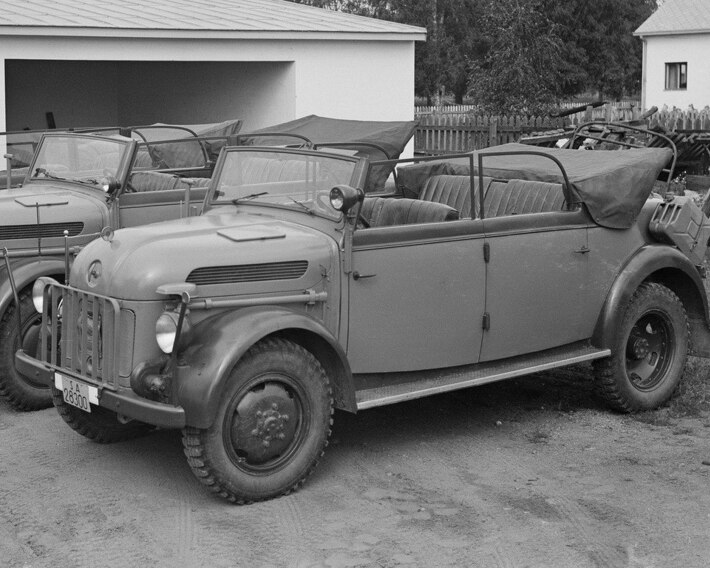
Model Lineup
Steyr's passenger and utility vehicle range, produced under the Steyr-Daimler-Puch banner, spanned classic pre-war cars, lightweight Alpine utility vehicles, and world-class military all-terrain transports.
Engineering & Technology
Steyr's engineering reputation rests primarily on the portal axle technology used in the Pinzgauer. A portal axle positions the wheel hub substantially below the axle centre line, achieved through a reduction gearbox at each wheel. This provides exceptional ground clearance without raising the vehicle's centre of gravity — giving the Pinzgauer the ability to traverse terrain that defeated conventional high-clearance vehicles while remaining stable on inclines.
- Portal axle technology — wheel hub positioned below axle centreline through reduction gearboxes; exceptional ground clearance without compromising stability
- Pinzgauer 4×4 and 6×6 configurations — two-axle and three-axle variants for different payload and terrain requirements
- Haflinger swing axle system — fully independent suspension with swing-axle rear setup; minimal unsprung weight for alpine agility
- Air-cooled flat-twin engines — reliable, simple powertrain requiring minimal maintenance; ideal for remote-operation military and expedition use
- Steel tube ladder frame — the Pinzgauer's structural backbone; exceptionally rigid and repairable in the field using basic tools
Steyr in Azerbaijan
Steyr vehicles — particularly the Pinzgauer — have a presence in Azerbaijan through military and government fleet use. Several former Soviet-bloc nations operated Pinzgauers, and examples have reached the Caucasus region through surplus military and government disposals. For Azerbaijani collectors of military and off-road vehicles, a Pinzgauer represents one of the finest examples of Cold War–era European all-terrain engineering.
The rugged terrain of Azerbaijan — from the Caucasus mountain roads to the semi-arid lowlands — makes Steyr-type portal-axle vehicles particularly well-suited. Any surviving Steyr or Steyr-Puch vehicle in Azerbaijan is both a practical off-road tool and a piece of Austrian industrial history; maintenance is straightforward for any competent mechanic, as both the Haflinger and Pinzgauer were designed for in-field servicing with minimal specialist equipment.
Why Consider Steyr?
- Austrian engineering excellence: The Steyr-Puch Pinzgauer represents the pinnacle of Austrian vehicle engineering — a purpose-built all-terrain vehicle that has served armies and expeditions on every continent.
- Portal axle technology: The Pinzgauer's portal axle design provides ground clearance exceeding that of most purpose-built off-road vehicles, including Land Rover Defenders and Mercedes G-Class, without raising the centre of gravity.
- Military durability: Designed for armed forces use, Steyr-Puch vehicles are built to withstand conditions that would destroy civilian off-road vehicles — 1970s Pinzgauers remain in active service in militaries worldwide.
- Alpine heritage: Designed in Austria for Alpine conditions, Steyr-Puch vehicles are supremely capable in steep, narrow mountain terrain — a relevant quality for any owner operating in mountainous regions.
- Collector and investment value: Original Steyr-Puch vehicles in good condition — especially Haflinger and early Pinzgauer examples — are increasingly sought after by specialist off-road collectors as genuine automotive icons.
BakuWheels uses cookies to improve your experience, analyse site traffic, and personalise content. By clicking Accept All, you consent to our use of cookies. Learn more in our Cookie Policy.