

Willys
Willys-Overland Motors is the American manufacturer whose wartime production of the MB Jeep created one of the most influential vehicle designs in automotive history. Founded in 1908 and based in Toledo, Ohio, the company survived repeated financial difficulties to win the US Army's 1940 competition for a lightweight reconnaissance vehicle — a contract that produced the iconic WWII Jeep and established the template for every light utility 4x4 that followed. Willys-Overland's civilian Jeep models, launched after the war, became the ancestor of an entire global vehicle category.
Origins & Heritage
Willys-Overland was established in 1908 when John North Willys acquired the ailing Overland Automobile Company in Toledo, Ohio, and reorganised it as a serious mass-market car manufacturer. Under Willys's aggressive leadership the company grew rapidly to become the second-largest American car manufacturer by 1912, behind only Ford, producing affordable vehicles that competed directly with the early Model T. The company's history was marked by repeated financial crises, two bankruptcy reorganisations, and a persistent capacity to recover — each time emerging with a cleaner balance sheet and renewed production capability.
The decisive moment in Willys-Overland's history came in 1940 when the United States Army issued its requirements for a quarter-ton 4x4 reconnaissance vehicle — a contract that would define military light vehicles for generations. Bantam Car Company and Ford also submitted designs, but Willys-Overland's proposal — engineered to meet the Army's stringent weight and performance requirements while incorporating the powerful "Go-Devil" four-cylinder engine — was selected for full production. The MB Jeep entered production in 1941 and over 350,000 were built during the Second World War.
After the war, Willys-Overland made the prescient decision to sell a civilian version of the Jeep — the CJ-2A, launched in 1945 — creating a new category of peacetime off-road utility vehicle. The Jeep became the foundation of the company's post-war business, supplemented by the innovative Jeep Station Wagon (1946), which is recognised as a pioneering ancestor of the modern SUV. Willys-Overland was acquired by Kaiser Motors in 1953, ending the independent Willys name, though the Jeep brand continued through subsequent owners to the present day.
Key Milestones
Willys in Pictures
From the wartime MB that equipped Allied armies to the post-war civilian CJ that created the recreational 4x4 category, Willys vehicles represent the founding chapter of off-road motoring history.
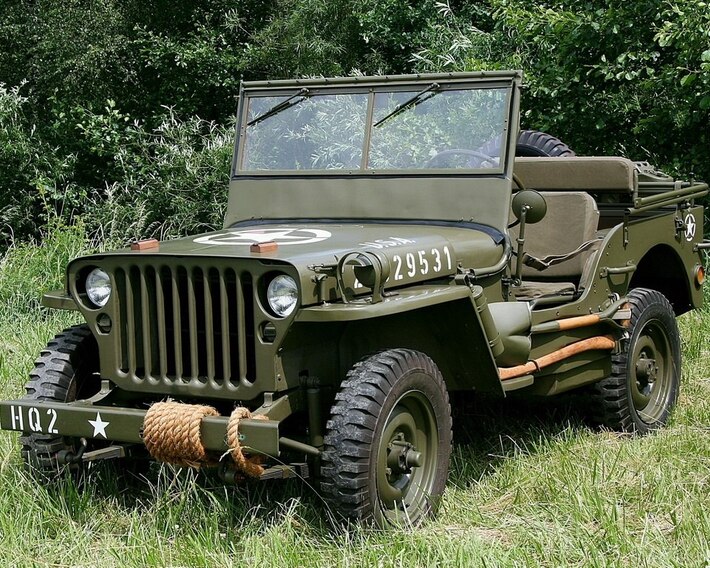
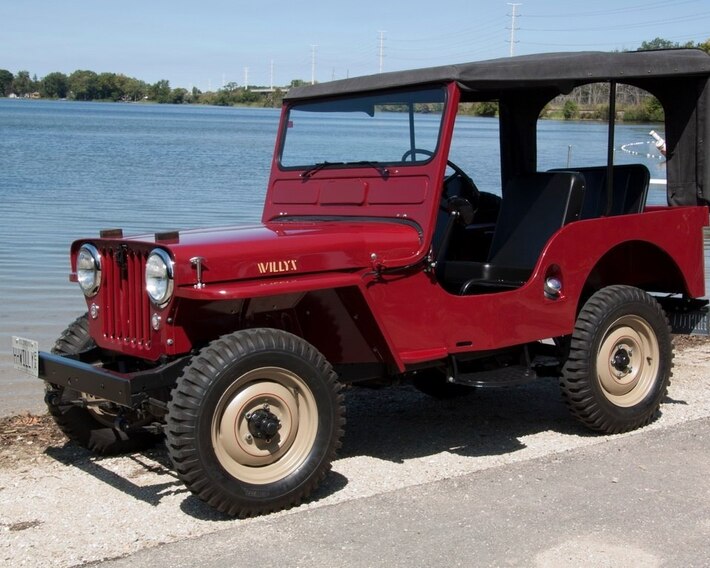
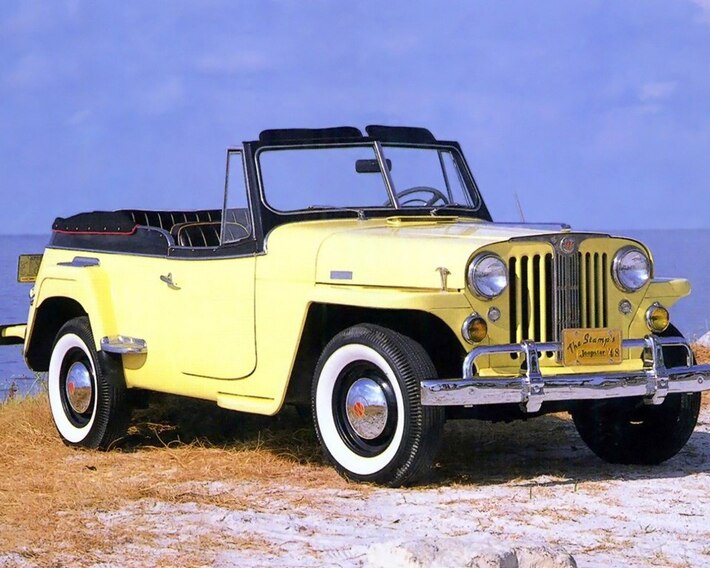
Historic Models
Willys-Overland's vehicle range was defined by military necessity and civilian adaptation — the Jeep in its various forms representing one of the most influential product families in automotive history.
Engineering Heritage
The Willys MB's engineering genius lies in its elegant simplicity — a vehicle designed to meet extreme military performance requirements (25 mph minimum speed, 600 lb payload, 600 lb vehicle weight) within the constraints of wartime material supply and mass production. The "Go-Devil" four-cylinder engine provided reliable torque at low speeds without the complexity of larger engines, while the transfer case and solid axles delivered straightforward 4x4 traction that could be maintained in the field by minimally trained mechanics. This philosophy of rugged simplicity influenced the engineering approach of every serious off-road vehicle that followed.
- The "Go-Devil" 2.2L four-cylinder side-valve engine — a low-revving, torque-oriented unit that prioritised reliability and field repairability over power output, producing adequate performance from a mechanically simple design
- Part-time four-wheel drive via a two-speed transfer case — simple, robust, and repairable in the field without specialist tools, establishing the 4x4 architecture that became standard in all subsequent off-road vehicles
- Solid front and rear axles with semi-elliptic leaf springs — a deliberately conservative suspension design chosen for durability, payload capacity, and ease of field repair over sophisticated handling characteristics
- Flat-panel body construction from pressed steel — designed for ease of manufacturing, simple repair, and the ability to accommodate a wide range of military equipment configurations and body variants
- Dana axle assemblies — heavy-duty, American-made axle units that became the benchmark for off-road vehicle durability, with a parts supply network that still supports original Willys vehicles today
Willys in Azerbaijan
Willys Jeeps reached the Caucasus region during and after the Second World War through Allied supply channels and Soviet acquisition of captured and lend-lease vehicles. Original Willys MB and CJ-series Jeeps exist in Azerbaijan as collector and heritage vehicles, prized for their historical significance and the authenticity of their mechanical simplicity. The Willys Jeep has deep connections to the post-war development of Soviet and Eastern European off-road vehicle categories, with the GAZ-67 and UAZ designs drawing heavily on Jeep concepts.
In the contemporary Azerbaijani market, original Willys vehicles are rare collector items rather than everyday transportation — sought by enthusiasts who value automotive history and the mechanical accessibility of simple, pre-electronic vehicles. BakuWheels occasionally lists vintage Willys Jeeps through its classic and specialist vehicle channels. Buyers should verify originality, structural integrity, and the availability of replacement parts — which, for original Willys vehicles, can be sourced from specialist suppliers in the USA and Europe.
Why a Willys Jeep?
- Automotive history in its purest form: The Willys MB is not merely a classic car — it is the vehicle that defined the entire 4x4 category and changed military logistics permanently. Ownership connects directly to the pivotal history of the Second World War.
- Mechanical simplicity and accessibility: Willys engines and drivetrain components are among the most accessible ever installed in a four-wheeled vehicle — rebuilding from scratch is achievable by any competent mechanic with basic tooling and the workshop manual.
- Global parts availability: Despite their age, Willys Jeep components are manufactured by multiple specialist suppliers worldwide. An active international community ensures that virtually every mechanical part can be sourced as either original-specification or improved aftermarket.
- Genuine off-road capability: Despite their age and simplicity, original Willys Jeeps remain genuinely capable off-road vehicles — their solid axles, locking differentials, and low-range gearing delivering performance that many modern SUVs with sophisticated electronics cannot match on the same terrain.
- Investment-grade collector value: Well-maintained, original-specification Willys MB and early CJ examples command substantial and rising collector prices internationally. An authentic, documented Willys Jeep is both a usable vehicle and a tangible piece of history whose value is recognised globally.
BakuWheels uses cookies to improve your experience, analyse site traffic, and personalise content. By clicking Accept All, you consent to our use of cookies. Learn more in our Cookie Policy.