

Yema
Yema Auto (Sichuan Yema Automobile Company, whose name translates as "Wild Horse") is a Chinese vehicle manufacturer founded in 1986 in Chengdu, Sichuan Province. The company built its initial reputation on commercial vehicles before transitioning to passenger cars and SUVs during China's domestic automotive boom of the 2000s and 2010s. Yema is notable for its early and serious commitment to electric vehicle development, launching battery-electric models at a time when EV infrastructure in China was still underdeveloped, positioning the brand as a budget-segment pioneer in electrification.
Origins & Heritage
Yema Auto was established in 1986 in Chengdu, the capital of Sichuan Province in southwestern China, initially as a manufacturer of commercial vehicles and agricultural machinery. The company operated in a period when China's automotive industry was dominated by joint ventures between state enterprises and foreign manufacturers, leaving independent domestic brands to occupy the lower-volume, lower-specification segments of the market that foreign partners were less interested in.
During the 2000s, Yema transitioned its focus toward passenger cars and SUVs, targeting the rapidly expanding Chinese domestic market for affordable private transportation. The company launched a series of compact SUVs and minivans that competed primarily on price, offering entry-level buyers basic but functional vehicles at price points below established Chinese-foreign joint venture brands. The F-series SUVs became Yema's most recognisable products, particularly in Sichuan Province and surrounding southwestern China.
Yema made an early and notable commitment to electric vehicle development, introducing the E30 battery-electric city car and subsequently expanding its EV range. This early investment in EV technology, though it predated the current mainstream EV boom, positioned the company as a genuine participant in China's electrification transition. The brand remains primarily a domestic Chinese producer with limited international distribution, but its vehicles reach export markets through used car trade channels.
Key Milestones
Yema Models in Pictures
Yema's range centres on practical, value-oriented SUVs and an early commitment to electric vehicles — reflecting the brand's position as an accessible entry point into both the SUV and EV segments.
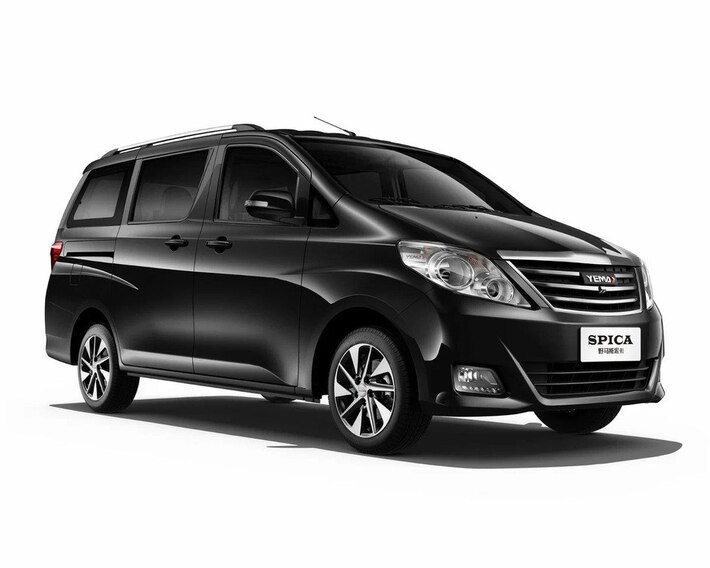
Model Lineup
Yema's product range spans conventional SUVs, minivans, and battery-electric vehicles, all positioned at entry-level and budget price points for the Chinese domestic market.
Technology & Engineering
Yema vehicles are engineered for the primary virtue of accessibility — offering basic but functional technology at price points that make vehicle ownership achievable for buyers at the lower end of China's income distribution. Conventional naturally aspirated and turbocharged petrol engines dominate the conventional range, while the EV models use lithium-iron-phosphate battery chemistry for durability and safety in the Chinese climate. Engineering choices consistently prioritise reliability and low maintenance cost over performance or premium features.
- Conventional 1.5L naturally aspirated and 1.5T turbocharged petrol four-cylinder engines emphasising durability and low running cost over maximum performance
- Lithium-iron-phosphate battery systems in EV models — a chemistry choice that prioritises cycle life, thermal stability, and safety over maximum energy density
- Manual and conventional automatic transmission options, kept simple to minimise repair costs in markets where transmission specialist services may be limited
- Basic active safety systems in higher-specification variants, including ABS, electronic stability control, and front airbags as standard in recent production models
- Touchscreen infotainment systems with basic connectivity in mid-specification models, meeting the minimum technology expectations of Chinese domestic market buyers
Yema in Azerbaijan
Yema vehicles reach the Azerbaijani market primarily through used car import channels from Russia and Georgia, where the brand has some presence from earlier years of Chinese vehicle imports. The F-series SUVs are the most likely Yema models to be encountered, offering buyers a basic but practical SUV at prices that undercut most Korean and European alternatives of similar age and mileage.
For Azerbaijani buyers considering a used Yema, the key factors are parts availability — which requires sourcing through specialist Chinese auto parts importers — and verifying the service history. Yema's conventional petrol engines are relatively simple mechanically, making repairs accessible to competent mechanics with Chinese vehicle experience. EV models require additional consideration regarding battery state of health, given the age of early units and the availability of replacement battery cells in Azerbaijan.
Why Consider a Yema?
- Lowest-cost SUV entry point: Yema vehicles offer the SUV body style, raised ride height, and practical interior at price points that significantly undercut any Korean or European competitor in the used market.
- Simple mechanical layout: Conventional naturally aspirated and turbocharged petrol engines with standard transmissions keep repair complexity low for mechanics familiar with Chinese vehicle technology.
- Early EV option: For buyers interested in electric mobility at minimal acquisition cost, Yema's E-series models offer battery-electric transportation at used prices that no other EV can approach.
- Practical SUV proportions: Despite budget positioning, Yema SUVs provide genuinely useful interior space, reasonable cargo capacity, and adequate ground clearance for Azerbaijan's mixed road surfaces.
- Minimal depreciation risk: Already priced at the lower end of the used market, Yema vehicles face limited further depreciation — a practical advantage for buyers prioritising total ownership cost over resale value.
BakuWheels uses cookies to improve your experience, analyse site traffic, and personalise content. By clicking Accept All, you consent to our use of cookies. Learn more in our Cookie Policy.