

Aixam 500 (1983–present)
The Aixam 500 is the defining product of France’s Aixam-Mega group — a light quadricycle (L7e category) that has been produced in various forms since 1983 and remains in production today as both a petrol/diesel and electric variant. Governed to a maximum speed of 45 km/h, the 500 weighs under 350 kg unladen, measures approximately 2.9 metres in length, and can be driven without a full driving licence in EU countries by persons aged 16 and over under the AM category. In Azerbaijan, the 500 is subject to standard vehicle registration and licensing requirements — the EU quadricycle exemptions do not apply — but it remains an interesting urban mobility option for buyers seeking an ultra-compact, low-cost city vehicle.
Overview
Aixam was founded in 1983 in Aix-les-Bains, France, as a specialist manufacturer of light quadricycles — vehicles that occupy a unique European regulatory niche below conventional passenger cars. The “500” designation has been applied broadly to the brand’s core hatchback microcar product across multiple generations, reflecting the 479–505 cc engine displacement of the original diesel powertrains. Aixam is consistently one of the top-selling quadricycle brands in France, Belgium, and the Netherlands, where the AM licence category makes microcars accessible to 16-year-olds, elderly drivers who have surrendered their full licence, and urban commuters who specifically want the smallest, most fuel-efficient vehicle that meets minimum road-legal standards.
The regulatory basis for the Aixam 500’s unique market position in Europe is the L7e category under EU Regulation 168/2013: a heavy quadricycle with an engine not exceeding 15 kW (or 13 kW net for electric), a maximum laden mass of 450 kg (excluding battery mass for EVs), and a maximum speed of 45 km/h. Vehicles meeting these criteria qualify for a simplified type approval process and, crucially for the European market, can be driven on public roads with only an AM (moped) category licence — no full car licence required. This exemption is the primary commercial reason for the entire French microcar segment’s existence.
In Azerbaijan, the L7e licence exemption does not apply. The Aixam 500 is treated as a conventional motor vehicle and requires standard vehicle registration, a full category B driving licence, and compliance with Azerbaijani technical inspection requirements. The 500’s unusual status — legally a quadricycle rather than a car — may create some administrative complexity at registration; buyers should verify the applicable classification with the State Traffic Police (Dövlət Yol Polis Xidməti) and a customs clearing agent before importing or purchasing a used Aixam 500 in Azerbaijan.
Setting aside the regulatory context, the Aixam 500 has genuine merits as an urban mobility tool in Baku. Its approximately 2.9-metre length makes it far easier to park than any conventional city car; it fits comfortably in spaces that are too short for a Fiat 500 or Volkswagen Polo. Its weight under 350 kg makes it highly manoeuvrable and agile at low speeds. The electric variant’s ~80 km urban range is sufficient for the vast majority of daily Baku commutes (the average car journey in Baku is under 25 km), and its 230 V domestic charging means no wallbox installation is required.
Aixam’s product has evolved substantially since 1983: modern 500-series cars feature LED lighting, digital instrument clusters on Premium and Connexion specifications, reversing cameras, Bluetooth audio, smartphone integration on higher trims, and body styling that is considerably more contemporary than the boxy first-generation cars. The electric e-Aixam variant uses a 6 kW motor and 6 kWh lithium-ion battery — modest by the standards of full EVs, but sufficient for the vehicle’s governed 45 km/h maximum speed and urban range requirements.
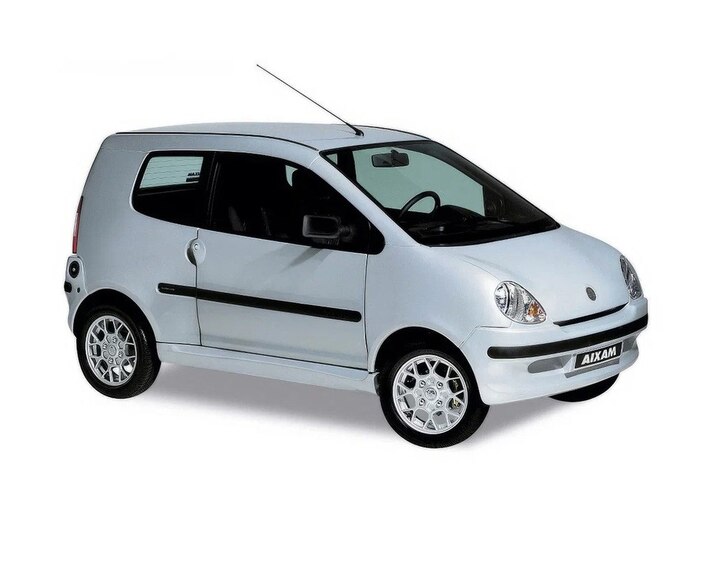
Aixam 500 in Pictures
Modern Aixam 500 variants are substantially more contemporary in appearance than their predecessors — rounded, smooth bodywork with LED lighting replaces the boxy shapes of the earlier generations, though the fundamental dimensions remain unchanged at approximately 2.9 metres in length.


Key Specifications
- Engine (diesel/petrol variants): Lombardini (Kohler) 479 cc 2-cylinder diesel engine on Classic and many Premium variants; approximately 5 kW (6.7 hp) continuous output; governed to 45 km/h. Fuel consumption approximately 3.5–4.0 L/100 km diesel; tank capacity approximately 20–25 litres. Some variants use a small-displacement petrol engine; diesel is the most common in France, Belgium, and the Netherlands.
- Motor (electric variant): 6 kW electric motor; 6 kWh lithium-ion battery pack; governed to 45 km/h; urban range approximately 70–90 km depending on load, temperature, and driving style. Charges from a standard 230 V/10 A domestic socket in approximately 4–5 hours. No CCS, CHAdeMO, or Type 2 AC charging — domestic socket only (the low battery capacity makes faster charging unnecessary). Maximum continuous power 6 kW (EU L7e limit).
- Top speed: 45 km/h (all variants, electronically or mechanically governed). This is not a performance limitation of the powertrain — it is a legal requirement of the L7e quadricycle category. Under EU rules, L7e vehicles must not exceed 45 km/h. Removing or circumventing the speed limiter constitutes a category reclassification and voids the vehicle’s type approval. In Azerbaijan, the 45 km/h limit has practical implications: the Aixam 500 cannot legally or safely be used on motorways or fast urban roads.
- Dimensions: Length approximately 2,880–2,950 mm depending on generation; width approximately 1,380–1,400 mm; height approximately 1,400–1,420 mm. Weight under 350 kg unladen (a maximum 350 kg is specified by the L7e category for non-electric variants; electric variants are permitted up to 450 kg excluding battery mass). Two seats only; no rear passenger capacity.
- Cargo: A small boot is available behind the two seats; practical capacity is modest. The 500 is primarily a two-person urban commuter vehicle, not a family or load-carrying car. Shopping bags, a briefcase, and light luggage are the practical cargo capacity.
- Safety: The Aixam 500 is not subject to Euro NCAP crash testing (L7e category vehicles are exempt). It has a steel body and a basic structure, but the safety standard is materially below that of a conventional passenger car. Airbags are not standard; some Premium and Connexion variants offer a driver airbag as an option in certain markets. ABS is not available. In a collision with a conventional car, occupant protection is significantly less than in a full-sized vehicle.
- Licence requirement (EU): AM category licence (moped licence), obtainable from age 14 in some EU countries and from age 16 universally; no full car licence (category B) required. This is the primary reason for the Aixam’s commercial success in France, Belgium, and the Netherlands. Elderly drivers who have voluntarily surrendered their category B licence, young people awaiting their full licence, and commuters who prefer not to hold a full licence are the core customer groups.
- Licence requirement (Azerbaijan): Standard category B driving licence required. The EU’s AM category exemption does not apply under Azerbaijani traffic law. The 500’s appeal in Azerbaijan is therefore based solely on its compact dimensions, low purchase price, low running costs, and ease of urban parking — not on any licence privilege.
- Registration category in Azerbaijan: The Aixam 500’s L7e classification may require clarification with Azerbaijani authorities. Importers should confirm the correct technical category with the State Traffic Police and customs authorities before import. Some L7e vehicles are registered in Azerbaijan as motorcycles or special vehicles; the applicable procedure varies by inspector and precedent.
Variant Comparison
| Variant | Engine / Motor | Power | Top Speed | Best For |
|---|---|---|---|---|
| 500 Classic | Lombardini 479 cc 2-cylinder diesel (or equivalent petrol), naturally aspirated | ~5 kW / 6.7 hp | 45 km/h (governed) | Lowest running cost of any 500 variant due to diesel fuel economy (~3.5 L/100 km); proven, simple mechanical drivetrain; easiest to service with conventional tools; suitable for buyers who prefer internal combustion to electric and expect to cover more than 80 km per day |
| 500 Electric (e-Aixam) | 6 kW electric motor, 6 kWh lithium-ion battery | 6 kW continuous | 45 km/h (governed) | Zero urban emissions; silent operation; approximately 80 km range on a full charge suitable for typical city use; charges from a standard 230 V domestic socket in approximately 4–5 hours; lowest fuel cost of any variant; ideal for short urban commutes where the range is sufficient and a charging point is available |
| 500 Premium | Lombardini diesel or petrol (market-specific) | ~5 kW / 6.7 hp | 45 km/h (governed) | Higher trim specification with improved interior materials, better sound insulation, and additional comfort features versus the Classic; same drivetrain; aimed at buyers who use the microcar as their primary vehicle and want a more car-like interior experience despite the compact dimensions |
| 500 Connexion | Lombardini diesel or petrol | ~5 kW / 6.7 hp | 45 km/h (governed) | Top-specification 500 with connectivity features (smartphone integration, reversing camera on some markets), leather-look upholstery, and enhanced trim; the most complete ownership experience in the 500 range; priced accordingly; represents Aixam’s attempt to compete with the perceived quality of small city cars in the L7e segment |
What Makes the Aixam 500 Stand Out
In the context of the European microcar market, the Aixam 500 is the most established and commercially successful product in its category. Its unique selling points are highly specific to its intended use case.
- Smallest legal road-going vehicle in its segment: At approximately 2.9 metres in length and under 350 kg, the Aixam 500 is significantly smaller than any conventional city car. A Fiat 500 is 3.6 metres long; a Smart ForTwo is 2.7 metres but considerably wider. The Aixam 500 occupies a genuinely unique physical footprint that makes it the easiest vehicle in the world to park in an urban environment, fitting into gaps that no other car can use.
- No driving licence required in EU (AM category): The single most important commercial feature of the Aixam 500 for its primary European market. Young people aged 16, elderly drivers who have surrendered their full licence, and commuters in dense urban areas can all legally drive the Aixam 500 without a category B licence. This exemption does not apply in Azerbaijan, but it explains why the vehicle exists in its current form.
- Ultra-low running costs (both variants): The diesel Classic’s 3.5 L/100 km consumption at 45 km/h represents perhaps the lowest fuel cost per kilometre of any road-legal vehicle. The electric variant’s 4–5 kWh/100 km consumption (approximate, at low speed) is similarly economical. Insurance, tyres (small 145/70 R13 fitment), and road tax all reflect the vehicle’s minimal specification. Total annual running costs for a typical user are among the lowest of any motor vehicle.
- 40+ years of continuous production and development: Aixam has been refining the same core product for over four decades. The current 500-series cars are substantially more sophisticated than the original 1983 product: modern body styling, digital instruments on higher specifications, LED lighting, smartphone connectivity, and improved NVH compared to earlier generations. The longevity of the product line means the second-hand market is well-established and parts are accessible.
- Electric variant charges from any domestic socket: Unlike most EVs, the e-Aixam’s 6 kWh battery charges fully from a standard 230 V household socket in 4–5 hours. No wallbox installation, no charging infrastructure dependency, and no specialist equipment are required. For buyers in Azerbaijan where home EV charging infrastructure varies widely, the e-Aixam’s domestic socket charging is a genuine practical advantage.
- Two-seat configuration ideal for solo commuting: The Aixam 500 makes no attempt to be a family car. Its two-seat configuration, minimal boot space, and single-purpose urban design make it the most efficient possible vehicle for a solo commuter whose journey is under 40 km each way in an urban environment. For that specific use case — daily urban solo commuting — the 500’s efficiency is unmatched by any larger vehicle.
Maintenance & Repairability in Azerbaijan
The Aixam 500’s mechanical simplicity is an advantage for maintenance, but the brand’s absence from the Azerbaijani market means parts must be sourced internationally. The diesel variant’s Lombardini engine is its most important maintenance consideration; the electric variant is simpler still.
- Lombardini diesel engine service: The Lombardini (Kohler) 2-cylinder diesel requires conventional diesel engine service: oil change every 3,000–5,000 km with the correct grade (typically 10W-40 diesel-rated oil), fuel filter replacement annually, air filter check, and belt inspection. The engine is simple and mechanically accessible; any mechanic familiar with small diesel engines (agricultural equipment, generators) can service it. Lombardini engine parts are available internationally.
- Electric variant maintenance: The e-Aixam’s electric drivetrain has minimal moving parts. Service items include: brake fluid (every 2 years), brake pad inspection (regen braking reduces wear but callipers can seize from inactivity), tyre checks, wiper blades, and cabin air filtration if fitted. Battery health check every 2 years is recommended; the 6 kWh lithium pack is smaller than a typical EV battery and typically retains good capacity beyond 100,000 km at low speeds.
- Body and structural repair: The Aixam 500’s steel body panels are straightforward to repair by any panel beater. However, the vehicle’s low mass and minimal structure means that significant collision damage may be uneconomical to repair — the vehicle’s new replacement cost is relatively low, making major structural repair unviable. Minor dents and scrapes are the more typical repair scenario for an urban-use vehicle.
- Tyres: The Aixam 500 uses 145/70 R13 tyres — a small size that is widely available and inexpensive. These tyres are used on older Fiat Pandas and Renault Twingos and are stocked by most tyre retailers in Baku. Annual tyre cost is very low due to the small size, low weight, and low top speed reducing wear.
- Parts sourcing: Aixam has no official dealer network in Azerbaijan. Body and mechanical parts can be sourced from Aixam’s European distributors (primarily in France, Belgium, and the Netherlands) with 1–3 week shipping to Azerbaijan. The Lombardini diesel engine is widely supported globally (same engine used in many small agricultural machines) so engine components are more accessible than body-specific parts.
- Registration and technical inspection (texniki baxış): Owners of Azerbaijani-registered Aixam 500 vehicles should be prepared for inspectors unfamiliar with the L7e category. The vehicle’s 45 km/h speed limit and governed engine may prompt questions; having the EU Certificate of Conformity and a technical datasheet available in Azerbaijani (or Russian) translation is recommended to smooth the inspection process.
- Climate considerations: Baku’s hot summers (peak temperatures 35–40°C) are not problematic for the Aixam’s diesel engine, though the cabin will heat rapidly due to the small interior volume; air conditioning is available on Premium and Connexion variants. The electric variant’s 6 kWh battery capacity will see modest reduction in extreme heat or cold, but the impact is proportionally less significant than on larger EV batteries due to the vehicle’s very low speed and energy consumption.
Aixam 500 vs. Competitors
| Model | Core Strength | Main Compromise |
|---|---|---|
| Ligier JS60 (2019–present) | Direct French L7e competitor; diesel and electric variants; slightly more modern design than classic Aixam; same 45 km/h governed speed; Ligier brand has slightly wider dealer network in some European markets; similar price range | Same fundamental category limitations as the Aixam 500; no advantage in top speed, range, or performance over Aixam; parts availability outside France may be challenging; no Ligier official presence in Azerbaijan |
| Microcar M.Go (2014–present) | Another French L7e microcar; diesel and electric; clean, modern styling; competitive pricing; airbag option on some variants; similar urban mobility proposition to the Aixam | Identical category limitations to the Aixam; no dealer network in Azerbaijan; parts must be imported; Microcar brand less widely known than Aixam outside France and Benelux |
| Citroën Ami (2020–present) | Ultra-compact electric quadricycle (L6e category, slightly lighter than L7e); 45 km/h top speed; ~75 km range; innovative subscription model in France; very low purchase price; symbolic of the next generation of urban micro-EVs; backed by the Stellantis dealer network | L6e category (lighter) with even more basic specification than the Aixam 500; no Citroën Ami dealer presence in Azerbaijan; plastic body panels require specialist repair; charging only via domestic 230 V socket (no faster AC option) |
| Renault Twizy (2012–2021) | Distinctive open-air tandem-seat EV; 45 km/h variant (L6e) and 80 km/h variant (L7e); iconic design; ~100 km range on 80 km/h variant; Renault branding and dealer support historically wider than Aixam; zero emissions | Production ended in 2021; successor (Mobilize Duo) has not reached widespread distribution; tandem seating less practical than side-by-side; no doors on basic variant; not suited to Azerbaijan’s climate; used examples increasingly aged |
| LEVC TX (London Taxi) | A completely different category; professional-grade range-extended electric taxi; not a microcar competitor | Included for reference only to illustrate the L7e quadricycle category’s narrowness — the Aixam 500 and LEVC TX are both technically “specialist vehicles” but are entirely different propositions at entirely different price points |
Cost-of-Ownership Calculator (Azerbaijan)
This calculator estimates annual running costs for an Aixam 500. For the electric variant, enter your electricity consumption in kWh per 100 km (approximately 4–5 kWh/100 km at 45 km/h urban driving) and electricity price per kWh. For diesel, enter fuel consumption in litres per 100 km (~3.5–4.0 L/100 km) and fuel price per litre. The default values assume the electric variant on typical urban use.
- Estimated annual energy use: 200 units (kWh or litres)
- Estimated annual energy cost: $20
- Total annual ownership estimate: $1320
- Average monthly ownership estimate: $110
Buying Checklist: Aixam 500 in Azerbaijan
Purchasing a used Aixam 500 in Azerbaijan involves considerations that are specific to the vehicle’s unusual regulatory category and the absence of official brand support in the country.
- Verify registration category and customs clearance: Confirm the vehicle is properly imported and registered with Azerbaijani authorities. L7e quadricycles occupy a regulatory grey area in many non-EU countries; ensure the vehicle has a valid Azerbaijani registration certificate (texniki pasport) and that the registered category is consistent with the vehicle type. Request the EU Certificate of Conformity (CoC) which confirms the vehicle’s original type approval specification.
- Engine/motor condition (diesel): Test the Lombardini diesel cold-start behaviour — it should start promptly on the glow plugs and idle smoothly within 30–60 seconds. Check for blue or white smoke from the exhaust (indicating oil burning or injector issues). Check oil level and condition; the Lombardini is sensitive to oil quality degradation. Listen for rattles or knocking at idle that could indicate worn main bearings or timing issues.
- Battery health (electric variant): The e-Aixam’s 6 kWh battery is small but critical to the vehicle’s usefulness. Test range by conducting a full charge and measuring real-world urban range; a healthy battery should deliver 70+ km in Baku conditions. Battery replacement is a significant cost relative to the vehicle’s value; any car showing under 50 km range should be priced accordingly or avoided unless the battery can be verified.
- Body and structural inspection: Inspect for collision damage, rust (particularly at sill edges and wheel arches on older examples), and quality of any previous bodywork repairs. The Aixam’s light construction means that even relatively minor front-end impacts can cause structural deformation; check panel alignment carefully. Repair costs can exceed the vehicle’s value for significant structural damage.
- Speed limiter integrity (diesel): Verify that the mechanical or electronic speed limiter is intact and correctly set to 45 km/h. Sellers may claim a limiter has been removed or adjusted; confirm actual top speed in a road test on an appropriate road. Driving an ungoverned L7e quadricycle on public roads in Azerbaijan would be a safety and regulatory concern.
- Service history and import documentation: A used Aixam 500 should ideally have a service history from its previous European owner, confirming engine oil changes and major service items. Understand which country it was originally registered in (typically France, Belgium, or Netherlands) and whether the odometer reading is in kilometres. French-origin cars are most common; check that all previous service stickers or receipts are consistent with the mileage shown.
Aixam 500 FAQ
Can the Aixam 500 be driven on Baku’s roads without a full licence?
No. Azerbaijan’s traffic law does not recognise the EU AM quadricycle licence category. Any person driving an Aixam 500 (or any other motor vehicle) on Azerbaijani public roads requires a standard category B driving licence (and the minimum driving age applicable under Azerbaijani law). The AM licence exemption is exclusively a European Union regulatory provision and has no legal effect in Azerbaijan.
Can the Aixam 500 be used on motorways or fast roads in Azerbaijan?
No. The Aixam 500’s 45 km/h governed top speed makes it unsuitable and typically illegal for use on motorways (where minimum speeds commonly apply) and fast multi-lane roads. In Azerbaijan, the vehicle is appropriate for use only on urban roads and suburban streets where traffic moves at or below its maximum speed. Attempting to use the Aixam 500 on the Baku Ring Road or intercity highways would be dangerous due to the extreme speed differential with other traffic.
What is the Aixam 500’s appeal in Azerbaijan if the licence exemption does not apply?
Without the EU licence exemption, the Aixam 500’s Azerbaijan appeal is based on: ultra-compact dimensions for urban parking (no other car of similar capability occupies less space); very low acquisition cost compared to any conventional city car; extremely low running costs (fuel, tyres, insurance, maintenance); and — for the electric variant — zero urban emissions and domestic-socket charging without any infrastructure investment. The 45 km/h speed limit, while restrictive, is tolerable for purely urban commuting in Baku’s heavily congested central areas where average traffic speeds are often below this level.
How does the Aixam 500 compare to a conventional small city car for everyday use in Baku?
For most buyers in Azerbaijan, a conventional small city car (Chevrolet Spark, Renault Logan, Kia Picanto) will be more practical than the Aixam 500 for everyday use. Conventional city cars can travel at motorway speeds, seat four passengers, carry more luggage, and have established service networks in Azerbaijan. The Aixam 500’s specific advantages — compact parking, very low running costs, and AM licence access in Europe — are most compelling in the European market for which the vehicle was designed. In Azerbaijan, the 500 is a niche purchase suited to buyers with a specific requirement for its unique combination of ultra-compact size and minimal running cost for short, purely urban journeys.
Should You Buy an Aixam 500?
The Aixam 500 makes most sense as a second vehicle for a buyer who already has a conventional car for longer journeys and wants the cheapest, smallest possible vehicle for short urban errands in Baku. Its 45 km/h speed limit, two-seat configuration, and minimal cargo capacity make it unsuitable as a primary or only vehicle for most Azerbaijani drivers. The electric variant’s domestic-socket charging is a genuine practical advantage for buyers without access to EV charging infrastructure, and the diesel variant’s fuel economy is unmatched at its price point. For the right buyer — urban-only, short-distance, solo commuting, parking-constrained — the 500 is a rational and economical choice.
Buyers should approach the Aixam 500 with clear expectations: it is not a conventional car, it is not safe at motorway speeds, and it does not qualify for any licence privilege in Azerbaijan. The EU quadricycle regulations that created its market simply do not apply here. That said, its fundamental engineering — a simple, lightweight, purpose-built urban vehicle with over 40 years of continuous production refinement — gives it a reliability and parts-support track record that many newer, more exotic micro-vehicles lack. If you can source one through a reputable importer with proper documentation and understand its limitations, the Aixam 500 is a genuinely useful niche product for its specific use case.
BakuWheels uses cookies to improve your experience, analyse site traffic, and personalise content. By clicking Accept All, you consent to our use of cookies. Learn more in our Cookie Policy.