
Alfa Romeo 146 (1994–2001)
The Alfa Romeo 146 is the five-door companion to the three-door 145 — sharing the same Alfa 140 platform, the same Twin Spark engine range, and the same Italian driving character, but adding the practicality of five doors for families who refuse to sacrifice style and engagement for daily usability. The 146 offered something unique in the mid-1990s compact segment: genuine Italian personality in a format that could accommodate four adults and their luggage without compromise.
Overview
The Alfa Romeo 146 was launched alongside the 145 in 1994 as the more family-oriented member of the Alfa 140 platform family. Where the 145 was a three-door coupe-styled hatchback aimed at the driving enthusiast, the 146 offered five doors and a more conventional hatchback silhouette without sacrificing the visual distinctiveness that was essential to any Alfa Romeo product. The result was a five-door compact hatchback that looked unmistakably Italian, drove with genuine Alfa character, and offered genuine everyday practicality.
The 146’s body was styled by Centro Stile Alfa Romeo and while it shared nothing structurally with the 145 beyond the platform, the design language was coherent and complementary. The five-door format added rear passenger access and a more versatile boot arrangement, making the 146 a genuine alternative to the Golf, the 306, and the Civic in the family compact segment. Italian buyers in particular were attracted by the combination of practicality and Alfa identity that the 146 offered; it outsold the 145 in most European markets.
Mechanically, the 146 was identical to the 145. The same range of engines — from the 1.4 ie base unit through the celebrated 1.8 and 2.0 Twin Spark petrol variants to the 1.9 turbodiesel — was carried across to the five-door body. The Twin Spark technology, with its dual ignition system and twin plugs per cylinder, was available in both 1.8 and 2.0 litre displacements and gave the 146 a performance edge over conventionally ignited rivals. The 2.0 Twin Spark variant in particular was a surprisingly rapid family hatchback, capable of reaching 100 km/h from rest in approximately 8.2 seconds in a car that could comfortably carry four adults.
The suspension and steering were calibrated for the same driver-oriented balance as the 145, giving the 146 a front-end responsiveness and steering feel that distinguished it from the more comfort-biased Golf or the dynamically superb but occasionally harsh Peugeot 306. Alfa Romeo’s engineers understood that buyers of the 146 would use it as a family car but expected Italian driving dynamics; the result was a chassis that was both comfortable enough for daily family use and engaging enough to satisfy enthusiast drivers.
Like the 145, the 146 was effectively superseded by the Alfa Romeo 147 when it was launched in 2000, though the two models coexisted briefly. The 147 offered a significantly more modern architecture and better interior quality, and it quickly became the preferred choice. The 146 continues to serve as an everyday car for Italian Alfa enthusiasts and is increasingly appreciated by collectors who want an affordable, genuine-driving Italian compact from the 1990s.
Alfa Romeo 146 in Pictures
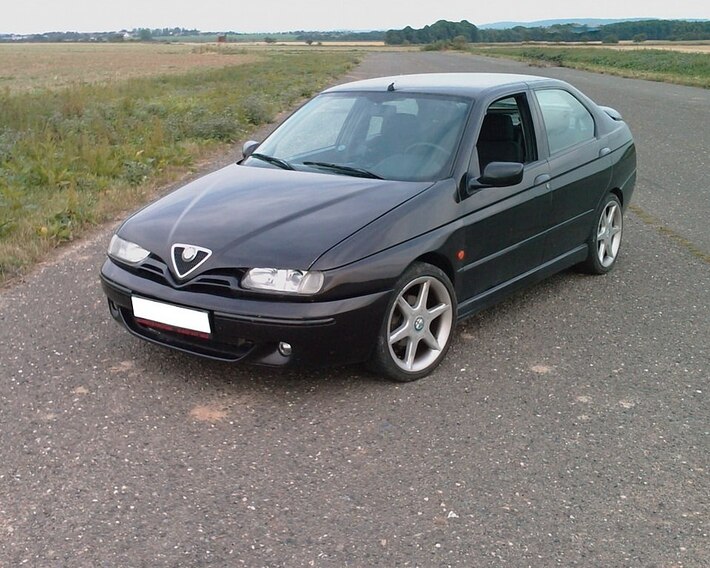
The 146’s five-door practicality comes without any sacrifice in Italian visual identity — the same sharp, angular Centro Stile language as the 145, adapted for family use.


Key Specifications
- Platform: Alfa Romeo 140 platform, identical to the 145. Front-wheel drive; transversely mounted inline-four engine; MacPherson strut front suspension; torsion beam rear axle. Hydraulic power-assisted rack-and-pinion steering. The 146 is dimensionally slightly larger than the 145 to accommodate the five-door body.
- Engine range: 1.4 ie 103 hp; 1.6 ie 16v 120 hp; 1.8 Twin Spark 144 hp; 2.0 Twin Spark 150 hp; 1.9 TD 90 hp. Identical to the 145 range. The Twin Spark variants are the most desirable performance options; the 1.6 is the best balance of economy and character for family use.
- Body: Five-door hatchback with a conventional three-box-inspired silhouette. The 146’s roofline is less rakish than the 145’s fastback, prioritising rear headroom and boot access. Boot capacity is usefully larger than the 145 for family use.
- Transmission: 5-speed manual on all variants. No automatic option was offered on the 146, consistent with Alfa Romeo’s positioning of the Alfa 140 platform cars as driver-oriented products.
- Weight: Approximately 1,095–1,145 kg — marginally heavier than the 145 due to the five-door body and additional rear door hardware. Still light by modern standards; the 2.0 TS power-to-weight ratio remained genuinely impressive.
- Safety: Dual front airbags on higher specifications; ABS available across the range. Side airbags not standard on most variants, reflecting the safety standards of the mid-1990s. Euro NCAP testing was not conducted on the 146 during its production life.
- Interior: Five full seats; the rear passenger space was genuinely adequate for three adults, an improvement over the 145’s tighter rear compartment. The boot offered approximately 330 litres of load space with the rear seats in use, expanding to around 970 litres with seats folded.
- Brakes: Front and rear discs on Twin Spark variants; front disc/rear drum on base models. ABS standard on upper trims, optional on lower specifications. Brake feel was progressive and well-weighted, consistent with the rest of the car’s driving character.
- Production: 1994–2001. The 146 sold in higher volumes than the 145 in most markets. Good used examples are now relatively scarce as many have been neglected; preserved, well-maintained cars are worth seeking out.
Variant Comparison
| Variant | Engine | Power | Gearbox | Best For |
|---|---|---|---|---|
| Alfa Romeo 146 1.4 ie (103 hp) | 1351cc Twin Spark inline-four, single-point injection | 103 hp at 6,000 rpm | 5-speed manual | Entry-level family hatchback; five doors make it significantly more practical than the 145 3-door for families; the 1.4 engine is adequate for urban use; lowest purchase price and insurance group of the range |
| Alfa Romeo 146 1.6 ie 16v (120 hp) | 1598cc 16-valve inline-four | 120 hp at 6,300 rpm | 5-speed manual | The ideal balance for family use; the 16-valve 1.6 delivers a willing, rev-happy performance character while remaining economical enough for everyday running; the most popular variant in the 146 range during production |
| Alfa Romeo 146 1.8 Twin Spark (144 hp) | 1747cc Twin Spark inline-four, multi-point injection | 144 hp at 6,000 rpm | 5-speed manual | The performance-minded family car; 144 hp in a five-door hatchback of this era was genuinely quick; the Twin Spark delivery is broad and progressive; excellent for buyers who need the practicality of five doors but refuse to compromise on driving engagement |
| Alfa Romeo 146 2.0 Twin Spark (150 hp) | 1970cc Twin Spark inline-four | 150 hp at 6,200 rpm | 5-speed manual | The range-topping 146; peak power in a practical package; combines the performance of the 145 2.0 TS with the usability of five doors; rarer than the equivalent 145 and increasingly sought as the more practical top-spec Alfa compact of the 1990s |
| Alfa Romeo 146 1.9 TD (90 hp) | 1929cc turbodiesel inline-four | 90 hp at 4,000 rpm | 5-speed manual | High-mileage family use where economy is paramount; the turbodiesel 146 was a practical choice for buyers covering large annual distances; less exciting than the petrol twins but economical and torquey for motorway driving |
What Makes the 146 Stand Out
The 146 occupies a niche that very few cars in automotive history have filled successfully: a genuinely practical family hatchback with an Italian character that could not be ignored.
- Five doors without compromise on character: The 146 proved that a family-sized Italian hatchback could retain the driving character of a sports car. The chassis, suspension, and steering of the 140 platform were not altered for the five-door body; the 146 drove with the same front-end responsiveness and steering precision as the 145, while offering better rear seat access and more boot space.
- Twin Spark efficiency in a family package: The 1.8 and 2.0 Twin Spark engines gave the 146 a genuine performance advantage over rival family hatchbacks while consuming less fuel than single-spark alternatives of similar power output. The twin-plug combustion was not only a performance feature; it was a genuine engineering advancement for the era.
- Italian design in an everyday class: In a segment populated by conservatively styled competitors, the 146’s Centro Stile bodywork made a statement. Driving a 146 communicated that its owner chose Italian character over German efficiency — a meaningful distinction for buyers who considered their car an expression of personality.
- Practical enough for genuine family use: Unlike the 145, the 146’s five-door body allows rear seat passengers to enter and exit without disturbing front-seat occupants. The boot is usefully sized for family shopping and travel. The 146 was a car that could serve as a genuine family’s only vehicle, not merely a second car for an enthusiast.
- Affordable entry into the Alfa classic compact segment: Well-maintained 146 1.8 and 2.0 TS examples represent excellent value as drivers’ cars. Values are modest, the cars are rewarding to drive, and the global Alfa parts supply makes maintenance practical for patient owners.
Maintenance & Repairability in Azerbaijan
The 146 shares all its mechanical components with the 145 and therefore the maintenance and parts supply situation is identical. The same considerations apply: parts require European sourcing, Twin Spark maintenance demands specific attention to dual ignition service, and timing belt history is critical.
- Timing belt (critical): All petrol Twin Spark engines in the 146 are interference engines. The timing belt and water pump must be replaced every 60,000 km or 4 years. Verify written records before purchase; a car without documented belt replacement history should receive immediate service. The cost of a snapped belt far exceeds the car’s market value.
- Dual spark plug service: Both sets of spark plugs (eight total on four-cylinder engines) must be replaced simultaneously at the correct service interval. Use NGK or Champion plugs to the manufacturer specification; incorrect heat range causes misfires and can damage catalytic converter. Annual check is recommended on high-mileage cars.
- Body rust inspection: The 146’s five-door body has the same structural rust risks as the 145 plus additional potential rust points at the rear door apertures and lower rear quarter panels. Inspect these areas carefully; structural rust in the sills or floor is expensive to address properly.
- Parts supply from Europe: Alfa OEM and quality aftermarket parts for the 140-platform cars are available from Italian (FAP), German (TRW, Brembo, Sachs), and UK (Alfaholics) suppliers. Shipping to Azerbaijan takes 1–2 weeks. Establish a supply relationship before the car needs urgent repairs.
- Cooling system: The 1.8 and 2.0 Twin Spark engines can suffer from coolant system issues — particularly the thermostat housing and water pump — as they age. Inspect the coolant colour and condition; brown or rusty coolant indicates a system that has not been properly maintained. Full coolant flush and thermostat replacement are sensible preventive maintenance items on any high-mileage 146.
- Suspension wear: Front anti-roll bar links and lower wishbone bushes are wear items on high-mileage 146s. These are standard components available from European suppliers; replacement is straightforward for a competent mechanic. Rear torsion beam bushes also wear with age and mileage.
- Local service capability: Mechanics in Baku familiar with Fiat Group or general European cars from the 1990s will be capable of routine service and most common repairs on the 146. The Bosch Motronic engine management is well-documented and generic OBD fault code readers are compatible with later variants.
Alfa Romeo 146 vs. Contemporaries
| Model | Core Strength | Main Compromise |
|---|---|---|
| Alfa Romeo 146 1.8/2.0 Twin Spark | Italian character and distinctiveness in a practical five-door; Twin Spark technology for efficiency; better driving engagement than any rival; unmistakable Alfa identity; a genuine Italian family hatchback with sports car DNA | Reliability record weaker than Golf or Civic in real-world use; Italian electrical gremlins on older cars; parts require European import in Azerbaijan; depreciation has been steep, leaving many neglected examples in the market |
| VW Golf III (1991–1997) | The benchmark for build quality and reliability in the segment; comprehensive dealer network worldwide; strong residuals; sophisticated ergonomics and interior quality; the safe choice for buyers prioritising reliability | Significantly less character than the Alfa 146; the Golf III is often criticised as the most uninspiring Golf generation; heavier and less engaging to drive than the Italian alternative |
| Peugeot 306 (1993–2002) | Outstanding chassis for its class; the 306 handled better than most rivals including the Golf; wide engine range; comfortable and practical; the 306 GTI-6 was one of the finest hot hatches of the era | Less distinctive styling than the Alfa; French PSA reliability in period similar to Alfa’s Italian reputation for electrical issues; no Italian prestige |
| Renault Mégane I (1995–2002) | Wide range of body styles; comfortable ride; practical five-door layout; Renault reliability improving in this era; well-equipped standard specification; good European dealer network | Conservative styling compared to the Alfa; no equivalent of the Twin Spark performance; the Mégane prioritised comfort over driver engagement |
| Honda Civic V/VI (1991–2001) | Outstanding reliability; VTEC engine technology; clean, efficient engineering; excellent build quality; Honda resale values significantly higher than Alfa; comprehensive Honda service network globally | Entirely different character — precise and competent rather than characterful; no Italian soul; driving experience less emotionally engaging; styling conservative compared to Alfa |
Cost-of-Ownership Calculator (Azerbaijan)
Annual running cost estimates for an Alfa Romeo 146 in daily or regular-use condition. Budget reflects Twin Spark service requirements and European parts sourcing costs.
- Estimated annual fuel use: 1200 litres
- Estimated annual fuel cost: $960
- Total annual ownership estimate: $5260
- Average monthly ownership estimate: $438
Used Buying Checklist
Buying a used Alfa Romeo 146 requires the same careful evaluation as the 145. The five-door body adds additional inspection points at the rear door apertures and sills.
- Timing belt records (non-negotiable): Verify documented timing belt replacement within the last 60,000 km or 4 years. An undocumented belt history means the belt may be overdue; budget for immediate replacement. A snapped belt destroys the engine.
- Body and structural condition: Inspect all four door aperture sills, the lower rear quarter panels, and the underbody floor pan. The five-door body has additional rust exposure points at the rear door bottoms and rear quarter lower sections. Probe with a screwdriver for soft metal at sill corners.
- Engine health check: Cold start, listen for valve noise (normal initially, should reduce to near-silence when warm); check for blue smoke (valve seals), grey smoke (rings), white steam (head gasket). Conduct a compression test across all four cylinders before purchase.
- Complete service history value: A 146 with a documented full service history (stamped service book or receipts) is significantly more valuable than one without records. History demonstrates that timing belt changes, fluid services, and major mechanical items have been addressed. Prioritise documented examples even at a modest premium.
- Interior wear assessment: The 146’s interior sees more wear than the 145 as a family car. Inspect rear door cards, rear seat upholstery, and boot carpet for excessive wear. Trim replacements are increasingly difficult to source; a well-preserved interior adds disproportionate value.
Alfa Romeo 146 FAQ
Is the 146 better than the 145 for family use?
For family use, the 146 is clearly the better choice. Five doors make a substantial practical difference for families with children or regular rear-seat passengers. The boot is larger, rear access is straightforward, and the overall usability as an everyday family car is meaningfully better than the 145’s three-door configuration. Mechanically the two cars are identical, so the driving experience is essentially the same.
Which variant should I choose: 1.6, 1.8 TS, or 2.0 TS?
For most family buyers, the 1.6 16v is the sensible choice: willing, economical, and easy to maintain without the added complexity of the Twin Spark dual ignition system. For driving enthusiasts who use the car daily and want real performance, the 1.8 Twin Spark is the sweet spot — enough power, excellent character, and better economy than the 2.0. The 2.0 TS is the fastest but commands a premium and is more expensive to insure and run; it makes most sense for buyers specifically seeking the top-specification family compact experience.
How does the 146 compare to the 147 that replaced it?
The 147 is a more refined and better-engineered car in virtually every measurable way: better interior quality, more modern safety systems, more sophisticated chassis, and stronger residual values. However, the 147 is also considerably more expensive to buy in good condition. For buyers on a tight budget who want an Italian compact with genuine character, a well-maintained 146 1.8 TS still offers a compelling experience at a fraction of the cost of an equivalent 147.
Should You Buy an Alfa Romeo 146?
The Alfa Romeo 146 is a car for buyers who understand that owning an Italian compact from the 1990s requires patience and engagement with the ownership experience, and who consider that engagement worthwhile. In well-maintained condition, the 146 1.8 or 2.0 Twin Spark is a genuinely rewarding driver’s car that also functions as a practical family vehicle — a combination that is still rare and still valuable. It is not the most reliable compact from its era, nor the best-built, but it is one of the few that will consistently make you enjoy the act of driving.
In Azerbaijan, the 146 is best approached as an enthusiast’s import from Europe in top-specification form. Buy a car with comprehensive service history, address all deferred maintenance immediately on arrival, and the 146 will reward you with Italian driving character that its modest price simply does not reflect.
BakuWheels uses cookies to improve your experience, analyse site traffic, and personalise content. By clicking Accept All, you consent to our use of cookies. Learn more in our Cookie Policy.