

Alfa Romeo 155 (1992–1997)
The Alfa Romeo 155 was the car that took Alfa back to the top of touring car racing — the racing version dominated the 1993–1996 DTM (Deutsche Tourenwagen Meisterschaft) championship and the British Touring Car Championship simultaneously. On the road, the 155 offered a range from the accessible 1.7 eight-valve base to the magnificent 2.5 Busso V6 and the rare Q4 all-wheel-drive turbo, bringing genuine Italian sports sedan character to a class where the BMW 3 Series and Mercedes C-Class competed for German dominance.
Overview
When Alfa Romeo replaced the celebrated 75 (Milano) with the front-wheel-drive 155 in 1992, many purists mourned the loss of the 75’s rear-wheel-drive transaxle layout. The 155 was a different car: front-wheel drive, based on the Fiat Tipo/Alfa 155 platform, and positioned against the BMW 3 Series E36 and Mercedes C-Class W202 in the compact executive segment. What the 155 brought to this contest was something no German rival could offer: a race-proven chassis with DTM and BTCC championship credentials, and an engine range that included one of the finest V6 engines ever produced.
The 155 V6 Ti racing programme, developed in partnership with Alfa Corse and initially using the Q4’s four-wheel-drive system before switching to a bespoke rear-wheel-drive specification, dominated the Deutsche Tourenwagen Meisterschaft championship from 1993 to 1996. Driven by Alessandro Nannini, Nicola Larini, and Gabriele Tarquini, the racing 155 V6 Ti won the DTM Championship three consecutive times — an achievement that established Alfa Romeo as the dominant force in European touring car racing during that era. Simultaneously, the road-going 155 was competing successfully in the British Touring Car Championship.
On the road, the 155 offered a more mature and refined character than its predecessors. The chassis, while front-wheel drive, was carefully developed by Alfa’s engineers to deliver genuine sports sedan dynamics. The suspension was tuned for agility over comfort, the steering was direct and informative, and the engine range offered genuine variety. The entry-level 1.7 eight-valve was competent if uninspiring; the 1.8 Twin Spark added genuine liveliness; but the car’s character peaked with the 2.0 Twin Spark and, above all, the magnificent 2.5-litre Busso V6.
The Alfa Busso V6 — a 24-valve, 2492cc unit developed by Giuseppe Busso and named in his honour — is one of the most beloved naturally aspirated engines ever fitted to a road car. Its 166 hp output was achieved with a smooth, progressive power delivery and a sound — between 3,000 and 6,000 rpm — that is arguably the finest noise ever produced by a V6 engine. The 155 2.5 V6 was not the fastest compact sedan of 1992–1997, but it was among the most emotionally rewarding to drive, and the Busso V6 remains a landmark engine in Alfa Romeo’s history.
The Q4 variant offered all-wheel drive with a 1995cc turbocharged engine producing 190 hp — the most powerful road-going 155 — and was Alfa’s technical response to the Lancia Delta Integrale’s AWD supremacy. The Q4 was produced from 1992 to 1995 in relatively small numbers and is now the rarest and most sought-after 155 variant. It combined the 155’s sharp chassis with the traction advantages of all-wheel drive in a package that felt genuinely rapid by the standards of its era.
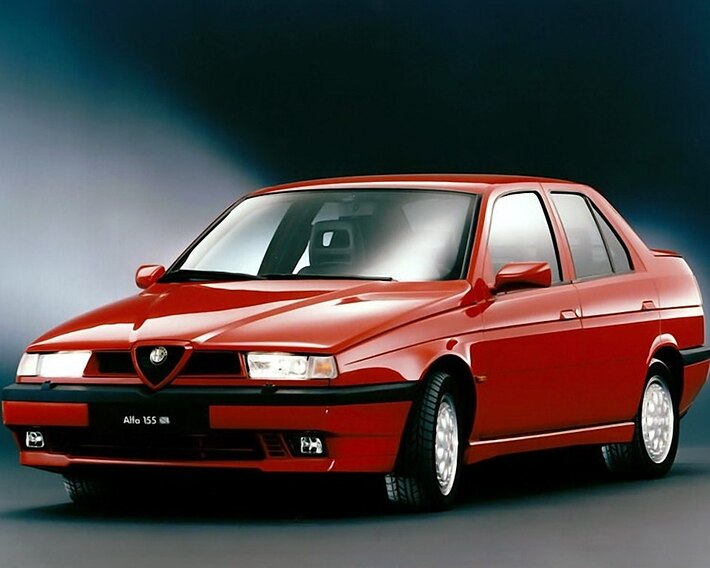
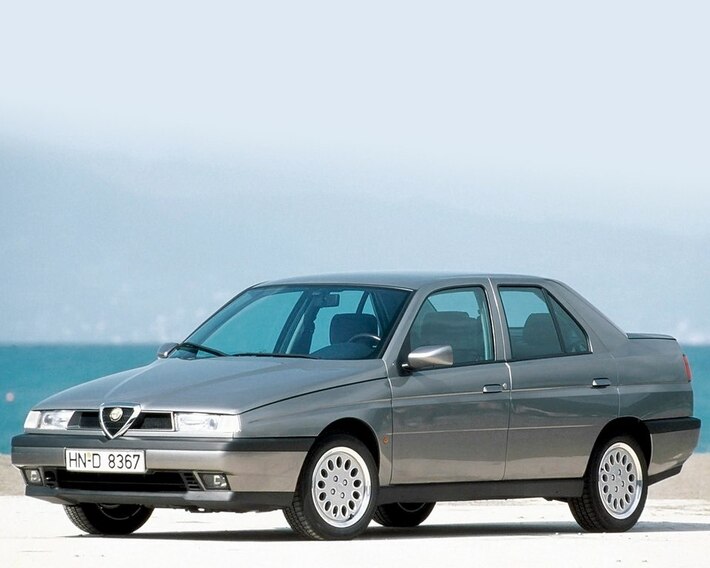
Alfa Romeo 155 in Pictures
The 155’s Centro Stile body was controversial when new — some felt it lacked the pure Alfa beauty of the 75 — but it has aged gracefully and today reads as a clean, purposeful 1990s sports sedan with Alfa’s unmistakable identity.


Key Specifications
- Platform: Fiat Tipo/Alfa Romeo 155 platform. Front-wheel drive (Q4 variant: all-wheel drive). MacPherson strut front suspension with anti-roll bar; multi-link rear suspension — a significant improvement over the torsion beam of the 140 platform; this rear suspension gives the 155 noticeably better handling balance than the 145/146.
- Busso V6 engine (2.5 V6): 2492cc, 60-degree DOHC 24-valve V6 designed by Giuseppe Busso; multi-point fuel injection; 166 hp at 5,800 rpm; 221 Nm torque at 5,000 rpm. The Busso V6 is revered for its extraordinary sound between 3,000 and 6,500 rpm — a high, harmonious note entirely unlike any other V6 engine; fitted to multiple Alfa models from the 75 through to the GTV, Spider, and 147 GTA.
- Twin Spark petrol engines: 1.8 Twin Spark (1747cc, 129 hp); 2.0 Twin Spark (1970cc, 150 hp). Both use the dual ignition system with two spark plugs per cylinder for improved combustion efficiency. The 2.0 TS is the most popular performance choice for buyers who cannot justify the V6’s higher running costs.
- Q4 variant: 1995cc turbocharged inline-four; 190 hp; Torsen-based all-wheel drive system; production 1992–1995; rare in the used market. Distinguished by wider bodywork and specific Q4 badging; the AWD system provides exceptional traction in wet conditions.
- Diesel variant: 1929cc turbodiesel inline-four; approximately 90 hp. Unusual in this class for Alfa Romeo; offered primarily for the Italian tax market where diesel attracted lower annual road tax; not sought by driving enthusiasts.
- Transmission: 5-speed manual across all variants. No automatic transmission offered on the 155 — consistent with Alfa Romeo’s commitment to manual gearboxes in its performance sedan range throughout this era.
- Dimensions and weight: Length approximately 4,280 mm; weight approximately 1,150–1,250 kg depending on variant (Q4 is heaviest). The 2.5 V6 weighs approximately 1,200 kg, giving a power-to-weight ratio of approximately 138 hp/tonne — competitive for its class in 1994.
- DTM racing 155 V6 Ti: The competition version used a 2.5-litre naturally aspirated V6 producing approximately 420 hp in period form, fully independent rear suspension, and a weight of approximately 1,030 kg. The racing car was developed entirely by Alfa Corse and shares the body design with the road car but almost no mechanical components. The visual similarity between racing car and road car was Alfa Romeo’s deliberate marketing strategy.
- Production: 1992–1997; replaced by the Alfa Romeo 156, which was universally praised as a major improvement in design, quality, and dynamics.
Variant Comparison
| Variant | Engine | Power | Gearbox | Best For |
|---|---|---|---|---|
| Alfa Romeo 155 1.7 8v (105 hp) | 1712cc inline-four 8-valve, multi-point injection | 105 hp at 5,500 rpm | 5-speed manual | The entry-level 155; adequate for everyday use; the most common variant in the used market; lowest running costs; choose if budget is tight and Italian sedan style is the primary motivation |
| Alfa Romeo 155 1.8 16v Twin Spark (129 hp) | 1747cc 16-valve Twin Spark inline-four | 129 hp at 6,100 rpm | 5-speed manual | The balanced choice; the Twin Spark 1.8 provides willing performance across the rev range with good fuel economy relative to its output; a significant step forward from the 8-valve base engine; suitable for daily driving with an enthusiast’s sensibility |
| Alfa Romeo 155 2.0 16v Twin Spark (150 hp) | 1970cc 16-valve Twin Spark inline-four | 150 hp at 6,200 rpm | 5-speed manual | The driver’s choice; 150 hp in a compact sports sedan weighing under 1,200 kg gave the 155 2.0 TS genuine performance credentials; the combination of Italian suspension tuning and Twin Spark power delivery made this the definitive daily-driver 155; 0–100 km/h in approximately 8.5 seconds |
| Alfa Romeo 155 2.5 V6 (166 hp) | 2492cc DOHC 24-valve V6 (Alfa Busso V6) | 166 hp at 5,800 rpm | 5-speed manual | The prestige variant; the Busso V6 is one of the finest naturally aspirated six-cylinder engines ever fitted to a compact car; magnificent sound, creamy power delivery, and an authentic Italian GT character that the four-cylinder cars cannot match; the most sought-after 155 specification for collector buyers |
| Alfa Romeo 155 Q4 AWD Turbo (190 hp) | 1995cc turbocharged inline-four, all-wheel drive | 190 hp at 5,800 rpm | 5-speed manual, AWD | The rarest and most exciting 155 variant; all-wheel drive with a 2.0 turbocharged engine; direct response to the Lancia Delta Integrale in the Touring Car and Group A rally classes; extremely rare in the used market; the racing 155 V6 Ti DTM used the Q4’s AWD-capable platform before switching to RWD for DTM |
What Makes the 155 Stand Out
The 155 made its case not just on paper but on the race track — a distinction that no BMW 3 Series or Mercedes C-Class of the same era could claim with anything like the same credibility in European touring car competition.
- The Busso V6 — one of the great engines: The 2.5-litre V6 designed by Giuseppe Busso is widely considered one of the finest naturally aspirated V6 engines ever fitted to a road car. Its sound at 4,000–6,500 rpm is a complex, harmonious blend of mechanical precision and emotional music that modern engines cannot replicate. Driving a 155 V6 is an experience in engine character that transcends mere performance figures.
- DTM Championship dominance: The 155 V6 Ti won the Deutsche Tourenwagen Meisterschaft championship three consecutive times (1993, 1994, 1995) and brought Alfa Romeo back to the front of German motorsport against Mercedes and BMW. This racing success was achieved by a car with genuine aesthetic similarity to the road-going 155, giving owners of road cars a direct visual connection to the championship-winning racing programme.
- Multi-link rear suspension: The 155’s multi-link rear suspension was a genuine engineering improvement over the torsion beams fitted to the 145/146. It gave the 155 more refined rear-end behaviour, better mid-corner stability, and a more progressive limit of adhesion — qualities that made the 155 a more satisfying car to drive quickly than the platform’s compact predecessors.
- Q4 AWD rarity and performance: The Q4 variant, produced in small numbers and featuring a 190 hp turbocharged engine with all-wheel drive, is now one of the most collectable 1990s Italian sedans. Its combination of AWD traction, turbocharged power, and Alfa styling anticipates the concept of the performance AWD sedan that would become mainstream only in the 2000s.
- Transitional significance in Alfa’s history: The 155 bridges the era of the rear-wheel-drive 75/Milano and the celebrated Alfa Romeo 156. It represents the point at which Alfa committed to front-wheel drive across its sedan range while maintaining the racing programme that gave the cars their credibility.
- Entering classic territory in V6 specification: The 155 2.5 V6 and the Q4 are beginning to attract serious collector interest as 1990s touring car champions age into historic racing eligibility. Well-preserved examples in these specifications are becoming increasingly scarce.
Maintenance & Repairability in Azerbaijan
The 155 is a 28–34 year old car requiring the maintenance appropriate to its age. In Azerbaijan, the Busso V6 and Twin Spark four-cylinder engines are best served by European-trained mechanics with access to international parts supply.
- Busso V6 service: The 2.5 V6 requires timing belt replacement every 60,000 km (critical — interference engine); valve clearance check every 30,000 km; spark plug replacement at 30,000 km intervals (6 plugs); coolant system service every 2 years. The V6 is mechanically robust when properly maintained; its primary weakness is the timing belt system, which must be current to avoid catastrophic engine damage.
- Busso V6 parts: The Busso V6 was used across multiple Alfa models (75 3.0, 164 3.0, GTV 2.0/3.0, Spider, 147 GTA, 156 GTA) and is comprehensively supported by specialist suppliers. Timing belt kits, water pumps, cam seals, and major mechanical components are available from FAP, FEBI, Gates (belts), and specialist Alfa suppliers. Costs are moderate; the V6 rebuild is not significantly more expensive than the four-cylinder.
- Rust inspection: The 155’s body shares the rust vulnerability of all 1990s Italian steel: check lower sills, wheelarches, inner wings, and the rear valance. A 155 from Central or Eastern Europe (common import source) may have more rust than a southern Italian example. Full underbody inspection is essential before purchase.
- Q4 AWD system: The Q4’s Torsen-based all-wheel drive system requires periodic transmission fluid changes and inspection of driveshafts and CV joints. The AWD system adds complexity and parts cost over the FWD variants; any Q4 buyer should verify the AWD system’s condition specifically, including a test on a varied surface to confirm even drive distribution.
- Twin Spark four-cylinder maintenance: Identical requirements to the 145/146: eight spark plugs, timing belt every 60,000 km, coolant service, and Bosch Motronic diagnostic compatibility. Well-understood and serviceable by any competent European car mechanic.
- European parts network: The 155 shares platform components with the Fiat Tipo and various Lancia models, broadening the parts supply base beyond Alfa-specific components. Suspension, brake, and electrical parts can often be sourced from Fiat/Lancia suppliers if Alfa-specific items are unavailable, at lower cost. Major suppliers in Germany and Italy ship to Azerbaijan within 1–2 weeks.
- Local expertise: Mechanics in Baku with European car experience — particularly those familiar with the Fiat Group platform — can service the 155 routine items. The Busso V6 is less common but its mechanical design is conventional; a competent DOHC specialist can maintain it with access to workshop data.
Alfa Romeo 155 vs. Contemporaries
| Model | Core Strength | Main Compromise |
|---|---|---|
| Alfa Romeo 155 2.0 TS / 2.5 V6 | Italian sports sedan character the Germans could not replicate; the Busso V6 is a landmark engine; sharper steering feel than BMW or Mercedes equivalents; beautiful Centro Stile design; BTCC and DTM racing heritage directly relevant to road cars | Reliability record below German rivals; parts less accessible outside Italy/Germany; resale values lower than BMW 3 Series; build quality not at German levels |
| BMW 3 Series E36 (1990–1998) | The benchmark sports compact sedan; rear-wheel drive with perfect front-rear weight distribution; excellent engine range (six-cylinder M52 is magnificent); outstanding build quality; global BMW dealer network; strong residuals | Considerably more expensive than the Alfa 155 in comparable specification; the BMW 3 Series lacks the Italian visual drama; the character is precise and clinical rather than passionate |
| Mercedes-Benz C-Class W202 (1993–2000) | Outstanding build quality and reliability; comprehensive safety equipment; strong diesel range; superb interior; the AMG variants offer genuine performance; excellent long-term durability | Significantly more expensive than the Alfa 155; conservative styling compared to the Italian; the base C-Class is not a driver’s car in the way the 155 V6 is; heavy depreciation on luxury-spec examples |
| Lancia Delta Integrale (1987–1993) | The World Rally Championship benchmark; turbocharged 2.0 with AWD; eight WRC Manufacturers’ Championships; raw, immediate driving experience; Italian badge prestige even higher than Alfa in enthusiast circles; now extremely collectible | No longer in production; Integrale values are now €40,000–€80,000+ for good examples; demanding to maintain; turbocharged AWD system requires specialist attention; a very different car to the 155 in character |
| Opel/Vauxhall Vectra A (1988–1995) | Reliable and affordable; comprehensive German/UK dealer network; wide range of engines; practical and comfortable; significantly cheaper than Alfa both new and used | No character whatsoever; the Vectra A is the antithesis of the 155’s Italian personality; the comparison only relevant in terms of market segment, not driving experience or emotional content |
Cost-of-Ownership Calculator (Azerbaijan)
Annual running cost estimates for an Alfa Romeo 155. V6 service costs are slightly higher than four-cylinder variants due to six spark plugs and V6-specific timing belt service.
- Estimated annual fuel use: 1200 litres
- Estimated annual fuel cost: $960
- Total annual ownership estimate: $5260
- Average monthly ownership estimate: $438
Used Buying Checklist
The 155 V6 and Q4 are now entering serious collector territory; careful authentication and condition assessment are essential before purchase.
- V6 timing belt history (critical): Verify the timing belt has been changed within the last 60,000 km. The Busso V6 is an interference engine; a failed belt destroys the engine. For any car without documented belt history, budget for immediate replacement (€400–700 including water pump and tensioners).
- Q4 AWD verification: For any car presented as a Q4, verify the AWD designation from the VIN and registration document. Check that the AWD system engages correctly during a test drive on a variety of surfaces; front-only or rear-only drive indicates a failed centre or rear differential.
- V6 engine health: Warm the engine fully before assessment; the Busso V6 should idle smoothly with no ticking or rattle. A cold start rattle from the timing belt area (normal for the first few seconds) should disappear promptly; persistent noise indicates worn tensioners or a stretched belt. Listen for bottom-end knock, which indicates bearing wear.
- Body condition: Inspect all sills, lower quarters, and the floor pan thoroughly. The 155’s body design concentrates water in the sill channels; rust in these areas is common on neglected examples. Any car with filled or covered sills should be treated with extreme caution.
- Interior and electrical condition: Check that all electrics function (windows, central locking, instruments, HVAC). Alfa electrical systems of this era can be troublesome; persistent faults may indicate wiring loom issues that are expensive to diagnose and repair.
Alfa Romeo 155 FAQ
Is the racing 155 V6 Ti related to the road car?
The racing 155 V6 Ti shares its body design and general visual identity with the road car but shares almost no mechanical components. The racing engine was a purpose-built 2.5 V6 producing approximately 420 hp (compared to the road car’s 166 hp); the suspension was bespoke; the gearbox was a sequential racing unit. Alfa Romeo deliberately designed the racing car to look like the road car as a marketing strategy — when people saw a 155 on the road, they would associate it with the DTM champion, even though the technical connection was primarily visual.
How does the Busso V6 in the 155 compare to the version in the 156 GTA?
The 155 uses the 2.5-litre (2492cc) version of the Busso V6, producing 166 hp. The 156 GTA used a 3.2-litre (3179cc) version producing 250 hp. Both share the same fundamental architecture but the 3.2 is a later development with larger displacement, additional power, and somewhat different tuning. The 2.5 in the 155 is considered by many enthusiasts to have a more characterful, free-revving nature than the torquier 3.2; both are celebrated engines, but the 2.5 is the classic expression of the Busso design.
Is the 155 worth buying over the 156 that replaced it?
The 156 is a better car in almost every objective measure — better designed, better built, better ride, better interior, and more dynamic chassis. However, the 155 V6 and Q4 have a rarity and motorsport heritage that the 156 cannot match. For a driving car on a daily basis, buy the 156. For a collectible piece of Italian motorsport history with a magnificent engine, the 155 V6 is the more interesting and increasingly valuable choice.
Should You Buy an Alfa Romeo 155?
The Alfa Romeo 155 is a car for buyers who appreciate the combination of motorsport heritage, Italian character, and a magnificent engine that the V6 specification uniquely provides. The DTM championship story is genuinely exciting and the Busso V6 is a landmark engine — owning the road car that inspired the championship-winning racer is a meaningful proposition for anyone who cares about automotive history.
As with all 1990s Italian cars in Azerbaijan, the practical considerations of parts sourcing and specialist maintenance require honest assessment. A well-preserved 155 2.5 V6 imported from Italy or Germany, with documented service history and sound bodywork, is a realistic daily driver with genuine collector appeal. Budget carefully for timing belt service, and approach the Q4 only with full AWD system verification. The 155 will reward patient ownership with driving experiences that no German contemporary from the same era can match.
BakuWheels uses cookies to improve your experience, analyse site traffic, and personalise content. By clicking Accept All, you consent to our use of cookies. Learn more in our Cookie Policy.