
Alfa Romeo 75 (1985–1992) — Milano in North America
The Alfa Romeo 75 — known as the Milano in North America — is widely considered the last “pure” Alfa Romeo: the final rear-wheel-drive sedan the company built, with a transaxle layout for perfect 50/50 weight distribution, available with the Busso V6 in 2.5 and 3.0-litre forms, and victorious in the 1988 European Touring Car Championship. For Alfa Romeo purists, the 75 is the definitive driving machine — the car that embodied Alfa’s sporting philosophy before front-wheel drive became the default architecture.
Overview
When Alfa Romeo launched the 75 in 1985 to mark the company’s 75th anniversary, it was already working on the front-wheel-drive 155 that would replace it. The 75 was therefore, from its launch, the final expression of Alfa Romeo’s rear-wheel-drive sedan tradition — the last car in a lineage that included the Giulia, the 1750, the Alfetta, and the Alfa 6. This historical context has shaped the 75’s collector reputation enormously: for Alfa Romeo enthusiasts, it is the car that most completely embodies what Alfa Romeo was before the commercial pressures of the modern era imposed front-wheel drive on the product range.
The 75 was based on the Alfetta platform, refined over the preceding decade through the Alfetta, GTV6, and Alfa 6 programmes. The transaxle layout — rear-mounted gearbox combined with the final drive in a single unit, connected to the engine by a driveshaft running through the cabin tunnel — gave the 75 a front-rear weight distribution that was either exactly 50/50 or close to it depending on engine specification. This distribution, combined with the rear-wheel drive and the carefully developed de Dion rear suspension, gave the 75 a handling balance that front-wheel drive simply cannot replicate: neutral in its responses, exploitable to a predictable limit, and deeply satisfying to drive quickly.
The engine range began with four-cylinder units (1.6 SOHC, 1.8 SOHC/TBI, 2.0 Twin Spark, 2.0 Turbo America) and peaked with the Busso V6 in 2.5 and 3.0-litre forms. The 2.5 V6 with its 158 hp output and magnificent sound between 3,000 and 6,000 rpm is the classic 75 choice for driving enthusiasts; the 3.0 V6 with 188 hp is rarer and faster. Both V6 variants in a car with perfect weight distribution and rear-wheel drive produce an experience that Alfa Romeo would not offer again in a mainstream road car for over two decades.
In racing, the 75 was a dominant force. The 75 Turbo Evoluzione (a homologation special for ETCC Group A racing) won the 1988 European Touring Car Championship; separately, the 75’s V6-engined variants competed successfully at Bathurst, in Australian touring car series, and in multiple national championships. The racing programme used the same rear transaxle RWD layout as the road car, giving the road car genuine credibility as the platform for championship-winning racing.
Production ended in 1992, replaced by the front-wheel-drive 155. The 75 was immediately and widely mourned by Alfa Romeo purists, and its reputation has grown consistently in the years since production ended. Well-preserved examples in V6 specification are now in serious demand; the 75 Evolution homologation special is particularly collectable, with values that have increased substantially in the past decade.
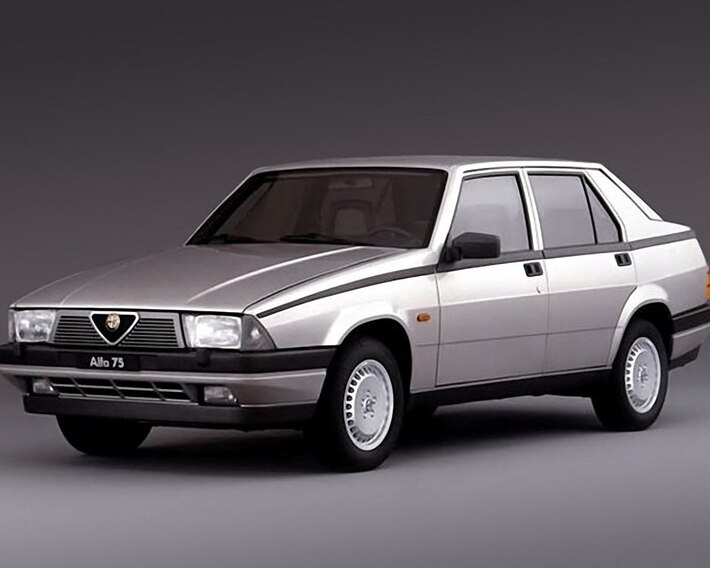
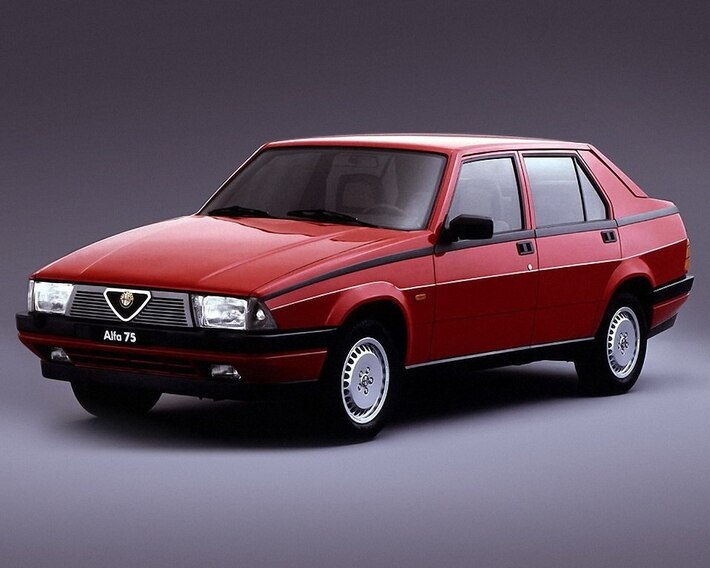
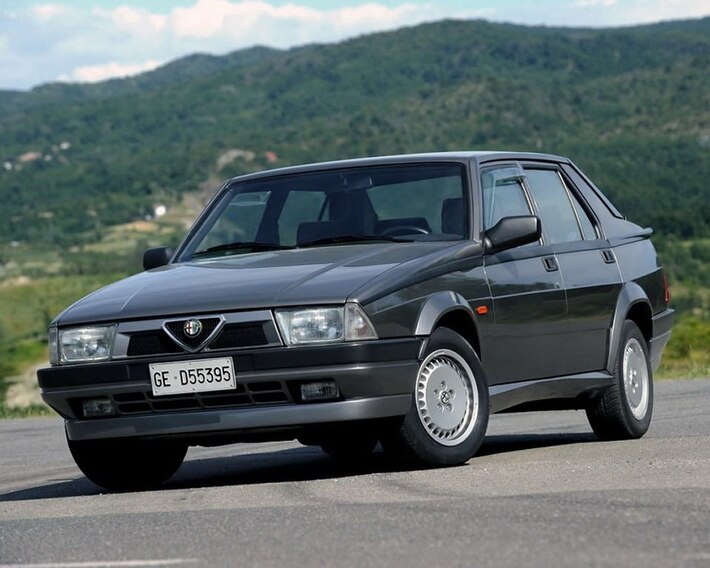
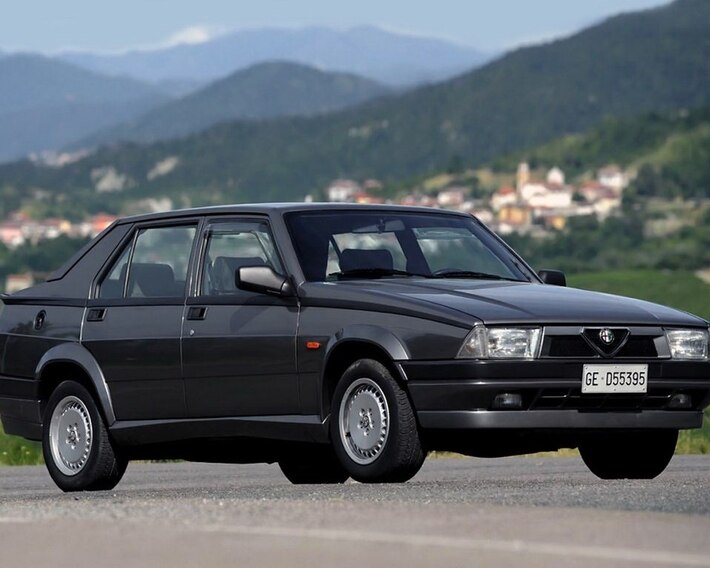
Alfa Romeo 75 in Pictures
The 75’s body — often criticised as angular and unloved when new — has acquired admirers with age; its clean, purposeful form is now recognised as appropriate to the car’s fundamental sporting character.


Key Specifications
- Transaxle layout: The 75’s defining engineering feature: the gearbox is combined with the final drive in a single unit at the rear axle, connected to the front-mounted engine by a torque tube running through the floor. This layout moves mass rearward, achieving either exact or near-exact 50/50 weight distribution. The result: a front-engine, rear-wheel-drive car that handles with the balance normally associated with mid-engine sports cars.
- De Dion rear suspension: The 75 uses a de Dion rear axle arrangement in which the differential is fixed to the body (reducing unsprung weight) and a tubular de Dion tube connects the rear hubs. This provides better handling than a live axle while being less complex than a fully independent setup; it works excellently with the transaxle layout to give the 75 its characteristic rear-end behaviour.
- Busso V6 (2.5, 2492cc): 158 hp at 5,600 rpm; the classic 75 choice; in a car with perfect weight distribution, this 158 hp feels substantially more than the figure suggests because the entire car weighs approximately 1,165 kg and the rear-wheel drive allows the power to be placed with precision. The Busso V6’s sound in this configuration is one of the outstanding experiences of 1980s motoring.
- Busso V6 (3.0, 2959cc): 188 hp at 6,000 rpm; rarer than the 2.5 in the 75; produces a more effortless power delivery and a marginally better sound at high revs; 0–100 km/h approximately 7.0 seconds; distinguished from the 2.5 by specific badging and a slightly wider body profile on the most complete examples.
- 75 Evolution (homologation): Built to homologate the ETCC Group A racing car; 500 examples produced; turbocharged 1762cc inline-four producing 156 hp in road form (race cars produced much more); widened body with flared wheelarches; upgraded brakes and suspension; the most collectable standard production 75 variant; values significantly above standard cars.
- Twin Spark 2.0 (148 hp): The most powerful four-cylinder 75; the Twin Spark technology provides more power than a conventional single-plug 2.0 and better fuel economy; the combination of 148 hp, rear-wheel drive, and perfect weight distribution makes the 75 2.0 TS one of the finest naturally aspirated drivers’ cars of the late 1980s.
- Milano (North America): The US/Canadian market version of the 75, sold as the Milano to avoid confusion with the Alfa 75 (a budget supermini sold in some markets). Mechanically identical to the European 75; available in Verde (2.5 V6) and Platinum (2.5 V6) specifications. The Milano name is now considered collectible in its own right in the North American market.
- Production: 1985–1992; approximately 386,000 total across all variants; the 2.0 Twin Spark and 2.5 V6 were the most popular specifications; 3.0 V6 rarer; Evolution very rare (500 units).
Variant Comparison
| Variant | Engine | Power | Gearbox | Best For |
|---|---|---|---|---|
| Alfa Romeo 75 1.6 (110 hp) | 1570cc SOHC inline-four | 110 hp at 5,800 rpm | 5-speed manual (rear transaxle) | The entry-level 75; already rear-wheel drive with transaxle layout; adequate performance with low running costs; choose for Italian character on a limited budget; the most accessible 75 for first-time Italian classic buyers |
| Alfa Romeo 75 1.8 SOHC/TBI (120–128 hp) | 1779cc SOHC inline-four or 1779cc TBI (Throttle Body Injection) | 120–128 hp at 5,500 rpm | 5-speed manual | The balanced mid-range; the 1.8 provides a good spread of torque with acceptable economy; the TBI fuel-injected variant is preferred for easier starting and more consistent performance; practical daily driver with the 75’s fundamental RWD transaxle advantage |
| Alfa Romeo 75 2.0 Twin Spark (148 hp) | 1962cc Twin Spark inline-four, multi-point injection | 148 hp at 5,800 rpm | 5-speed manual | The driver’s four-cylinder 75; the Twin Spark engine’s responsive character in a rear-wheel-drive car with perfect weight distribution creates a driving experience that is genuinely involving; comparable power to the 2.0 Turbo America without the turbo’s complexity; the most common enthusiast specification in the current used market |
| Alfa Romeo 75 2.0 Turbo America (165 hp) | 1962cc turbocharged inline-four | 165 hp at 5,800 rpm | 5-speed manual | The high-performance four-cylinder; originally intended for the North American market (hence “America”); turbocharged power in a RWD transaxle car; requires careful throttle management due to turbo boost characteristics; most powerful four-cylinder 75; demands experienced driver to exploit correctly |
| Alfa Romeo 75 2.5 V6 (158 hp) | 2492cc Busso DOHC V6 | 158 hp at 5,600 rpm | 5-speed manual | The definitive 75; the Busso V6’s sound combined with the 75’s perfect 50/50 weight distribution creates one of the finest naturally aspirated sporting sedans of the 1980s; the most sought 75 specification for collectors; 0–100 km/h approximately 7.8 seconds |
| Alfa Romeo 75 3.0 V6 (188 hp) | 2959cc Busso DOHC V6 | 188 hp at 6,000 rpm | 5-speed manual | The flagship V6; 188 hp in a car with perfect weight distribution; the 3.0 V6’s power delivery is effortless and the sound magnificent; significantly faster than the 2.5; rarer than the 2.5 V6; the highest-specification 75 available without the turbocharged option; now the most collectable standard road 75 alongside the 2.5 V6 |
What Makes the 75 Stand Out
The Alfa Romeo 75 is not just a good car — it is the last car that Alfa Romeo built that expressed the company’s fundamental engineering philosophy without compromise.
- The last rear-wheel-drive Alfa Romeo sedan — ever: When production ended in 1992, Alfa Romeo had no plans to return to rear-wheel drive for a mainstream sedan. The Giulia (952) eventually arrived in 2016, but the 24-year gap between the 75 and the Giulia gives the 75 a unique position in Alfa’s history as the conclusion of a 60-year rear-wheel-drive sedan tradition.
- Perfect 50/50 weight distribution: The transaxle layout gives the 75 a handling balance that is genuinely exceptional among road cars of any era. The neutral response to steering inputs, the predictable behaviour at the limit, and the way that the rear wheels can be used to adjust the car’s attitude under power are qualities that most front-drive rivals simply cannot replicate.
- 1988 ETCC Championship: The 75 Turbo Evoluzione won the European Touring Car Championship in 1988 in a campaign where the road car’s architecture — rear-wheel drive, transaxle, perfect weight distribution — was directly relevant to the racing car’s competitiveness. This is one of the few cases in modern European touring car racing where the production car’s fundamental engineering gave the racing car a genuine advantage over competitors.
- The Busso V6 in the finest application: Many argue that the 75 2.5 V6 is the finest application of the Busso V6 precisely because the rear-wheel-drive transaxle layout allows the engine’s character to be fully exploited. In a front-drive car, V6 torque is managed and suppressed by traction limitations; in the 75, it can be deployed fully and progressively through the rear wheels.
- Rapidly appreciating collector values: The 75 in V6 specification — particularly the 3.0 V6 and the Evolution — has seen significant value appreciation in the past decade as the classic car market recognises its significance. Well-preserved examples that were available for €5,000–8,000 in 2010 now command €15,000–30,000 in similar condition.
Maintenance & Repairability in Azerbaijan
The 75 is a 32–41 year old car requiring maintenance proportionate to its age. The transaxle layout adds specific maintenance requirements compared to conventional front-engine, front-drive cars.
- Transaxle maintenance: The rear-mounted transaxle requires periodic transmission oil change (every 30,000 km); the gearshift linkage running through the floor tunnel requires lubrication at the pivot points and cable connections. A sloppy or imprecise gearchange on a 75 is often a linkage adjustment issue rather than a gearbox fault; proper adjustment restores most of the original precision.
- Busso V6 timing belt: The 2.5 and 3.0 V6 in the 75 are interference engines; timing belt replacement at 60,000 km intervals is essential. Include the water pump, tensioners, and accessory belts in the same service. On a car whose replacement engine is increasingly difficult to source, this service is critical.
- De Dion rear suspension: The de Dion axle’s rubber bushes wear with age and should be inspected at major service intervals; worn bushes cause imprecise rear-end behaviour. Replacement bushes are available from Italian and European suppliers; the work requires a workshop with the correct press tools for bush replacement.
- Electrical system: The 75 uses Alfa’s period Italian electrical architecture — generally reliable when properly maintained but can develop intermittent faults with age. The ignition/immobiliser system on some later cars can be troublesome; the Bosch Motronic fuel injection on Twin Spark and fuel-injected V6 variants is serviceable with generic European diagnostic equipment on later models.
- Parts availability: The 75’s transaxle is shared with the Alfetta and Alfa 6 (parts interchangeable); the Busso V6 is common across multiple Alfa models. Body panels are becoming increasingly difficult to source new; good used panels from salvage cars are the realistic option for bodywork repair. European suppliers (FAP Italy, Alfaholics UK) stock most mechanical parts; allow 1–2 weeks for international shipping to Azerbaijan.
- Rust assessment: The 75’s body rusts at the same predictable points as other 1980s Italian cars: sills, floor, inner wings. The wider bodywork of the Evolution model has additional sealing requirements at the wheelarch extensions. Any 75 import to Azerbaijan should undergo full rust assessment before purchase.
- Azerbaijan daily use: A well-maintained 75 V6 can serve as a semi-regular driver in Azerbaijan. The transaxle layout improves rear traction, but the car’s age and parts sourcing challenges mean it is best used as a second car or enthusiast vehicle rather than a primary daily driver.
Alfa Romeo 75 vs. Contemporaries
| Model | Core Strength | Main Compromise |
|---|---|---|
| Alfa Romeo 75 2.5/3.0 V6 | The last rear-wheel-drive Alfa Romeo sedan; perfect 50/50 weight distribution from transaxle layout; Busso V6 in 2.5 and 3.0 forms; ETCC champion 1988; won the Bathurst 1000 in 1987 and touring car events globally; driving character that no front-drive rival can match; the purist’s Alfa Romeo | Unreliable reputation; electrics from the 1985–1992 era can be troublesome; parts increasingly difficult in markets outside Italy; transaxle layout with long gearshift linkage requires calibration for best feel; the 75 rewards patient, experienced ownership |
| BMW 3 Series E30 (1982–1994) | The benchmark rear-wheel-drive compact sedan of the era; outstanding build quality and reliability; comprehensive BMW dealer network; the E30 M3 is a legend; the 325i straight-six a landmark engine; strong residuals; considered by many as the best BMW ever made | Significantly more expensive than the Alfa 75 in comparable specification; the BMW E30 is more reliable but less emotionally involving; no equivalent to the Busso V6 sound; the E30 is now expensive as a classic |
| Mercedes-Benz 190E (W201, 1982–1993) | The compact Mercedes; outstanding build quality and durability; the 2.3-16 Cosworth a landmark performance variant; independent rear suspension on all variants; Mercedes brand prestige; excellent long-term value | The 190E is a comfortable, refined compact that deliberately prioritises quality over driver engagement; no Italian character; significantly less emotionally involving than the 75 V6 |
| Lancia Thema (1984–1994) | Contemporary Italian executive car on the Fiat Type 4 platform; shared with Saab 9000, Fiat Croma, Alfa 164; the Thema 8.32 with Ferrari V8 is legendary; Pininfarina interior; genuine Italian prestige; Thema 2.0 Turbo IE fast | The Thema is front-wheel drive (platform constraint) — fundamentally different driving character to the 75’s RWD transaxle; parts are even more challenging than Alfa 75 spares; the Thema 8.32 is desirable but the mainstream Thema less so |
| Ford Sierra Cosworth (1985–1992) | The Cosworth-engined Sierra is one of the most celebrated performance Fords; turbocharged 2.0 Cosworth; rear-wheel drive; Group A rally and touring car winner; significant motorsport heritage; strong parts and specialist network in the UK | Ford character versus Italian character — entirely different proposition; the Sierra Cosworth is a performance tool where the 75 V6 is a GT experience; different collector communities |
Cost-of-Ownership Calculator (Azerbaijan)
Annual running cost estimates for an Alfa Romeo 75 V6. Service budget reflects transaxle maintenance, Busso V6 timing belt service amortised annually, and European parts sourcing.
- Estimated annual fuel use: 1200 litres
- Estimated annual fuel cost: $960
- Total annual ownership estimate: $5260
- Average monthly ownership estimate: $438
Used Buying Checklist
The 75 in V6 specification is now entering serious collector territory. Buying a good example requires careful assessment of structure, drivetrain, and specification authenticity.
- V6 specification verification: Confirm the engine specification (2.5 or 3.0) from the chassis plate and engine number. Some 75s have been retrofitted with V6 engines from other Alfa models; a numbers-matching V6 75 commands a significant premium over a car with an unoriginal engine.
- Transaxle and gearshift assessment: Drive the car through all five gears at full operating temperature. A precise, mechanical gearchange indicates a healthy transaxle and linkage; a vague or baulking gearchange requires investigation. The 75’s gearshift character is one of its defining pleasures when correct.
- Busso V6 timing belt history: The critical service item; verify documented replacement history. A snapped belt destroys the engine; on a 75, replacement engine sourcing is difficult and expensive. Budget for immediate belt replacement if history is absent.
- Structural rust inspection: Inspect all four sill areas, the floor pan, inner wings, and the rear de Dion tube mounting points. Rust in the de Dion mounts is a structural safety issue; rust in the sills weakens the body stiffness critical to the 75’s handling character.
- Evolution authentication: If presented as an Evolution (the homologation special), verify against the factory production list; only 500 were built. The Evolution is identified by specific widebody wheelarch extensions, unique interior elements, and the turbocharged engine. Request proof of Evolution-specific VIN prefix from the seller.
- Electrical completeness: Check that all electrical systems function: instruments, heating/ventilation, central locking, windows. Non-functioning electrics may indicate failed components that are increasingly difficult to source; a complete, electrically functional car is significantly more valuable than one with multiple non-working systems.
Alfa Romeo 75 FAQ
Is the 75 really the last “real” Alfa Romeo?
Within the enthusiast community, the 75 is widely described as the last Alfa Romeo that expressed the company’s traditional engineering philosophy without compromise: rear-wheel drive, transaxle layout, and manual gearbox available in all specifications. The 155, 156, and subsequent front-drive models are outstanding cars in their own right, but they lack the fundamental rear-wheel-drive architecture that characterised Alfa Romeo from its founding through 1992. The Giulia (952) from 2016 partially restores this tradition, but the gap of 24 years gives the 75 its unique position.
Which is the better driving car: 2.5 V6 or 3.0 V6?
Both are exceptional. The 2.5 V6 at 158 hp provides a slightly more demanding experience that rewards the driver more obviously — you need to work the engine harder to access its performance, which some find more satisfying. The 3.0 V6 at 188 hp is effortlessly fast, with more torque available lower in the rev range; it is a more relaxed express. The 3.0’s sound at high revs is marginally better than the 2.5’s. Both are correct choices; the 2.5 is more common and less expensive.
How important is the 75 as a collector car investment?
The 75 in V6 specification has appreciated significantly in the past decade and shows no signs of stagnating. The combination of unique engineering (last RWD Alfa sedan), racing history (ETCC 1988), mechanical excellence (Busso V6 in the finest application), and Alfa Romeo brand significance make it a credible investment-grade collector car. The Evolution is the premium choice for investment buyers; V6 cars in concours condition are increasingly difficult to find.
Should You Buy an Alfa Romeo 75?
The Alfa Romeo 75 in V6 specification is one of the most compelling drivers’ car purchases currently available in the Italian classic market. It offers the combination of rear-wheel drive, perfect weight distribution, a magnificent engine, and ETCC racing heritage at a price that is still accessible compared to equivalent BMW E30s and Mercedes W201s in comparable condition. The 75’s values are rising and will continue to do so.
For buyers in Azerbaijan, the 75 V6 is best imported from Italy in sound condition with documented timing belt history. The transaxle and Busso V6 combination is well-understood by European specialists; establish parts supply relationships before import and plan for regular timing belt service as the primary preventive maintenance item. The 75 will reward experienced drivers with a rear-wheel-drive Italian GT experience that nothing else in the current used car market can replicate.
BakuWheels uses cookies to improve your experience, analyse site traffic, and personalise content. By clicking Accept All, you consent to our use of cookies. Learn more in our Cookie Policy.