

Auburn Automobile Company
Indiana's golden age of automotive elegance — Auburn produced some of the most dramatically styled and mechanically sophisticated American automobiles of the 1920s and 1930s.
The Golden Age of American Automotive Design
The Auburn Automobile Company was founded in 1900 in Auburn, Indiana — a small city in the American Midwest that would eventually become synonymous with the most glamorous chapter of American pre-war motoring. The company's early years were marked by modest production of conventional vehicles; it was not until the intervention of Errett Lobban Cord in 1924 that Auburn was transformed into one of the most celebrated luxury car marques of its era.
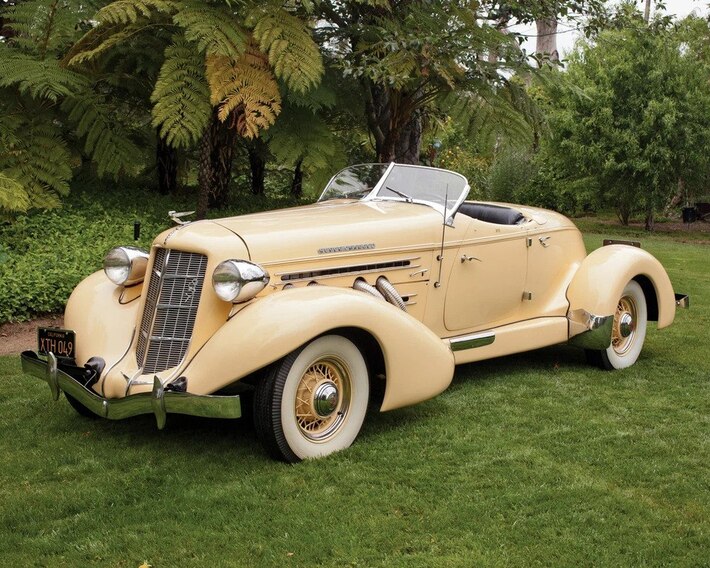
E.L. Cord, a visionary businessman who had turned around the ailing Auburn company from near-bankruptcy, brought in designer Alan Leamy and engineer Augie Duesenberg to transform the brand. The result was a series of extraordinarily beautiful automobiles — the 851 Speedster, with its flowing boattail body and exposed exhaust pipes, remains one of the most iconic designs in American automotive history. Auburn, together with sibling brands Cord and Duesenberg under the Cord Corporation umbrella, represented the pinnacle of 1930s American automotive ambition.
The Great Depression devastated the market for luxury automobiles, and despite the technical brilliance and aesthetic achievement of its final models, Auburn ceased production in 1937. The factory in Auburn, Indiana, has since been preserved as the Auburn Cord Duesenberg Museum — a tribute to the extraordinary concentration of automotive talent that briefly flourished in one small Indiana town.
Brand Milestones
Notable Models
Auburn's greatest cars combined European styling influences with American mechanical ambition — creating automobiles that were simultaneously beautiful, fast, and exclusive.
Auburn in Pictures
Auburn's cars were expressions of the American belief that automobiles could be as beautiful as they were fast — each model a rolling sculpture that has grown only more admired with time.
Engineering Excellence
Auburn's engineering distinguishing factor was the Lycoming engine — a family of straight-six, straight-eight, and V-12 engines built to a standard of precision that rivalled European competition. The supercharged version of the straight-eight, as fitted to the 851 Speedster, was developed by August Duesenberg and used a Schwitzer-Cummins centrifugal supercharger to develop approximately 150 horsepower — sufficient for the claimed top speed that was guaranteed, with signed documentation, for every supercharged car that left the factory.
The body design work, primarily by Gordon Buehrig, represented the most sophisticated American application of the European streamline moderne aesthetic — combining swooping fenders, tapered tails, and exposed mechanical elements into compositions that were simultaneously theatrical and aerodynamically rational. Auburn's designers understood that the road presence of an automobile was as important as its mechanical specification, and the cars they produced remain compelling evidence of that belief.
- Lycoming straight-eight engine — Auburn's primary powerplant was built by the in-house Lycoming division to exacting tolerances, delivering smooth, refined power delivery appropriate to the brand's luxury positioning
- Schwitzer-Cummins supercharger — the centrifugal blower fitted to the 851 Speedster was a sophisticated forced-induction system that boosted power output by approximately 35 per cent while adding to the car's visual theatre through exposed piping
- Columbia two-speed rear axle — an overdrive rear axle that effectively gave Auburn's larger models two final drive ratios, improving high-speed cruising economy without a mechanical gearchange
- Gordon Buehrig styling — Auburn employed one of America's most gifted automotive designers, whose work for the brand established an aesthetic vocabulary that influenced American car design for decades
- Factory speed guarantee — the Auburn policy of certifying each supercharged 851 as having achieved 100 mph in factory testing, with a signed card in the glovebox, was a pioneering piece of performance marketing that set a standard for factory-certified performance claims
Auburn in Azerbaijan
Pre-war American classics such as Auburn are exceptionally rare in Azerbaijan, with any examples present in the region representing significant collector investments. The global auction market for Auburns — particularly the 851 Speedster — is active and well-documented, with original examples regularly achieving prices above one million US dollars.
For Azerbaijani collectors interested in the history of American automotive design, Auburn represents one of the highest expressions of pre-war luxury and style. BakuWheels can connect enthusiasts with specialist auction houses and classic car dealers who operate in the international pre-war American market.
Why Auburn?
- Unmatched pre-war design: The Auburn 851 Speedster is widely regarded as one of the most beautiful American automobiles ever built — its boattail body, exposed exhaust, and supercharged engine represent a peak of pre-war American automotive aesthetics that has never been surpassed.
- Factory speed guarantee: Every supercharged 851 left the Auburn factory with documentation certifying that it had achieved over 100 mph — a performance claim supported by the testing signature of Augie Duesenberg, giving buyers extraordinary confidence in a period before standardised performance testing.
- Investment value: Original Auburn 851 Speedsters have appreciated significantly over recent decades, with the finest examples commanding over two million dollars at auction — making them genuinely competitive with the best European pre-war classics as investment-grade collector vehicles.
- Automotive historical significance: Auburn, Cord, and Duesenberg under E.L. Cord's leadership represented a brief, extraordinary moment in American manufacturing when small-scale luxury producers could challenge the world's best — understanding Auburn's history is essential to understanding the ambition of American automotive design in the 1930s.
- Museum preservation: The Auburn Cord Duesenberg Museum in the original factory building provides exceptional documentation of the brand's history, making Auburn one of the best-documented pre-war American marques for researchers and collectors.
BakuWheels uses cookies to improve your experience, analyse site traffic, and personalise content. By clicking Accept All, you consent to our use of cookies. Learn more in our Cookie Policy.