

Cizeta-Moroder
The most extreme supercar Italy ever produced — 16 cylinders, 540 horsepower, and a story as dramatic as the car itself.
Origins & Heritage
Cizeta-Moroder was founded in 1988 in Los Angeles, California — a remarkable birthplace for an Italian supercar — by two extraordinary figures: Claudio Zampolli and Giorgio Moroder. Zampolli was a former Ferrari and Lamborghini engineer who had worked extensively with exotic car customers in California. Moroder was an Oscar and Grammy-winning music producer best known for his pioneering electronic disco music and film scores, including his work on "Midnight Express" and "Flashdance."
The V16T — the only model Cizeta-Moroder would produce — was a direct spiritual successor to the legendary Lamborghini Countach, on which Zampolli had worked during his Lamborghini years. The car featured a unique transversely mounted 6.0-litre V16 engine, achieving 540 horsepower and a top speed of 328 km/h (204 mph). The V16 was constructed by combining two V8 cylinder blocks — an ingenious solution that produced an engine note unlike anything else in automotive history.
Despite generating enormous press coverage and admiration upon its launch at the 1988 Los Angeles Motor Show, Cizeta faced chronic production and financial difficulties. Moroder departed from the venture in 1991 following disagreements, and the company became Cizeta Automobili. Total production barely exceeded 20 examples before financial constraints ended manufacturing activity. The cars that exist today are among the rarest and most extraordinary supercars ever produced.
Key Milestones
The Extraordinary Cizeta V16T
The Cizeta V16T's wedge-shaped bodywork drew directly on the Countach tradition while pushing the supercar formula to its absolute extreme with 16 cylinders and 540 hp.
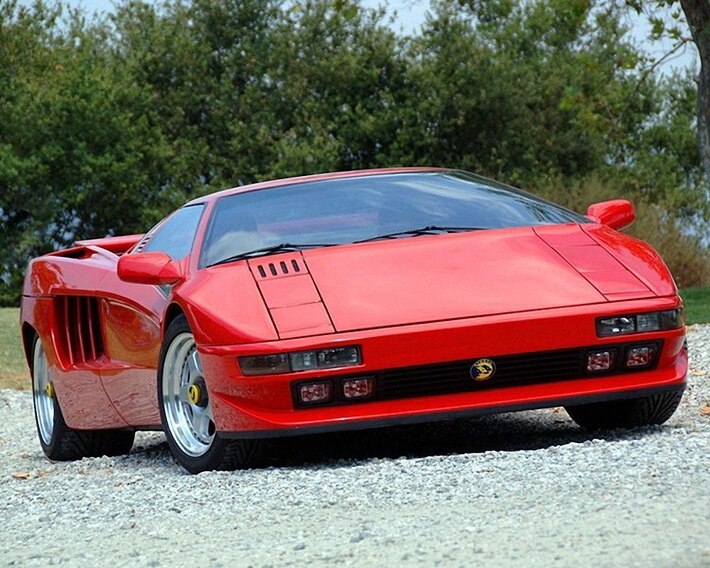
The V16T — One Model, One Legend
Cizeta produced only a single model in its history — but that model was extraordinary enough to ensure the company's permanent place in supercar history.
Engineering Extremes
The Cizeta V16T's defining technical achievement is its transversely mounted V16 engine — a configuration unprecedented in production car history. The 6.0-litre unit was constructed by combining two V8 cylinder blocks with a shared crankshaft, producing an engine of extraordinary character.
- 6.0L transverse V16 engine — constructed from two V8 blocks, producing 540 hp and one of the most distinctive engine sounds ever heard in a production vehicle
- Mid-mounted engine layout with rear-wheel drive — providing near-perfect weight distribution and the high-revving character essential to the supercar experience
- Aluminium space frame chassis with fibreglass and composite bodywork — extremely light for the era, contributing to performance beyond what raw power figures suggest
- Pop-up headlights and Countach-inspired scissor door option — styling elements that placed the V16T firmly within the tradition of Italian supercar theatre
Cizeta in Azerbaijan
Cizeta vehicles are essentially unknown in Azerbaijan — a predictable outcome for a car produced in fewer than 20 examples worldwide. The V16T is primarily found in private collections in the United States, Europe, and the Middle East, where a small number of examples have been preserved by dedicated supercar collectors.
The Cizeta V16T is significant not for its market presence but for what it represents: the absolute extreme of Italian supercar engineering at the most creative period of the genre. For Azerbaijani automotive enthusiasts familiar with supercar history, the Cizeta name represents one of the most exotic and tragically short-lived experiments in the art of extreme car-making.
Why Cizeta Is Significant
- Unique V16 powertrain: The Cizeta V16T is the only production car to use a transversely mounted V16 engine — an engineering achievement with no predecessor and no successor.
- Extreme rarity: Fewer than 20 examples were produced — making the Cizeta one of the rarest supercars in the world and a significant investment-grade collector's car.
- Lamborghini DNA: Designed by a former Lamborghini engineer, the V16T carries direct engineering and stylistic DNA from the Countach era — representing a legitimate continuation of that tradition.
- Cultural significance: The collaboration between a supercar engineer and an Oscar-winning music producer represents one of the most unusual and compelling stories in automotive history.
BakuWheels uses cookies to improve your experience, analyse site traffic, and personalise content. By clicking Accept All, you consent to our use of cookies. Learn more in our Cookie Policy.