

Asia Topic
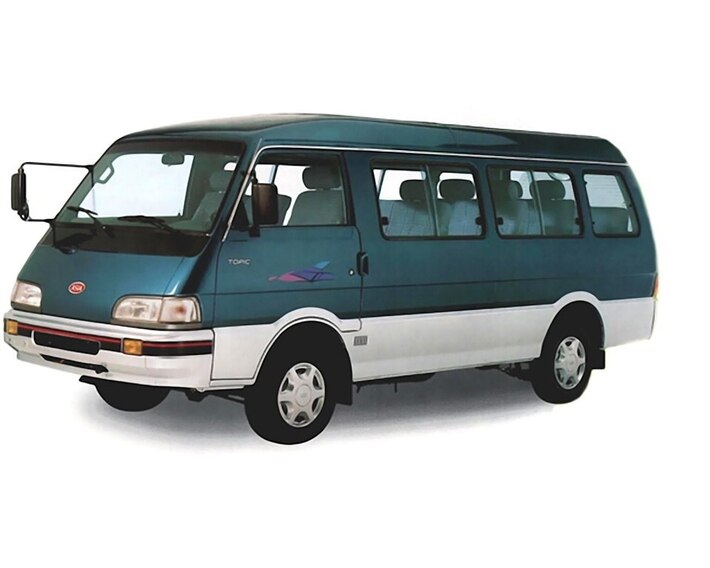
The Asia Topic is a Korean compact commercial van and minibus from Asia Motors — a front-engine, rear-wheel-drive workhorse that served South Korean businesses, delivery operations, and passenger transport throughout its 13-year production life.
Overview
The Asia Topic was launched in 1986 as Asia Motors' primary commercial van product — a conventional front-engine, rear-wheel-drive panel van designed to address the growing demand for light commercial transport in South Korea's rapidly industrialising economy. Built on a straightforward ladder-frame-inspired commercial van platform, the Topic offered practicality, affordability, and the mechanical simplicity demanded by commercial fleet operators who needed minimal downtime and basic field maintenance.
Engine options reflected commercial priorities: a 1.8-litre Kia petrol unit producing 72 hp for lighter-duty urban delivery, and a 2.2-litre Kia J2 diesel producing 61 hp for operators seeking fuel economy and long-distance durability. The diesel was particularly popular with fleet operators running high annual kilometres. The 1994 Hi-Topic introduced a high-roof body variant, significantly increasing cargo volume for businesses requiring maximum load capacity without stepping up to a larger truck.
The Topic competed directly with the Hyundai Grace and Kia Besta in the Korean domestic market, all three products of what was effectively the same corporate group. Production ended in 1999 with the wind-down of the Asia Motors brand following Kia's financial collapse. In Azerbaijan today, the Asia Topic is an extreme rarity — a piece of Korean commercial vehicle history that predates the modern Korean automotive industry's global dominance. For a buyer seeking a low-cost working van or an unusual collector piece, a surviving Topic in running condition is a remarkable find.
Gallery
Key Specifications
| Production Years | 1986 – 1999 |
|---|---|
| Body Styles | Panel van, high-roof van (Hi-Topic), minibus (windowed) |
| Layout | Front-engine, rear-wheel drive |
| Engine (petrol) | 1.8L Kia petrol, 72 hp |
| Engine (diesel) | 2.2L Kia J2 diesel, 61 hp |
| Gearbox | 5-speed manual |
| Suspension (front) | Independent with coil springs |
| Suspension (rear) | Leaf spring live axle |
| Brakes | Front disc, rear drum |
| Payload | approximately 700–900 kg (panel van) |
| Seats (minibus) | up to 12–15 passengers |
| Fuel consumption | approximately 9–12 L/100 km |
| Origin | South Korea (Asia Motors, Kia subsidiary) |
Variant Comparison
| Variant | Engine | Power | Layout | Best For |
|---|---|---|---|---|
| Topic Van (1986) | 1.8L Kia petrol | 72 hp | Front-engine, RWD van | Original commercial van — basic goods transport |
| Topic 2.2D (1990) | 2.2L Kia J2 diesel | 61 hp | Front-engine, RWD van | Diesel economy — long-distance commercial operations |
| Hi-Topic (1994) | 1.8L / 2.2D | 61–72 hp | High-roof extended body | Maximum cargo volume — high-roof commercial use |
What Makes the Asia Topic Stand Out
Korean Commercial Heritage
The Asia Topic represents an authentic piece of South Korea's commercial vehicle history during the country's extraordinary industrial growth of the late 1980s and 1990s. It was a workhorse of Korean enterprise — the vehicle that delivered goods, transported workers, and kept businesses moving during the Korean economic miracle.
Kia J2 Diesel Longevity
The 2.2L J2 diesel engine is a commercial-grade unit engineered for durability in continuous fleet operation. When properly maintained, these engines are known to accumulate very high mileage — a characteristic that makes surviving Topic diesel examples potentially more mechanically sound than their age alone would suggest.
Multi-Configuration Utility
The Topic's ability to serve as a panel van, high-roof cargo van, or minibus gives it practical versatility that many specialist vehicles lack. A minibus-configured Topic could still serve as rural community transport in Azerbaijan's less densely served areas.
13-Year Production Longevity
A 13-year production run from 1986 to 1999 speaks to the Topic's commercial success and engineering durability. Vehicles that fail in commercial service are quickly discontinued; the Topic's longevity reflects genuine operator satisfaction with its cost-of-operation.
Maintenance & Repairability in Azerbaijan
The Asia Topic's maintenance position in Azerbaijan is similar to the Rocsta — helped considerably by its Kia-sourced drivetrain. The 2.2L J2 diesel is an indirect injection pre-common-rail unit with no electronic management systems — fuel injection is mechanical and can be serviced by any diesel injection specialist. This is a significant advantage in a market where older diesel mechanics are often better equipped for mechanical injection systems than modern electronically controlled units.
Standard commercial diesel servicing — oil changes every 5,000–7,000 km, fuel filter replacement, air filter service, and glow plug maintenance — are all achievable with standard tools and parts available through Kia aftermarket channels or commercial diesel suppliers. The petrol 1.8L engine is similarly straightforward. The rear leaf spring suspension is a conventional commercial van layout familiar to any truck mechanic.
The main challenge is Asia-specific body and trim components. Panel van body panels and interior trim are not shared with any current-production vehicle and require sourcing from South Korea. For the minibus configuration, seat components and interior panels are even harder to find. Any owner should treat a Topic primarily as a working vehicle and budget conservatively for cosmetic repairs — sourcing specific trim items from Korea is feasible but requires patience and planning. Corrosion management, given the vehicle's age, is the most critical ongoing maintenance priority.
Competitor Comparison
| Model | Strength vs. Asia Topic | Compromise vs. Asia Topic |
|---|---|---|
| Hyundai Grace | More refined interior, better build quality, stronger Hyundai brand support in South Korea | Similar price point — Topic had competitive positioning in the commercial van market |
| Kia Besta | Kia mainstream support, widely available parts, higher production numbers | Largely similar mechanics — Topic was a contemporary under the Kia corporate umbrella |
| Toyota HiAce (2nd/3rd gen) | Legendary reliability, global parts availability, far better long-term durability | Much more expensive to purchase and maintain; higher running costs |
| Daihatsu Delta | Japanese construction quality, better engine refinement, competitive fuel economy | Higher initial cost, Daihatsu parts harder to find in the Caucasus region |
Cost-of-Ownership Calculator
Estimate your annual running costs for an Asia Topic in Azerbaijan. Adjust the values to match your driving profile and usage pattern.
Used Buying Checklist
- Commercial use history — Establish whether the vehicle served in fleet or commercial operations. High commercial mileage accelerates wear on gearbox, clutch, and rear suspension components.
- Diesel engine injection system — On 2.2D models, check for uneven idle, hard starting, and black smoke. Mechanical injection pump condition is the most critical factor in diesel engine health.
- Chassis and floor rust — Commercial vans of this age are highly susceptible to floor pan and chassis rust, especially if used for wet cargo delivery. Lift the floor mats and inspect the floor pan thoroughly.
- Rear suspension leaf springs — Commercial variants are often overloaded. Check rear leaf springs for fatigue, broken leaves, and worn shackle bushings.
- Load area condition — For panel van variants, inspect the load floor for damage, corrosion, and evidence of heavy or inappropriate loading that may have stressed the body structure.
- Sliding door operation — Test the sliding side door(s) for smooth operation, correct latching, and seal integrity. Worn sliding door rollers are a common issue on vans of this age.
- Cooling system — Commercial diesels run hot under sustained load. Check radiator condition, coolant age, thermostat operation, and confirm no head gasket issues (look for white exhaust smoke or oily coolant).
Frequently Asked Questions
Should You Buy the Asia Topic?
Reasons to Buy
- Very low purchase cost for a functional commercial van
- Kia J2 diesel engine is proven commercial-grade hardware built for longevity
- Mechanical injection diesel is simpler to repair than modern common-rail systems
- Multiple configurations — van, hi-roof, and minibus
- Genuine Korean commercial heritage from the Asia Motors era
- Practical cargo capacity for light commercial use
Reasons to Consider Alternatives
- Asia-specific body and trim parts extremely difficult to source
- Corrosion risk on all surviving examples is very significant at this age
- Likely high-mileage commercial history on most examples
- Toyota HiAce of similar vintage offers far better reliability and global support
- No modern safety features — no airbags, ABS, or crash protection
- Comfort and noise levels are poor by any modern standard
Verdict: The Asia Topic is a working commercial van first and a collector curiosity second. For buyers who need basic cargo or passenger transport at a minimal price, and who can manage the parts-sourcing challenges that come with a 25–40-year-old Korean commercial vehicle, the Topic remains functional transport. For commercial use requiring reliability without interruption, modern alternatives or a Toyota HiAce of similar vintage are the more pragmatic choices. The Topic's main value in today's market is as a rare piece of Korean automotive and commercial history from a brand that no longer exists.
BakuWheels uses cookies to improve your experience, analyse site traffic, and personalise content. By clicking Accept All, you consent to our use of cookies. Learn more in our Cookie Policy.