

Bajaj
Bajaj Auto is one of India's most storied industrial names — a conglomerate that transformed from a scooter importer in 1945 into the world's largest manufacturer of three-wheeled vehicles, a global two-wheeler powerhouse, and the creator of the Bajaj Qute, a revolutionary quadricycle that challenges conventional notions of affordable urban mobility. With operations across 50+ countries and a product range spanning auto-rickshaws, motorcycles, and compact personal vehicles, Bajaj represents Indian engineering ambition at its most expansive.
Origins & Heritage
Bajaj Auto traces its roots to 1945, when Jamnalal Bajaj — a prominent Indian industrialist and close associate of Mahatma Gandhi — established a trading company in Bombay. The company initially imported Vespa scooters from Italy under licence before transitioning to domestic manufacturing. In 1959, Bajaj Auto Ltd was incorporated and began producing two and three-wheeled vehicles in India, establishing manufacturing facilities in Pune that would grow into one of Asia's largest vehicle production complexes.
The three-wheeled auto-rickshaw became Bajaj's defining product — the ubiquitous vehicle that transformed urban mobility across the Indian subcontinent and subsequently across South and Southeast Asia, Africa, and Latin America. The Bajaj RE series of auto-rickshaws, with its distinctive yellow and black livery in cities like Mumbai and Delhi, became an icon of Indian street life and an essential element of public transportation infrastructure in cities where formal transit systems could not keep pace with population growth.
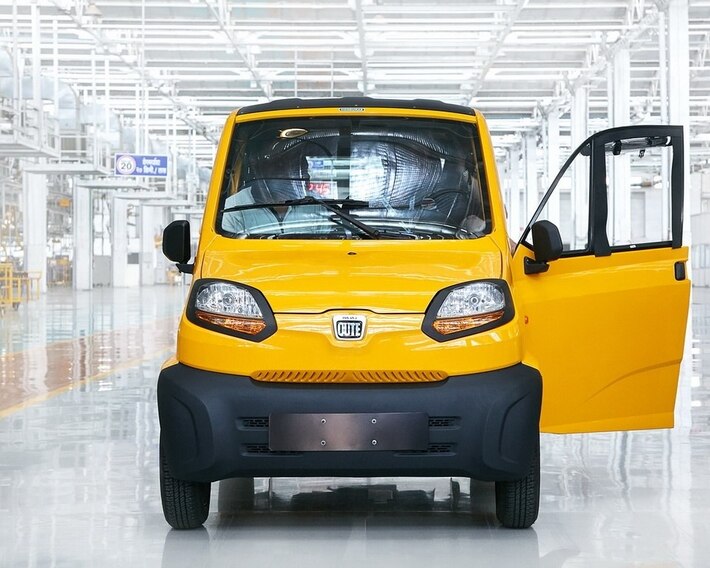
Bajaj's automotive ambitions extended beyond two and three-wheelers when the company developed the Bajaj Qute — a quadricycle launched in 2012 and progressively introduced to markets globally. The Qute challenges the boundary between motorcycle and car, offering four-wheel stability, a roof, doors, and a small engine in a package far cheaper to purchase and operate than a conventional automobile. For markets where a full car is unaffordable but a motorcycle is insufficient, the Qute offers a genuinely compelling proposition.
Key Milestones
Bajaj Vehicles in Pictures
From the iconic auto-rickshaw that defines Indian urban mobility to the innovative Bajaj Qute quadricycle, Bajaj's vehicles have shaped transportation across South Asia and beyond for more than seven decades.
Model Lineup
Bajaj's automotive product range spans three-wheeled auto-rickshaws, the Qute quadricycle, and commercial load carriers — all engineered for affordability, reliability, and suitability to markets where conventional automobiles remain economically inaccessible.
Technology & Innovation
Bajaj's engineering approach is distinguished by its focus on maximum utility at minimum cost — a discipline that has produced some of the most reliable and economically efficient small-vehicle powertrains in the world. The Qute in particular represents a genuine engineering achievement: delivering enclosed four-wheel personal mobility with a fuel efficiency that rivals two-wheelers, at a total operating cost that makes automobile ownership viable for a far broader segment of society.
- DTS-i twin-spark ignition technology — Bajaj's patented Digital Twin Spark ignition system provides two spark plugs per cylinder for more complete combustion, delivering improved fuel efficiency and power output compared to conventional single-spark engines
- Multi-fuel compatibility — Bajaj three-wheelers are engineered to operate on petrol, CNG, LPG, and electric power, providing flexibility for operators in markets with varying fuel infrastructure and price dynamics
- Quadricycle architecture — the Bajaj Qute's lightweight quadricycle body structure achieves exceptional fuel economy (35+ km/l) through a combination of low weight, aerodynamic efficiency, and optimised powertrain calibration
- Low maintenance architecture — Bajaj vehicles are designed for ease of maintenance in markets with limited specialist service infrastructure, using standardised components and straightforward service procedures that can be performed with basic tools
Bajaj in Azerbaijan
Bajaj vehicles — primarily three-wheeled auto-rickshaws — have found their way to Azerbaijan through trade routes connecting the Caucasus with South Asia and the Middle East, where Bajaj three-wheelers are widely used in commercial passenger transport. While three-wheelers are not a conventional fixture of Azerbaijani urban transport, interest in the Bajaj Qute quadricycle has grown among buyers seeking economical urban personal mobility options.
The Bajaj Qute presents a particularly interesting proposition for Azerbaijan: its compact dimensions make it suited to Baku's increasingly congested urban environment, while its low operating costs align with the priorities of cost-conscious urban commuters. For buyers exploring alternatives to conventional city cars, the Qute's quadricycle classification and corresponding advantages in purchase price and operating cost deserve serious consideration.
Why Consider Bajaj?
- Pioneer of affordable mobility: Bajaj has spent 75+ years engineering practical transportation solutions for markets where affordability is the primary constraint — producing vehicles of exceptional value that conventional manufacturers cannot match at equivalent price points.
- Proven global reliability: With vehicles operating across 50+ countries in the most demanding conditions — from Mumbai traffic to African rural roads — Bajaj's mechanical reliability has been validated at a scale that few manufacturers can claim.
- Qute quadricycle innovation: The Bajaj Qute represents a genuine category innovation — the first vehicle to seriously challenge the cost barrier between two-wheelers and conventional cars, offering enclosed four-wheel transport at a price point and operating cost previously only achievable with motorcycles.
- Multi-fuel flexibility: Bajaj's ability to offer petrol, CNG, LPG, and electric variants of its three-wheelers provides genuine flexibility for operators across markets with varying fuel availability and pricing structures.
BakuWheels uses cookies to improve your experience, analyse site traffic, and personalise content. By clicking Accept All, you consent to our use of cookies. Learn more in our Cookie Policy.