

Santana
Santana Motor was Spain's most celebrated off-road vehicle manufacturer, building rugged 4×4 vehicles under licence from Land Rover before developing its own models. Based in Linares, Jaén, Santana spent four decades equipping the Spanish Armed Forces, Civil Guard, and agricultural sector with vehicles renowned for durability in the harshest terrain.
Origins & Heritage
Santana Motor was founded in 1955 in Linares, Andalusia, as a state-sponsored industrial project under Franco's Spain. The company was established with the specific purpose of producing Land Rover vehicles under licence — giving Spain a domestically manufactured 4×4 capable of equipping its military and agricultural workforce. The first Santana-built Land Rover Series I models rolled off the Linares production line in 1958, distinguishable from British-built counterparts by their Spanish-sourced components and local assembly.
Through the 1960s and 1970s, Santana became the backbone of the Spanish Armed Forces and Civil Guard motorised fleet. The company produced long-wheelbase and short-wheelbase Land Rover variants suited to Spain's diverse terrain — from the arid plains of Castile to the mountain ranges of the Pyrenees and Sierra Nevada. In 1982, Santana signed a technical cooperation agreement with Suzuki, gaining access to Japanese powertrain technology and modern engineering expertise that helped diversify the model range beyond the Land Rover template.
The Santana PS-10 — introduced in 1988 — was the first vehicle developed entirely in-house, embodying Santana's own engineering identity rather than a licensed design. However, the collapse of Spain's state-controlled industrial sector in the 1990s brought financial pressure, and Suzuki gradually increased its shareholding. Production continued into the 2000s with the Santana Anibal and military variants, but the plant finally closed in 2011 after decades of serving Spain's defence and agricultural sectors, leaving behind a legacy as one of Europe's most respected off-road specialists.
Key Milestones
Iconic Models in Pictures
Santana's visual identity is defined by the functional, squared-off proportions inherited from Land Rover, adapted and refined over decades to suit Spanish manufacturing capability and operational requirements.
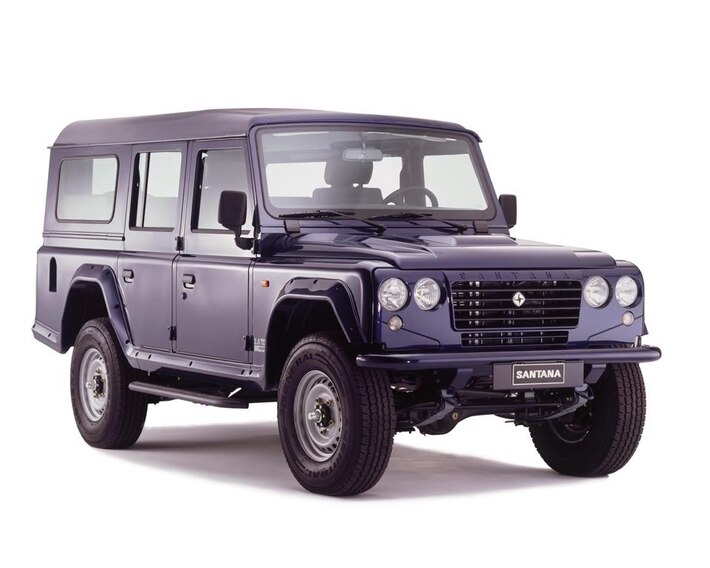
Model Lineup
Santana's model range evolved from straight Land Rover licence-builds to increasingly independent designs, culminating in purpose-designed military and commercial 4×4 vehicles unique to the Spanish manufacturer.
Engineering & Technology
Santana built its reputation on robust, proven engineering — a philosophy inherited from Land Rover and refined through decades of operation in Spain's demanding terrain. The adoption of Suzuki technology in the 1980s introduced modern fuel injection, improved diesel engines, and updated transmission systems to the established off-road platform.
- Selectable 4×4 drive system — high and low range transfer gearbox for extreme off-road capability; standard across all Santana military variants
- Rigid axle suspension — coil and leaf spring configurations offering superior articulation on rough terrain; proven in desert, mountain, and agricultural environments
- Suzuki diesel engines — 1.9L and 2.0L turbodiesel units from the Suzuki partnership; improved fuel economy and reliability over earlier petrol variants
- Body-on-frame construction — traditional ladder-frame chassis with aluminium body panels; exceptional repairability in field conditions without specialist tools
- Military specification variants — the PS-10 and Anibal were supplied in armoured, communications, and medical evacuation configurations to the Spanish Armed Forces
Santana in Azerbaijan
Santana vehicles are exceptionally rare in Azerbaijan — the brand was primarily confined to Spain and its former colonies, with limited export to other markets. However, Santana's Land Rover-derived vehicles share parts and mechanical architecture with genuine Land Rover products, meaning that Azerbaijani Land Rover specialists could in principle service a Santana if one were encountered. The brand's Spanish origin makes any surviving example a genuine collector's curiosity in this region.
For Azerbaijani enthusiasts of classic European utility vehicles, Santana represents a fascinating chapter in licensed automotive manufacturing — a story of national industrial ambition using British engineering as its foundation. The Anibal in particular would be an interesting collector piece: a Spanish-engineered, Suzuki-powered, Land Rover-inspired 4×4 that carries the heritage of four different automotive traditions in a single vehicle.
Why Consider a Santana?
- Land Rover heritage, Spanish character: Santana vehicles combine the proven mechanical architecture of Land Rover Series vehicles with Spanish manufacturing adaptations — offering a distinctive collector proposition that few other European brands can match.
- Military-grade durability: Santana's primary customer base — the Spanish Armed Forces, Civil Guard, and emergency services — demanded vehicles that could operate without breakdown in remote terrain; the engineering standards reflect this demanding brief.
- Rarity value: Outside Spain and Latin America, Santana vehicles are extraordinarily rare — making any surviving example a genuine collector find with strong provenance interest among European classic car enthusiasts.
- Suzuki powertrain reliability: The later Anibal and PS-10 models use Suzuki diesel engines that are well-regarded for reliability and longevity — parts availability from Suzuki networks is a practical advantage for maintaining these vehicles.
- Historical significance: Santana Motor represents a critical moment in Spanish industrial history — the state-sponsored effort to build a domestic automotive capability from imported technology; its vehicles are tangible artefacts of 20th-century European industrial policy.
BakuWheels uses cookies to improve your experience, analyse site traffic, and personalise content. By clicking Accept All, you consent to our use of cookies. Learn more in our Cookie Policy.