
Barkas
Barkas was the German Democratic Republic's primary manufacturer of delivery vans and minibuses — a brand whose name became synonymous with the workhorse vehicles that kept East German commerce and public services moving from 1961 until German reunification in 1990. The Barkas B 1000, produced in Karl-Marx-Stadt (now Chemnitz) for three decades, was the van that delivered goods, transported workers, and served as ambulance, police vehicle, and public transport across the entire Eastern Bloc.
Origins & Heritage
Barkas was established in 1961 in Karl-Marx-Stadt, the East German industrial city known for its manufacturing tradition (and today called Chemnitz following German reunification). The company was created to fill a specific gap in the GDR's automotive landscape: the need for a practical, medium-sized delivery van and minibus that could serve the commercial, industrial, and public service needs of the socialist economy. The result was the Barkas B 1000 — a vehicle that remained in continuous production for thirty years with remarkable consistency.
The B 1000's name referenced its payload capacity: one thousand kilograms, or one metric tonne. This straightforward functionality was the vehicle's defining characteristic — a van built to work rather than impress, engineered within the constraints of GDR industry to be practical, repairable, and capable of serving multiple body variants on a single platform. The front-wheel drive layout — unusual for a van of this size in 1961 — allowed for a flat load floor without a transmission tunnel, maximising the usable cargo volume.
The B 1000 was initially powered by a three-cylinder two-stroke engine shared with the Wartburg passenger car — a pragmatic reuse of available technology that prioritised simplicity and parts commonality over refinement. In 1990, shortly before production ended, the engine was upgraded to a modern four-stroke unit from Volkswagen — but reunification arrived too soon for this improved version to be produced in meaningful numbers. Today, surviving Barkas B 1000s are valued as honest, functional representatives of GDR industrial heritage.
Key Milestones
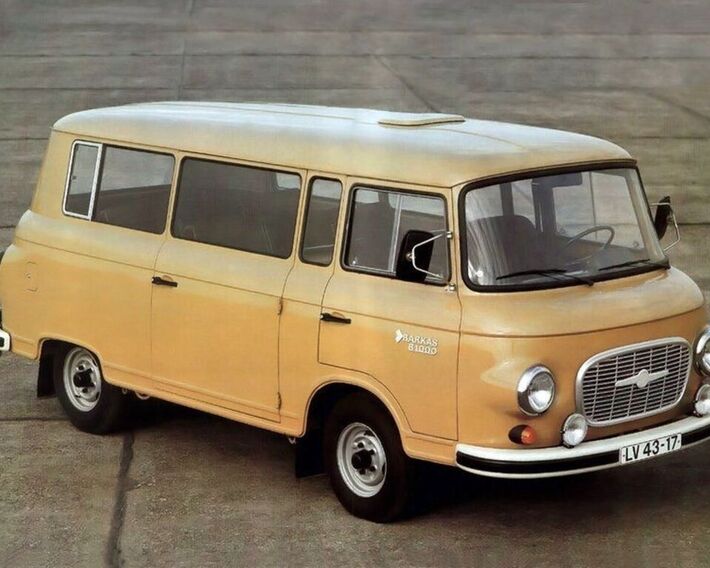
Barkas B 1000 in Pictures
The Barkas B 1000 epitomised the functional, purpose-driven design philosophy of East German industry. Available in a remarkable variety of body configurations, it served every role from grocery delivery to ambulance, police vehicle to workers' minibus.
Model Lineup
The Barkas range centred entirely on the B 1000 platform, offered in a comprehensive array of body configurations that served virtually every commercial and public service vehicle need in the German Democratic Republic.
Engineering & Technology
The Barkas B 1000 was a product of pragmatic GDR engineering — built to work reliably with available technology and components rather than to push technical boundaries. Its front-wheel drive layout was genuinely progressive for a commercial van in 1961, providing a flat load floor that maximised cargo utility. The two-stroke engine was a limitation, but one that GDR mechanics knew intimately and could service with basic tools.
- Front-wheel drive architecture — the B 1000's FWD layout eliminated the rear axle housing and transmission tunnel from the load area, providing a genuinely flat and maximally usable cargo floor in 1961, when most commercial vans still used rear-wheel drive with elevated load floors
- Three-cylinder two-stroke engine (1961–1990) — the IFA/Wartburg-sourced 992cc three-cylinder two-stroke, while basic by Western standards, was a unit that every GDR mechanic understood thoroughly, ensuring that vehicles could be serviced anywhere in the Eastern Bloc with available tools and parts
- Volkswagen four-stroke upgrade (1990) — the final evolution of the B 1000 received a modern 1272cc VW four-stroke engine, transforming refinement and performance in the brief period before production ended with reunification
- Modular body platform — the B 1000's standardised cab-forward platform accommodated an exceptional variety of body configurations, allowing a single production platform to serve as delivery van, minibus, ambulance, refrigerator vehicle, and specialist service vehicle
Barkas in Azerbaijan
Barkas vehicles reached Azerbaijan during the Soviet era, when the GDR's commercial vehicle production served the needs of the broader Eastern Bloc. The B 1000 was deployed across Soviet industry and public services, and surviving examples in Azerbaijan typically represent this Soviet-era introduction rather than later imports.
Today, Barkas B 1000s in Azerbaijan are primarily of interest to collectors of Eastern Bloc automotive heritage and enthusiasts of GDR industrial history. Their relative scarcity outside Germany makes surviving examples particularly interesting for collectors who appreciate the honest, functional design philosophy that characterised East German manufacturing. BakuWheels can connect interested buyers with specialist importers experienced in sourcing Eastern Bloc commercial vehicles.
Why Barkas?
- Eastern Bloc heritage: The Barkas B 1000 is one of the most significant commercial vehicles of the Cold War era — a vehicle that served the daily operational needs of the German Democratic Republic for thirty years, making it an authentic piece of 20th-century European industrial history.
- Mechanical simplicity: The two-stroke GDR-era versions are among the most mechanically straightforward commercial vans ever produced — simple enough that a knowledgeable amateur mechanic can maintain and restore them without specialist equipment or esoteric parts knowledge.
- Collector rarity: Surviving roadworthy Barkas B 1000s, particularly the rare 1990 VW-engined version, are uncommon and actively sought by collectors of Eastern Bloc vehicles in Germany and across Europe — making well-preserved examples increasingly valuable.
BakuWheels uses cookies to improve your experience, analyse site traffic, and personalise content. By clicking Accept All, you consent to our use of cookies. Learn more in our Cookie Policy.