

Trabant
The Trabant — affectionately known as the "Trabi" — was the signature car of the German Democratic Republic (East Germany), produced from 1957 until 1991. Built by VEB Sachsenring Automobilwerke Zwickau, the Trabant became one of the most enduring symbols of communist-era Eastern European life and one of automotive history's most fascinating social documents.
Origins & Heritage
The Trabant was developed from the earlier IFA F8 and F9 models produced in Zwickau, Saxony, under the centralised planning of the East German (GDR) state industrial enterprise VEB Sachsenring. The P50 Trabant — the first model — launched in 1957, featuring a two-stroke two-cylinder engine producing 18 hp, a front-wheel-drive layout, and an unusual Duroplast body. Duroplast — a composite of cotton fibres and phenol resin — was chosen because East Germany lacked sufficient steel, but it proved durable if peculiar: it did not rust, yet it also could not be easily recycled, painted conventionally, or repaired using standard bodywork techniques.
The Trabant 601 — introduced in 1964 — became the definitive model and remained in production with minimal changes until 1990. An astonishing 2.8 million examples of the 601 were built over 26 years with virtually no engineering updates, because the GDR's central planning system prioritised production quotas over product development. Buyers often waited 10–15 years on a state waiting list to receive their Trabant — a detail that perfectly illustrates the economic realities of communist consumer goods production.
When the Berlin Wall fell in November 1989, a famous image was created: streams of Trabant 601s pouring through the border crossings, their two-stroke engines creating a distinctive blue smoke, their Duroplast bodies in pastel colours. The Trabi became the symbol of German reunification — a touchstone of nostalgia and historical memory. A final attempt to modernise the Trabant 1.1 with a Volkswagen Golf engine was made in 1990, but reunification made it commercially unviable, and production ended in 1991.
Key Milestones
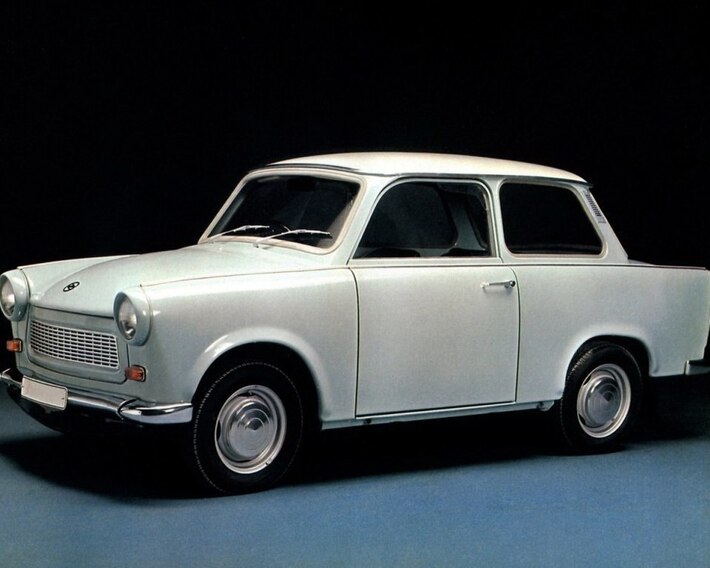
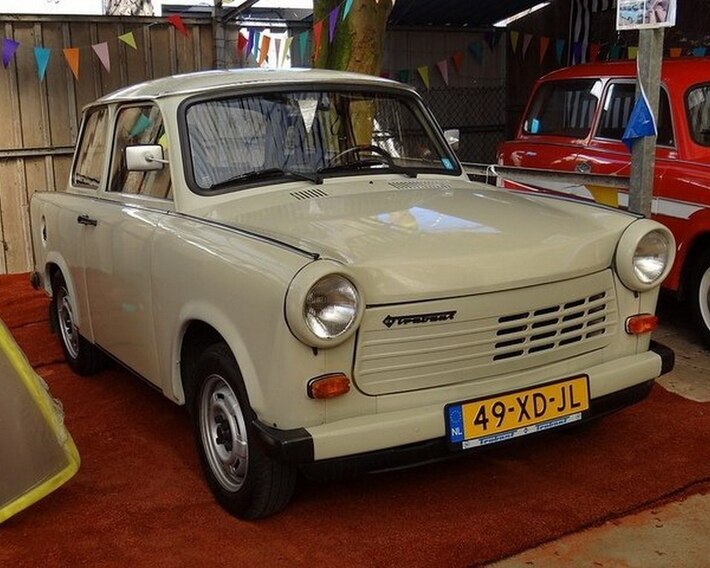
Iconic Models in Pictures
The Trabant 601's pastel Duroplast body and two-stroke blue exhaust smoke are among the most recognisable images of the Cold War era — a car whose appearance perfectly encapsulated the world it was built for.
Model Lineup
The Trabant range comprised a series of related models built on the same two-stroke mechanical foundation, from the original P50 to the final modernised 1.1.
Engineering & Technology
The Trabant's engineering was deliberately simple — a product of the GDR's industrial constraints and central planning priorities. The two-stroke two-cylinder engine required a premix of petrol and oil (like a chainsaw), produced approximately 26 hp, and generated a distinctive blue smoke exhaust. The Duroplast body panels, while unusual, proved extremely durable — Trabants survived decades of use with their panels intact, even as other components failed.
- Two-stroke 594cc two-cylinder engine — 26 hp, requiring a petrol-oil premix; distinctive blue exhaust smoke and characteristic sound
- Duroplast body panels — phenol resin reinforced with cotton wool or wool fibres; does not rust but cannot be recycled
- Front-wheel-drive layout — unusual for the 1950s when most cars were rear-wheel drive; gave the Trabant good traction in winter conditions
- Monocoque steel chassis with Duroplast outer panels — a hybrid construction that made the body lightweight but difficult to repair
- Trabant 1.1 variant used Volkswagen Polo 1.1 litre 40 hp engine — a direct fuel injection petrol unit replacing the two-stroke
Trabant in Azerbaijan
The Trabant is one of the most recognisable cars of the Soviet era, and while Azerbaijan was part of the USSR, Soviet Trabants were imported primarily to East Germany's socialist allies. Some Trabants reached the Caucasus region through commercial exchanges within the Eastern Bloc, though they were never as common as Soviet-produced LADA or Moskvich models. Today, surviving Trabants in Azerbaijan are genuine curiosities — appreciated by vintage car collectors for their unique cultural significance.
For Azerbaijani enthusiasts of Soviet-era automotive history, the Trabant represents a fascinating window into East German consumer culture — so different from Soviet-era Soviet production despite sharing the same ideological framework. A Trabant 601 in Azerbaijan is an authentic piece of Cold War history; maintaining one requires dedication, but the two-stroke engine's mechanical simplicity means that basic servicing is accessible to any competent mechanic.
Why Consider a Trabant?
- Living history: The Trabant 601 is one of the most historically significant cars ever produced — a vehicle whose story encompasses the entire arc of communist East Germany from 1957 to 1991.
- Cultural icon: The Trabi's image at the Berlin Wall in 1989 is one of the defining photographs of the 20th century — making every surviving 601 a genuine piece of living history.
- Mechanical simplicity: The Trabant's two-stroke engine is among the mechanically simplest automotive powerplants ever produced — basic maintenance is accessible to any enthusiast willing to learn its particular requirements.
- Duroplast durability: Despite its unusual material, Duroplast has proven extraordinarily resistant to decay — surviving Trabants retain intact body panels decades after production.
- Collector's rarity: As the decades pass, Trabants in good condition become increasingly rare and increasingly appreciated — particularly examples outside Germany, where reunification resulted in most Trabants being scrapped.
BakuWheels uses cookies to improve your experience, analyse site traffic, and personalise content. By clicking Accept All, you consent to our use of cookies. Learn more in our Cookie Policy.