
Wartburg
Wartburg is East Germany's most iconic passenger car brand — a product of the state-owned VEB Automobilwerk Eisenach factory whose two-stroke-engined saloons, estates, and roadsters carried millions of DDR citizens across four decades of divided Germany. From the beautifully styled 311 of the 1950s to the long-lived 353 Tourist, and finally the Volkswagen-engined 1.3 that marked the end of an era, Wartburg represents one of automotive history's most remarkable survival stories: a car brand that kept producing vehicles under a command economy until the moment the Berlin Wall fell.
Origins & Heritage
The Wartburg name has roots stretching to 1898, when the Fahrzeugfabrik Eisenach began producing Wartburg-branded vehicles in the Thuringian city of Eisenach — a town that had been synonymous with engineering and craftsmanship for generations. The factory produced cars and motorcycles under various brand names through the pre-war decades, including a period as the producer of BMW automobiles under licence in the early 1930s. After World War II, when Eisenach found itself in the Soviet Occupation Zone — and later the DDR (Deutsche Demokratische Republik, or East Germany) — the factory was nationalised and reorganised as VEB Automobilwerk Eisenach.
The modern Wartburg era began properly in 1956 with the launch of the Wartburg 311, a surprisingly elegant three-cylinder car whose styling bore the influence of pre-war German automotive aesthetics filtered through 1950s sensibility. The 311 was followed by the 353 in 1966 — the model that would define Wartburg for over two decades. Built on a unibody platform with a 993cc three-cylinder two-stroke engine, the 353 was manufactured in saloon, estate (Tourist), and van body styles, becoming the everyday transport of countless East German families and achieving significant export sales to Western Europe and other markets.
The two-stroke engine that powered Wartburgs throughout most of their production life was both the brand's defining characteristic and its greatest engineering limitation. Simple, light, and easy to repair, it nonetheless produced visible smoke, required oil to be mixed with petrol, and struggled to meet tightening Western European emissions standards. By the late 1980s, Wartburg had secured a supply of Volkswagen Polo 1.3L four-stroke engines — and the resulting Wartburg 1.3 represented a genuine quantum leap in refinement. Production ended in April 1991, just eighteen months after German reunification made the transition to Western automotive standards both inevitable and commercially necessary.
Key Milestones
Iconic Models in Pictures
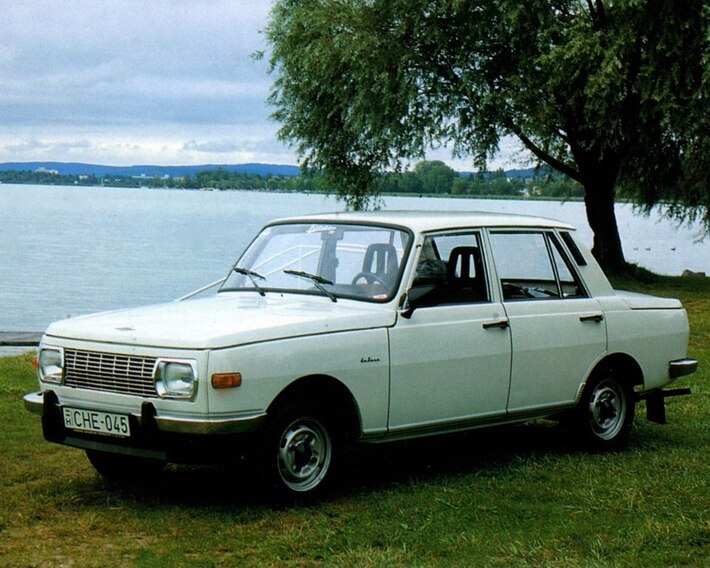
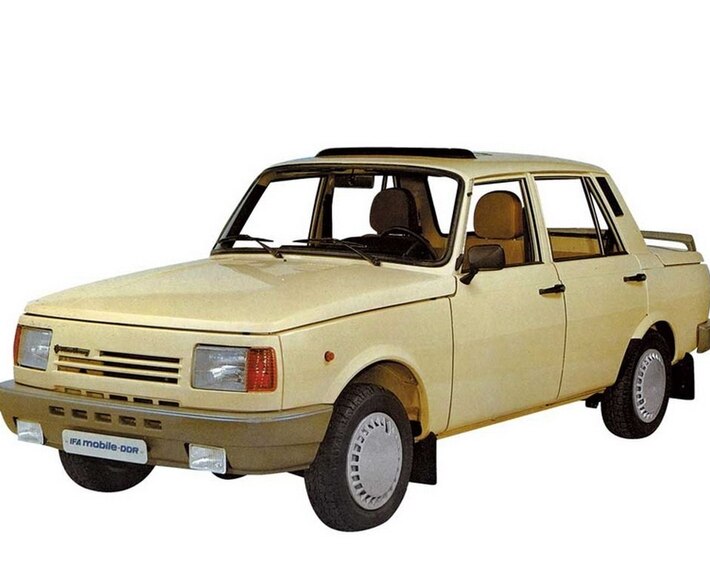
Three generations of Wartburg design — from the elegantly styled 311 of the mid-1950s through the utilitarian 353 Tourist that defined everyday East German motoring, to the four-stroke 1.3 that attempted to bridge the gap between communist-era engineering and modern standards.
Model Lineup
Wartburg produced a focused range of passenger cars across its post-war production life, with body style variations — saloon, estate, cabriolet, and van — providing flexibility within a common mechanical platform.
Engineering & Technology
Wartburg's engineering philosophy was shaped entirely by the constraints and priorities of a planned economy: simplicity of manufacture, ease of field repair using basic tools, and maximum use of domestically available materials and technology. The three-cylinder two-stroke engine that powered the 311 and 353 was a masterpiece of pragmatic engineering — fewer moving parts than any four-stroke of comparable output, requiring no oil pump, no camshaft, and no complex valve train. A mechanic with basic hand tools could completely disassemble and rebuild a Wartburg engine in an afternoon.
- Three-cylinder 991cc two-stroke engine developing approximately 45–50 hp — simple, light, and repairable with minimal tooling across the entire DDR service network
- Unibody construction (Wartburg 353) providing reasonable structural rigidity while keeping vehicle weight below 900 kg, aiding performance from the modest engine output
- Front-wheel drive layout — technically progressive for its era, particularly for an Eastern Bloc vehicle — providing good traction in winter conditions common across Central Europe
- Volkswagen 1.3L four-stroke engine (Wartburg 1.3) — a 46 hp overhead-valve unit that eliminated the smoke, oil mixing, and emissions issues of the two-stroke while fitting the existing bodyshell with minimal modification
- Durable tubular steel frame construction in the 311 series, contributing to the exceptional structural survival rate of early examples now prized by collectors worldwide
Wartburg in Azerbaijan & the Former Soviet Sphere
Wartburg vehicles reached the Soviet sphere — including Azerbaijan — through the Comecon trade framework that linked East Germany's industrial output with the Soviet Union and its satellite states. East German vehicles, particularly the Wartburg and its smaller sibling the Trabant, were distributed across Soviet bloc countries as part of bilateral trade agreements. In Azerbaijan, as across the Caucasus, a small number of Wartburg 353 models arrived through official channels during the 1970s and 1980s, typically as vehicles allocated to enterprises, institutions, or privileged individuals rather than through open consumer sales.
Today, Wartburg vehicles in Azerbaijan occupy the niche of European classic car imports — rare, historically significant, and of genuine interest to collectors of Cold War-era automobiles. The mechanical simplicity of the two-stroke models means that a resourceful mechanic can keep one running with ingenuity and basic parts, while the Wartburg 1.3's Volkswagen drivetrain makes it the most practically maintainable of all variants. Interest in Soviet-bloc classics has grown steadily across the South Caucasus as a generation that remembers these vehicles reaches collecting age.
Why Consider a Wartburg?
- Genuine automotive history: Owning a Wartburg means owning a tangible piece of Cold War automotive history — a vehicle that encapsulates the industrial ambitions, engineering constraints, and everyday realities of life in East Germany across four extraordinary decades.
- Two-stroke rarity: The three-cylinder two-stroke engine is one of the most distinctive automotive configurations ever used in series production, producing a sound, character, and driving experience completely unlike any modern vehicle — making Wartburgs an unforgettable experience for those who appreciate mechanical uniqueness.
- Exceptional mechanical simplicity: The two-stroke Wartburg models are among the mechanically simplest cars ever built for road use — with far fewer components than any comparable four-stroke, they can be maintained and repaired by any competent mechanic with basic hand tools and a willingness to learn.
- Strong collector community: Wartburg enjoys an active and enthusiastic international collector community, with clubs across Germany, the UK, and the wider former Eastern Bloc providing technical knowledge, parts sourcing, and fellowship for owners of these historically significant vehicles.
- Appreciating rarity: As surviving two-stroke Wartburgs diminish through attrition, well-preserved and restored examples are steadily increasing in collector value — particularly the elegant 311 series and the rare open-top variants, which command premium prices at specialist auctions.
BakuWheels uses cookies to improve your experience, analyse site traffic, and personalise content. By clicking Accept All, you consent to our use of cookies. Learn more in our Cookie Policy.