

Carbodies
The Coventry coachbuilder that gave London its most enduring icon — the FX4 black taxi that defined a city.
Origins & Heritage
Carbodies Ltd was founded in 1919 in Coventry, England, initially as a general coachbuilding company producing custom vehicle bodies for a variety of automotive clients. In the post-war years, the company's fortunes became increasingly tied to one specific product: the purpose-built London taxi cab. This specialisation would define Carbodies for the remainder of its independent existence and create one of the most recognisable vehicles in the world.
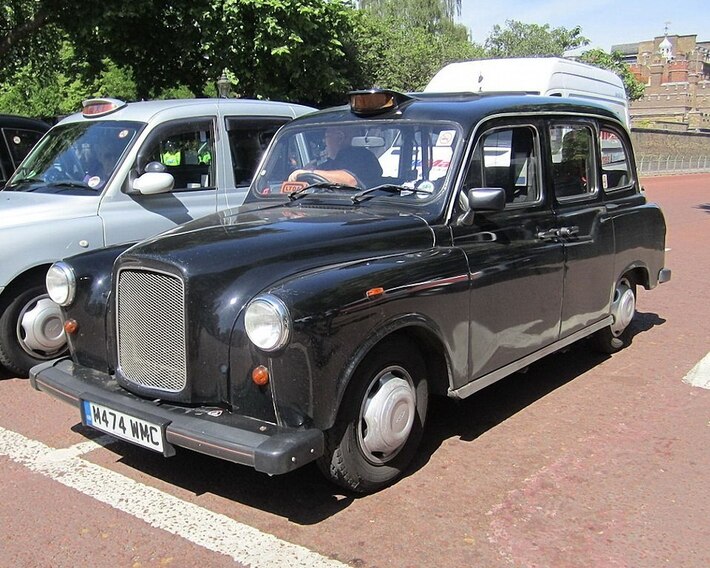
The Carbodies FX3, introduced in 1948, was the first purpose-designed London taxi cab to replace the converted private cars that had served the capital's streets. Its successor, the FX4, arrived in 1958 and would go on to become the quintessential London black cab — a vehicle so closely associated with the city that it is one of the most immediately recognisable automobile silhouettes in the world, alongside the Volkswagen Beetle and the Mini.
The FX4 remained in production under Carbodies and its successor companies for over 40 years, a testament to the soundness of its original design. The vehicle's exceptional turning circle — required by London taxi licensing regulations — its tall, accessible interior, and its remarkable durability made it uniquely suited to its purpose. In 1982, Carbodies was acquired by Mann & Overton, the taxi wholesaler, forming the company that would become LTI (London Taxi International).
Key Milestones
Iconic Carbodies Models
The Carbodies FX4 is one of the most photographed vehicles in history — an instantly recognisable symbol of London that has appeared in thousands of films, photographs, and artworks.
Notable Models
Carbodies' vehicle history is defined by its iconic London taxi cab series — a lineage that began with the FX3 and culminated in the FX4.
Engineering Heritage
Carbodies' vehicles were engineered with a single overriding purpose: to withstand the extraordinary demands of London taxi service. This meant prioritising durability, ease of repair, and passenger accessibility over performance or cost.
- Purpose-designed taxi chassis — reinforced floor structure and body mounts engineered for continuous commercial use over 200,000+ miles
- Tight 25-foot turning circle — mandated by London taxi licensing regulations, achieved through a specialised steering geometry unique to the FX series
- Tall, accessible interior — designed to allow passengers to enter and exit without stooping, and to accommodate passengers with mobility requirements
- Diesel power throughout later production — Land Rover 2.25L diesel and later Nissan 2.7L diesel units, chosen for fuel economy and durability
Carbodies in Azerbaijan
Carbodies vehicles are virtually unknown in Azerbaijan, where the taxi market has historically been dominated by conventional sedans and, more recently, purpose-built minivan-type vehicles. The classic FX4 London taxi, however, is universally recognised as a cultural icon — its image appearing widely in travel media, film, and global popular culture.
The occasional appearance of an FX4-style London taxi in Azerbaijan would invariably attract significant attention, as the vehicle is instantly associated with London in the global cultural consciousness. For collectors and automotive historians in the region, a surviving Carbodies FX4 represents a genuine piece of British automotive and social history.
Why Carbodies Matters
- Cultural icon: The Carbodies FX4 is one of the most recognised automobile silhouettes in the world — a vehicle that represents an entire city in the global imagination.
- Engineering longevity: The FX4 remained in continuous production for 39 years — one of the longest production runs of any automobile — a testament to the soundness of its original engineering.
- Historical significance: Carbodies defines the history of professional taxi cab design in Britain, establishing standards for passenger accessibility, durability, and urban performance that influenced taxi design worldwide.
- Collector value: Surviving FX4s are increasingly sought by automotive collectors, particularly those with an interest in British commercial vehicle history and mid-20th century industrial design.
BakuWheels uses cookies to improve your experience, analyse site traffic, and personalise content. By clicking Accept All, you consent to our use of cookies. Learn more in our Cookie Policy.