

TH!NK
TH!NK — founded in Norway in 1991 as Think Nordic — was one of the world's earliest dedicated electric microcar manufacturers, producing the TH!NK City ahead of the mainstream EV revolution. Backed at one point by Ford Motor Company, TH!NK pioneered lightweight urban electric mobility a decade before Tesla changed the automotive world.
History & Origins
TH!NK was founded in 1991 by Jan Otto Ringdal in Norway under the name Think Nordic AS, with the ambition of creating a practical electric city car for Norwegian consumers. Norway's strong environmental policies and government support for electric vehicles made it an ideal early market for an EV specialist. The company developed the TH!NK City — a two-seat urban electric vehicle with a polymer body designed to minimise weight and cost.
In 1999, Ford Motor Company acquired TH!NK as part of its research into electric vehicles — a strategic investment during a period when major manufacturers were evaluating the potential of zero-emission mobility. Ford invested significantly in TH!NK's development and even sold the TH!NK City through selected European Ford dealers. However, in 2003, Ford's strategy changed: the company sold TH!NK back to Norwegian investors, believing that EV technology was not yet commercially viable at scale.
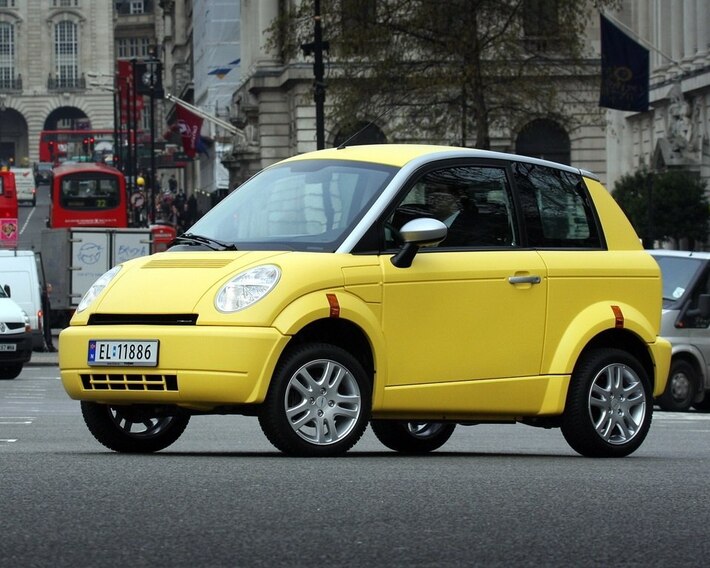
Reorganised under new Norwegian ownership, TH!NK relaunched the City in 2007 with improved performance and range. The updated TH!NK City used a 34 kW electric motor, achieved a range of approximately 160 km, and featured a distinctive teardrop body. Financial difficulties persisted, however, and TH!NK filed for bankruptcy in 2011. The assets were acquired by a Finnish consortium but a sustained revival never materialised. TH!NK remains historically significant as one of the electric vehicle industry's true pioneers.
Key Milestones
Iconic Models in Images
The TH!NK City's polymer teardrop body was ahead of its time — a lightweight, recyclable urban EV designed in Norway a full decade before mainstream electric vehicles became commercially viable.
Model Range
TH!NK's production centred on the City in two generations, with concept variants pointing toward a broader future that never fully materialised.
Technology & Engineering
The TH!NK City used a lightweight polymer body over a steel safety cage — a construction philosophy designed to minimise weight while meeting European crash safety standards. The polymer panels were recyclable and available in multiple colours, giving TH!NK an environmental advantage over painted steel-bodied competitors. The electric drivetrain was simple, reliable, and ideally suited to urban stop-start driving.
- 34 kW electric motor — adequate for urban use up to 100 km/h, optimised for stop-start city driving
- Lithium-ion battery (later models) — approximately 160 km city range from a full charge
- Polymer body panels over a steel safety cage — lightweight, recyclable, and colour-stable without painting
- Integrated onboard charger — TH!NK City could charge from standard European household sockets overnight
- Norwegian cold-weather engineering — battery management and cabin heating systems adapted for Scandinavian winter conditions
TH!NK in Azerbaijan
TH!NK vehicles are virtually absent from Azerbaijan — the brand ceased production in 2011 and its total production numbers were very small. However, TH!NK's story is an important chapter in the history of electric vehicles: the company demonstrated that urban EVs were practical and desirable a decade before the mainstream market accepted this proposition.
For Azerbaijani EV enthusiasts, TH!NK is a fascinating historical brand — a reminder that Norway's electric vehicle culture predates Tesla's global expansion by many years. Knowing TH!NK's story provides useful context for understanding why Norway today leads the world in EV adoption — the country's support for pioneering manufacturers like TH!NK helped build the infrastructure and consumer confidence that now makes Norway the world's most EV-dense market.
Why Choose TH!NK?
- EV pioneer: TH!NK began developing electric city cars in 1991 — making it one of the world's earliest dedicated EV manufacturers, predating the mainstream EV revolution by two decades.
- Norwegian cold-weather expertise: TH!NK's development in Norway demanded battery and cabin systems capable of performing in severe cold — a technical challenge that gave the brand valuable engineering experience.
- Ford Motor Company connection: Ford's 1999 acquisition validated TH!NK's technology and brought significant investment — a major manufacturer recognising the potential of electric urban mobility.
- Lightweight polymer engineering: The TH!NK City's recyclable polymer body was an early example of sustainable automotive manufacturing — ahead of most mainstream manufacturers in environmental philosophy.
- Historical significance: TH!NK occupies a unique position in EV history: a brand that was right about the future but wrong about the timing — its pioneering work contributed to the electric vehicle infrastructure and policy environment that makes today's EV revolution possible.
BakuWheels uses cookies to improve your experience, analyse site traffic, and personalise content. By clicking Accept All, you consent to our use of cookies. Learn more in our Cookie Policy.