
Alfa Romeo 6C (1925–1954)
The Alfa Romeo 6C is the foundation of everything Alfa Romeo became in the twentieth century — Vittorio Jano’s masterpiece, a DOHC straight-six that won the Targa Florio, the Mille Miglia, and captured the imagination of the finest Italian coachbuilders for thirty years. Available in four main displacement families (1500, 1750, 2300, 2500) and with coachwork by Touring, Zagato, Pininfarina, and the greatest Italian carrozzerie, the 6C is one of the supreme collector cars in automotive history.
Overview
When Vittorio Jano arrived at Alfa Romeo from Fiat in 1923, he brought with him the engineering philosophy that would transform Alfa Romeo from a competent Italian manufacturer into the most celebrated sporting car company in the world. His first major project was the P2 Grand Prix car; his second, and arguably more significant for Alfa Romeo’s road car legacy, was the 6C series of twin-cam straight-six road and racing cars that would define the Italian sports car from 1925 through to the outbreak of war.
The first 6C (6 cylinders — Alfa Romeo followed a naming convention describing the engine’s cylinder count) was the 6C 1500 of 1925: a 1487cc twin overhead camshaft straight-six that was among the most technically advanced road car engines in the world at its introduction. The twin-cam design allowed higher compression ratios and more precise valve timing than the pushrod engines used by most contemporaries; with supercharging, the small six produced outputs that far exceeded what might be expected from a 1.5-litre engine.
The 6C 1750 (1929) is widely regarded as the most historically significant 6C variant. The 1752cc unit, available in multiple states of tune from the standard touring configuration to the Grand Sport supercharged version producing 102 hp, became the weapon of choice for Alfa Romeo’s finest racing drivers. The moment that defines the 6C 1750’s place in history occurred at the 1930 Mille Miglia, when Tazio Nuvolari — starting last due to regulations — drove through the night without headlamps to preserve his position, passed teammate Achille Varzi in the closing stages, and won the race by a margin of 22 minutes. Nuvolari’s 1930 Mille Miglia victory is considered by many historians as the greatest single act of racing driving in history.
The 6C 2300 (1934) and 6C 2500 (1939–1952) continued the lineage through the pre-war and immediate post-war periods. The 6C 2500 Villa d’Este (1949–1952) — a cabriolet variant by Touring Superleggera of extraordinary beauty — is considered the finest of all post-war 6C bodies and one of the most sought coachbuilt Italian cars of any era. The name “Villa d’Este” was taken from the concours d’élégance at which a 1949 example won Best in Show; the name has since been applied to the entire cabriolet production run of that period and the concours itself continues as one of the world’s most prestigious classic car events.
The 6C was replaced by the 1900 in 1950 as Alfa Romeo’s primary road car, with 6C 2500 production continuing in declining numbers until 1954. The 6C is today among the most important and valuable series of Italian collector cars, with exceptional examples of the most significant variants selling for prices that reflect their historical significance as much as their automotive merit.
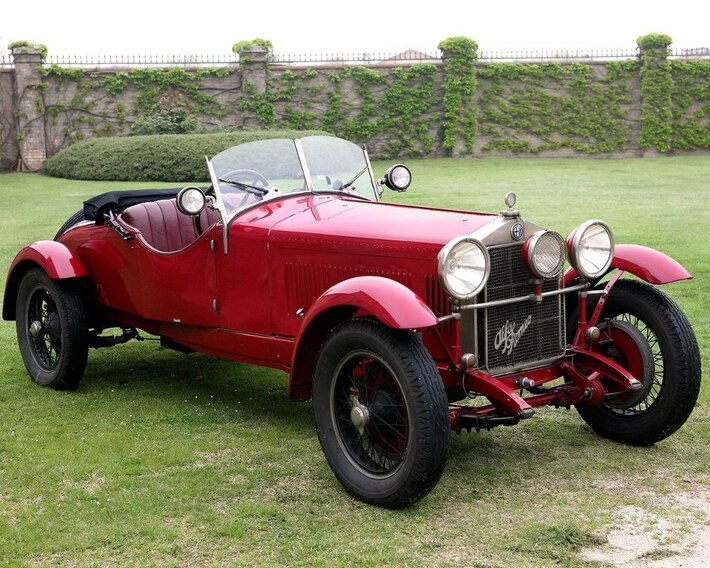
Alfa Romeo 6C in Pictures
The 6C’s coachbuilt bodies by the greatest Italian carrozzerie represent the peak of pre-war and early post-war Italian coachbuilding art: a combination of engineering excellence and aesthetic mastery.


Key Specifications
- 6C 1500 (1925–1928): 1487cc DOHC straight-six; early cars single overhead camshaft, later twin-cam; optional supercharger on Sport variants; 44–78 hp depending on specification. The first 6C; Jano’s initial expression of the concept; won the Targa Florio 1928 (Campari) and demonstrated the architecture’s racing potential.
- 6C 1750 (1929–1933): 1752cc DOHC straight-six; Roots-type supercharger optional (Gran Sport); 46 hp (standard) to 102 hp (Gran Sport supercharged); multiple body variants including Sport, Super Sport, and Gran Sport. The Gran Sport driven by Nuvolari to 1930 Mille Miglia victory is the most celebrated 6C 1750; all authentic 1750 GS cars are now documented and extremely valuable.
- 6C 2300 (1934–1939): 2309cc DOHC straight-six; normally aspirated (primary) with supercharged racing versions; 68–95 hp road cars; new chassis with improved suspension; available in short (Mille Miglia) and long (Pescara touring) wheelbase configurations. Touring, Pininfarina, and Zagato bodies available; slightly more touring-oriented character than the 1750.
- 6C 2500 (1939–1952): 2443cc DOHC straight-six; normally aspirated; 87–145 hp (SS Super Sport top specification); available in pre-war and post-war body styles. The Villa d’Este cabriolet (Touring Superleggera, 1949–1952) is the post-war apex of the 6C family; values $3–5M for exceptional examples. The 6C 2500 SS (Super Sport) is the highest-performance road-going 6C.
- Construction: All 6C variants use a separate chassis frame (ladder frame) with hand-built coachwork; no two 6C cars are identical. The chassis was supplied to the great Italian carrozzerie (Touring, Zagato, Pininfarina, Stabilimenti Farina, James Young, Ghia) who built bodies to customer specification. Each car is therefore a unique combination of mechanical specification and coachwork design.
- Jano engine significance: Vittorio Jano’s DOHC straight-six design established principles — twin camshafts, hemispherical combustion chambers, chain-driven camshaft drive — that influenced Alfa Romeo’s engine design philosophy through the 1950s and contributed to the twin-cam four-cylinder engines of the 1900 and 105/115 series. The lineage from the 6C’s DOHC six to the 105/115’s twin-cam four-cylinder is direct and acknowledged.
- Coachbuilders: Touring Superleggera (Milano): Villa d’Este cabriolet, numerous open and closed bodies on all 6C variants; among the most sought. Zagato (Milano): competition berlinettas and spiders; double-bubble roofline; aerodynamic focus; now among the most valuable. Pininfarina (Torino): touring bodies of great elegance; multiple variants. James Young (UK): right-hand-drive export cars for the British market.
Variant Comparison
| Variant | Engine | Power | Gearbox | Best For |
|---|---|---|---|---|
| Alfa Romeo 6C 1500 (1925–1928) | 1487cc DOHC straight-six, initially single OHC then twin-cam | 44–78 hp (varies by specification) | 4-speed manual | The first 6C — Vittorio Jano’s original six-cylinder design; historically the most significant variant as it established the architecture that would win the Targa Florio and lay the foundation for all subsequent 6C models; the entry point into 6C collecting at the lowest acquisition cost within the family |
| Alfa Romeo 6C 1750 (1929–1933) | 1752cc DOHC straight-six, twin supercharger option (1750 Gran Sport) | 46–102 hp (1750 GS supercharged) | 4-speed manual | The most famous 6C variant; the car driven by Tazio Nuvolari to victory in the 1930 Mille Miglia against team orders; the 1750 in Gran Sport supercharged form is one of the most sought pre-war Italian racing cars; values for exceptional examples reach $5–8M; Pininfarina, Zagato, Touring, and James Young all created bodies on the 1750 chassis |
| Alfa Romeo 6C 2300 (1934–1939) | 2309cc DOHC straight-six, supercharged options | 68–95 hp (road); more in competition form | 4-speed manual | The larger-displacement mature 6C; slightly more road-oriented in character than the 1750; the 2300 Pescara (long-chassis) was the principal touring variant; Touring, Pininfarina, and Zagato bodies available; good starting point for 6C ownership at lower acquisition cost than the 1750 |
| Alfa Romeo 6C 2500 (1939–1952) | 2443cc DOHC straight-six, supercharged (rare) or normally aspirated | 87–145 hp (SS Sport version) | 4-speed manual | The definitive post-war 6C; the Villa d’Este (1949–1952) is the most elegant of all 6C bodies — a Touring Superleggera cabriolet of extraordinary beauty; values for Villa d’Este consistently reach $3–5M at auction; the last true 6C before the 1900 replaced the separate-chassis construction method |
What Makes the 6C Stand Out
The Alfa Romeo 6C is not merely an important collector car — it is one of the most significant objects in the entire history of motor sport and Italian design culture.
- The foundation of Alfa Romeo’s sporting heritage: Without the 6C, there would be no Alfa Romeo as we know it. The car’s racing victories — Targa Florio, Mille Miglia, Coppa Acerbo, the great Italian road races of the late 1920s and 1930s — established Alfa Romeo’s identity as the definitive Italian sporting car manufacturer. This identity has defined the brand for a century.
- Nuvolari’s 1930 Mille Miglia — the greatest drive in history: The 6C 1750’s association with Tazio Nuvolari’s 1930 Mille Miglia victory gives it a place in sporting history that transcends the automotive world. Nuvolari is considered by many historians as the greatest racing driver of all time; his 1930 victory in the 6C 1750 is his most celebrated achievement. Any 6C 1750 Gran Sport with documented Mille Miglia history is a supreme collector car.
- The Villa d’Este — a name that defines Italian elegance: The 6C 2500 Villa d’Este cabriolet gave its name to what became the world’s most prestigious concours d’élégance. The car’s beauty is so consistent with the setting that the concours took the car’s designation as its permanent title. Owning a genuine Villa d’Este is owning the car that defined a concept.
- The greatest Italian coachbuilders working on a single platform: The 6C chassis was the canvas on which Touring, Zagato, Pininfarina, and the other great carrozzerie exercised their finest craft. No other single chassis family received such consistent attention from so many great designers over so many years. The variety of surviving coachbuilt 6C bodies is itself a museum of pre-war Italian coachbuilding.
- Investment returns consistently among the highest in pre-war cars: The 6C’s combination of racing history, coachbuilding significance, and Alfa Romeo prestige has driven consistent appreciation over 50 years. Exceptional 6C 1750 GS and 2500 Villa d’Este examples have increased in value at rates that outperform most alternative investments over comparable periods.
Maintenance & Acquisition in Azerbaijan
A 6C is a 70–100 year old car requiring the most specialist maintenance available. Acquisition in Azerbaijan requires importation from Italy, specialist custodianship, and the highest level of insurance and storage provision.
- Alfa Romeo Classiche mandatory: No 6C should be acquired without full Alfa Romeo Classiche certification. The programme maintains comprehensive records for the 6C series and provides official authentication documentation without which the car’s provenance cannot be officially established. Contact Alfa Romeo Museum, Arese, Italy directly for Classiche evaluation.
- Specialist engine maintenance: The Jano DOHC straight-six requires maintenance by specialists with specific experience in the engine type. A very small number of workshops in Italy, the UK, and Germany are equipped to rebuild and maintain these engines correctly. Remote maintenance in Azerbaijan is not practical; the car should be returned to Italy for major service work.
- Parts fabrication: Parts for the 6C series are largely unavailable new; most requirements must be met by fabrication from original drawings (available through the Alfa Romeo Museum archive), sourcing from other 6C cars of the same variant, or commissioning a specialist to manufacture them. This is both expensive and time-consuming; budget accordingly.
- Coachbuilt body specialist: Any maintenance or repair to the coachbuilt aluminium or steel body requires a specialist coachbuilder with experience in pre-war Italian construction methods. In Italy, a small number of historic coachbuilding restorers maintain this capability; the work is expensive and should be budgeted as a major element of ownership cost.
- World-class auction preparation: Significant 6C examples (1750 GS, 2500 Villa d’Este) that will be offered at auction benefit from specialist preparation that includes mechanical recommissioning, coachwork preparation, and full documentation assembly. Major auction houses (RM Sotheby’s, Gooding & Company, Bonhams) provide specialist guidance for consignors of significant 6C cars.
- Insurance: Agreed-value specialist classic car insurance through Lloyd’s of London or an equivalent specialist insurer is the only appropriate coverage for a 6C. Standard motor insurance policies are entirely insufficient for the values involved ($2M–8M+). Storage facilities must meet the insurer’s specific requirements for climate control, security, and fire suppression.
6C vs. Pre-War Contemporaries
| Model | Core Strength | Main Compromise |
|---|---|---|
| Alfa Romeo 6C 1750 Gran Sport | The pinnacle of pre-war Italian motorsport engineering; Jano’s masterpiece; won the Targa Florio, Mille Miglia; Nuvolari’s 1930 Mille Miglia victory is one of the most celebrated in motorsport history; coachwork by the greatest Italian carrozzerie; auction values consistently among the highest for any Italian car | Purchase prices are at the extreme top of the collector car market ($3M–8M+); extreme specialist maintenance requirements; parts are virtually unobtainable except through other cars or specialist fabrication; acquisition due diligence must be thorough to the highest possible standard |
| Mercedes-Benz SSK (1928–1932) | The German counterpart to the 6C 1750 in 1920s–30s motorsport; supercharged straight-six; Ferdinand Porsche design; equal racing prestige; some of the most dramatic pre-war bodies; now among the most expensive pre-war cars at auction ($10M+) | Even more expensive than the 6C 1750; Mercedes SSK ownership requires the absolute highest level of specialist support; German versus Italian character; the SSK is a larger, more imposing car than the nimble 6C |
| Bugatti Type 43 / Type 57 (1920s–30s) | French engineering genius at its peak; exquisite mechanical precision; the Type 57 Atlantique is the most valuable pre-war car in existence; Bugatti collector community among the most prestigious in the world; extraordinary craftsmanship | Bugatti values are at or above 6C 1750 levels; French rather than Italian; the mechanical philosophy is entirely different; Bugatti ownership is even more rarefied and specialist than 6C ownership |
| Bentley Speed Six / R-Type (1928–1955) | British pre-war excellence; the Speed Six won Le Mans 1929 and 1930; magnificent large-displacement straight-six; Bentley Boys racing heritage; strong British collector community; good specialist support in the UK | Heavier and larger in character than the Italian 6C; British rather than Italian; Bentley values at the top of the pre-war market comparable to 6C; different aesthetic tradition |
| Alfa Romeo 6C 2500 Villa d'Este | The most beautiful 6C variant and one of the most beautiful open Italian cars ever built; Touring Superleggera cabriolet body; post-war elegance combining 6C engineering with early 1950s Italian coachbuilding at its peak; values $3–5M; also wins Villa d’Este Concours d’Elegance regularly | The Villa d’Este is in the same price bracket as the 1750 GS; post-war rather than the more racing-focused 1750; the comparison between variants is not a compromise but a choice of preference |
Cost-of-Ownership Calculator
Provided for reference; the 6C is a museum-grade acquisition where annual custodianship costs (storage, insurance, specialist maintenance) dwarf running costs.
- Estimated annual fuel use: 1200 litres
- Estimated annual fuel cost: $960
- Total annual ownership estimate: $5260
- Average monthly ownership estimate: $438
Acquisition Checklist
Acquiring an Alfa Romeo 6C is one of the most serious decisions in the pre-war collector car market. The due diligence process must be conducted to the highest standard.
- Classiche certification and Alfa Romeo Museum archive verification: Every 6C acquisition must begin with Alfa Romeo Classiche certification. The Museum Archive in Arese holds production records including chassis numbers, engine numbers, and original body specifications. Cross-reference all numbers on the car against the archive before proceeding.
- Coachbuilder archive verification: For significant coachbuilt variants (Touring, Zagato, Pininfarina), the coachbuilder’s own archive should be consulted. The Touring Superleggera archive (now managed by a continuation company in Milan), the Zagato Archive, and the Pininfarina Archive all maintain records of the bodies they built on the 6C chassis. Any discrepancy between car and archive records is a critical concern.
- RIAR (Registro Italiano Alfa Romeo) registration: The RIAR is Italy’s most comprehensive Alfa Romeo classic car registry. Registration of a 6C with RIAR adds provenance documentation and connects the car to the Italian Alfa Romeo classic car community, which is the primary market for significant 6C trades.
- Race history documentation: For any 6C with claimed racing history (particularly Mille Miglia, Targa Florio), research the documented race results against Italian motorsport archives. The ACI Storico (Automotoclub Storico Italiano) maintains records of Italian historic race results; international archives including IMRC are also relevant. A car with documented race history carries a significant premium; undocumented claims should be treated with caution.
- International legal and tax compliance: Acquiring and importing a 6C to Azerbaijan requires full legal compliance with Italian cultural heritage law (pre-war Italian cars may be subject to export restrictions), EU export licensing, Azerbaijani customs procedures, and value declaration. Engage an international law firm with experience in cultural heritage and classic car transactions before proceeding.
Alfa Romeo 6C FAQ
Which 6C variant is the most historically significant?
The 6C 1750 Gran Sport is the most historically significant in terms of racing achievement — specifically the cars associated with Nuvolari’s 1930 Mille Miglia victory. For aesthetic significance, the 6C 2500 Villa d’Este cabriolet is the most celebrated, having given its name to the world’s most prestigious concours. Both are in the highest tier of pre-war Italian collector cars.
Can a 6C be driven on public roads?
Yes, and they regularly are — in the Mille Miglia Storica, the Villa d’Este parade, and on private roads by their owners. Driving a 6C on public roads in Azerbaijan would require appropriate registration (possible under historic vehicle regulations), specialist insurance, and a driver who understands the car’s pre-war mechanical characteristics (cable brakes on early cars, crash gearbox on some variants, no modern safety equipment). It is not advisable to drive a 6C in heavy traffic or on modern roads at speed; the cars are best enjoyed on roads appropriate to their era.
Is Italian cultural export law an issue for 6C acquisition?
Potentially yes. Italy’s Codice dei Beni Culturali (Cultural Heritage Code) may classify pre-war Italian cars of historic importance as “cultural goods” subject to export restrictions. Any 6C acquisition intended for permanent export from Italy requires a cultural heritage export licence from the Italian Ministry of Culture. The process can take several months and the licence may not be granted for the most historically significant examples. This legal requirement must be verified before any acquisition commitment is made.
Should You Acquire an Alfa Romeo 6C?
The Alfa Romeo 6C is not merely a collector car — it is a primary document of European motorsport and design history, an object whose significance extends well beyond automotive circles. For the collector with the financial resources, specialist support network, and genuine understanding of what it means to be the custodian of one of these cars, acquiring a 6C is among the most significant and rewarding decisions available in the collector car market. Values have appreciated consistently for decades and will continue to do so.
For buyers in Azerbaijan, the 6C acquisition path requires Italy as the acquisition source, the full complement of specialist legal, technical, and custodial support, and a long-term commitment to responsible ownership of an object of genuine historical significance. The rewards — driving, displaying, and stewarding one of the most important Italian cars ever built — are commensurate with the commitment required.
BakuWheels uses cookies to improve your experience, analyse site traffic, and personalise content. By clicking Accept All, you consent to our use of cookies. Learn more in our Cookie Policy.