
ARO
Romania's Rugged Off-roader: Built for the Mountains, Built to Last.
Origins & Heritage
ARO was Romania's specialist off-road vehicle manufacturer — a brand that produced rugged, capable four-wheel-drive vehicles for nearly five decades from its factory in Câmpulung, in the foothills of the Carpathian Mountains. The company's origins trace to the Uzina Mecanică Muscel plant established in the 1950s as part of Romania's communist-era industrialisation programme, with automobile production beginning under the IMS brand name before transitioning to the ARO identity (Auto România) in the early 1960s.
ARO's engineering philosophy was shaped by the Romanian landscape and the practical needs of agricultural, forestry, and military users who required vehicles capable of operating reliably on unmaintained mountain tracks, forest roads, and in seasonal conditions that would defeat most conventional passenger cars. The resulting vehicles were not sophisticated by Western European standards — they were heavy, mechanically straightforward, and unrefined in their on-road behaviour — but they possessed genuine off-road capability that matched or exceeded much more expensive competitors in terms of ground clearance, approach angles, and four-wheel-drive effectiveness.
ARO achieved considerable export success through the 1970s and 1980s, reaching markets in Western Europe, the Middle East, Africa, and the Americas — a remarkable achievement for a Romanian state enterprise competing against Land Rover, Toyota Land Cruiser, and other established off-road specialists. The ARO 24 series in particular found buyers across a diverse range of markets, with some Western European versions sold under local brand names. After the 1989 revolution, ARO struggled through the transition to a market economy, eventually ceasing production in 2006 after failed privatisation attempts and declining commercial viability.
Key Milestones
Iconic Models in Pictures
ARO's range of tough off-road vehicles served agricultural workers, foresters, military users, and adventurous private buyers across Eastern Europe and beyond — rugged machines whose capability far exceeded their modest engineering sophistication.
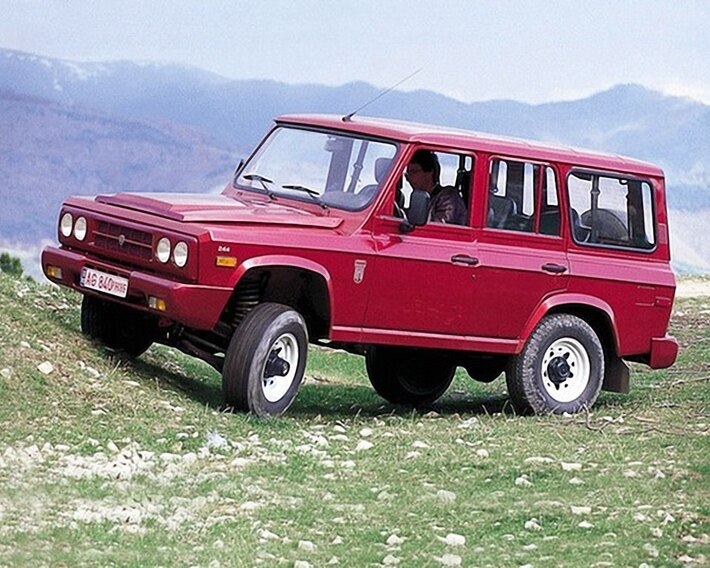
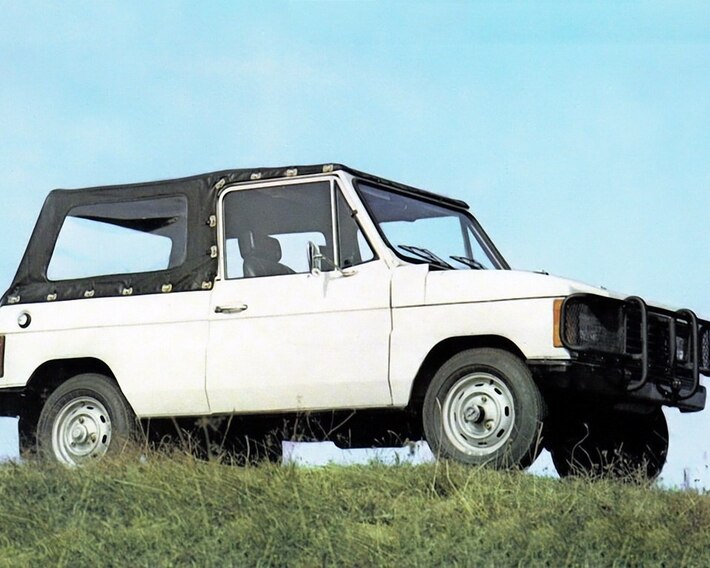
Model Lineup
ARO's product range was focused and purposeful — full-size and compact off-road utility vehicles designed for genuine capability in Romania's mountains, forests, and agricultural landscapes, with a simplicity of construction that enabled field maintenance far from any dealer.
Engineering & Technology
ARO's engineering approach prioritised durability, repairability, and genuine off-road capability over comfort or on-road refinement — the vehicles were designed to be maintained by rural mechanics using basic tools, with conventional ladder-frame construction, beam axles, and mechanical four-wheel-drive systems that could be repaired in field conditions without specialist equipment.
- Ladder-frame chassis construction — ARO's vehicles used traditional body-on-frame construction with a rigid ladder chassis providing the structural foundation, offering exceptional durability under off-road loading conditions and enabling straightforward body repair and replacement without specialist facilities
- Part-time four-wheel-drive with low-range transfer case — ARO's mechanical 4WD system engaged the front axle when needed, with a two-speed transfer case providing a low-range gear ratio for severe terrain — effective, robust, and repairable with conventional mechanical skills
- Beam axles front and rear — live axle construction on both ends provided maximum ground clearance and articulation capability in off-road conditions, at the expense of on-road refinement, placing ARO firmly in the traditional off-road utility vehicle category alongside Land Rover Series and early Toyota Land Cruiser
- Romanian-sourced diesel and petrol engines — ARO used Romanian-produced engines including diesel units derived from Renault technology and petrol engines of Soviet-influenced design, providing adequate power for off-road use with the advantage of locally sourced parts and widespread Romanian mechanic familiarity
- Extreme simplicity for field maintenance — ARO's conventional carburetor engines, mechanical fuel injection on diesel variants, and non-electronic control systems ensured that vehicles could be maintained and repaired by agricultural and forestry workers far from any dealer or specialist workshop, a critical capability for ARO's intended market
ARO in Azerbaijan
ARO vehicles reached the Soviet republics and post-Soviet markets through Eastern Bloc trade networks during the communist era — Romania and the USSR maintained commercial relationships that included vehicle exports, and some ARO 24 series examples were distributed to Soviet republics including Azerbaijan. A small number of ARO vehicles remain in circulation in Azerbaijan today, primarily older examples maintained by enthusiasts and rural owners who value the vehicles' mechanical simplicity and genuine off-road capability.
For Azerbaijani buyers and collectors interested in ARO vehicles, these represent genuinely capable and historically interesting four-wheel-drive vehicles at accessible prices. Parts availability is the primary challenge — Romanian-sourced components are not readily available in Azerbaijan, though some mechanical parts are shared with or compatible with Soviet-era vehicles, and the simple mechanical construction means that many repairs can be accomplished with fabricated parts or substitutes. ARO vehicles are best suited to enthusiast collectors or buyers in rural areas where their off-road capability remains practically relevant.
Why Consider an ARO?
- Proven genuine off-road capability: The ARO 24's ladder-frame chassis, live beam axles, and part-time four-wheel drive with low range provide off-road capability that remains practically relevant for buyers in rural Azerbaijan — capable of terrain that would defeat most modern crossovers and SUVs that only offer all-wheel-drive assistance.
- Extreme mechanical simplicity: ARO's conventional construction — carburetor engines, mechanical 4WD, and conventional bodywork — means that virtually any competent mechanic can service and repair these vehicles using standard tools, without specialist diagnostics, coding equipment, or manufacturer-specific parts.
- Unique Eastern European automotive heritage: ARO vehicles represent Romania's most significant contribution to global automotive manufacturing — a brand whose vehicles were exported to dozens of countries and whose engineering story is intertwined with the social and industrial history of communist-era Eastern Europe.
- Collector value in a niche segment: As one of the rarest Eastern European off-road vehicles in the Azerbaijani market, well-preserved ARO examples command collector interest among enthusiasts of communist-era vehicles and Eastern European automotive history — a niche but genuine appreciation community.
- Practical load-carrying and towing capability: ARO's ladder-frame construction and conventional drivetrain provide excellent towing and payload capacity relative to body size — the ARO 24 in particular can carry substantial loads and tow trailers that would exceed the capability of lighter modern crossovers at equivalent used-car pricing.
BakuWheels uses cookies to improve your experience, analyse site traffic, and personalise content. By clicking Accept All, you consent to our use of cookies. Learn more in our Cookie Policy.