

Heinkel
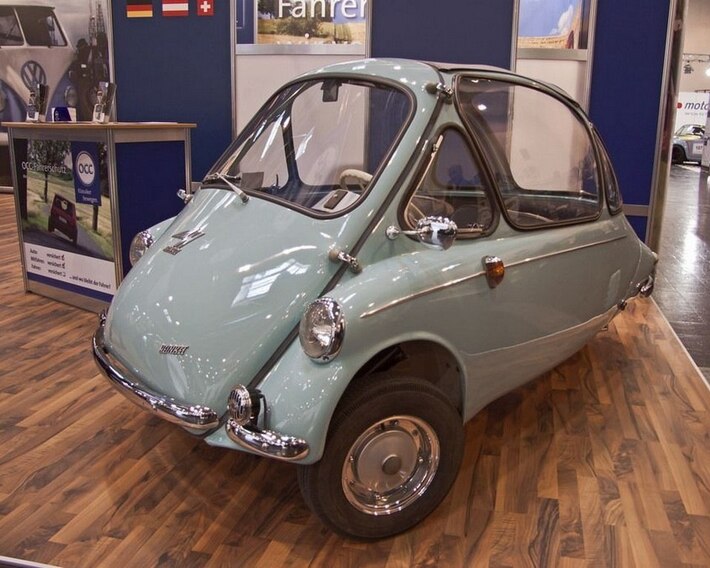
The aircraft manufacturer that built Germany's most beloved bubble car — the Heinkel Kabine, a three-wheeled icon of post-war European motoring.
Origins of Heinkel
Heinkel Flugzeugwerke was founded in 1922 in Germany, initially as an aircraft manufacturer. The company became famous in the aviation world for producing some of Germany's most advanced pre-war and wartime aircraft, including the He 111 bomber and the He 178 — the world's first jet-powered aircraft to fly, in 1939. After World War II, the Allied Control Council prohibited German aircraft production, forcing Heinkel to seek new commercial directions.
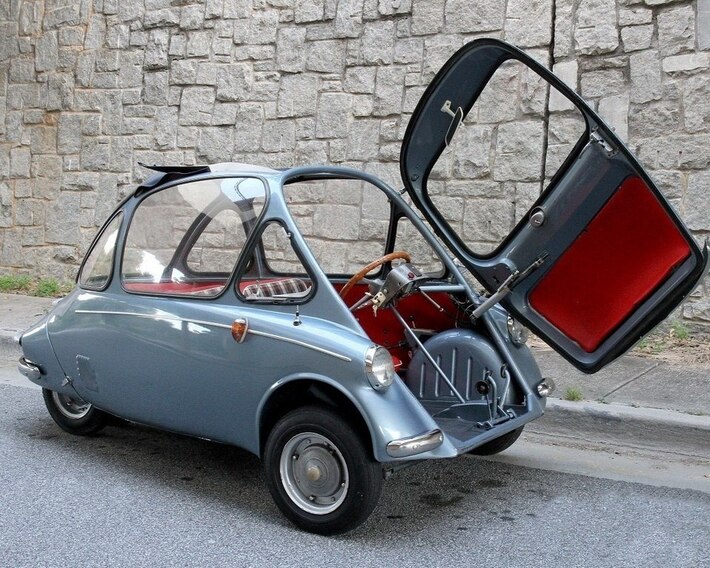
In the early 1950s, Heinkel entered the personal transport market by producing the Heinkel Tourist motor scooter in 1953 — a sophisticated, enclosed scooter that leveraged the company's precision engineering heritage. The success of the scooter encouraged Heinkel to develop a fully enclosed three-wheeled microcar, leading to the creation of the Heinkel Kabine (Cabin Scooter) in 1956. This distinctive bubble car, with its aircraft cockpit-inspired design and front-opening door, became one of the defining vehicles of the post-war European economy motoring era.
The Heinkel Kabine was produced from 1956 to 1958. When Heinkel was permitted to resume aircraft production, car manufacturing was no longer commercially necessary. The Kabine design was sold to Dundalk Engineering in Ireland, where it was briefly produced as the Trojan 200. Today, surviving Heinkel Kabines are prized collector vehicles worldwide, representing a unique intersection of aviation engineering heritage and automotive creativity.
Key Milestones
Notable Models
Heinkel's automotive output was brief but historically significant — two products that demonstrated how aviation engineering precision could translate into innovative personal transport.
Technology & Engineering
Heinkel's engineering approach drew directly from aviation manufacturing — precision, light weight, and structural efficiency were prioritised, producing vehicles of exceptional quality relative to their small scale.
- Aircraft-inspired monocoque body construction — efficient, lightweight, and structurally rigid, borrowing directly from Heinkel's aircraft manufacturing techniques
- Unique front-hinged door design on the Kabine — the entire front of the vehicle opened for entry and exit, a layout inspired by aircraft canopy design that provided exceptional interior access
- Rear-mounted single-cylinder engine with four-speed gearbox — a compact powertrain that kept weight distribution even and maximised interior space in the tiny cabin
- Precision-machined components throughout — quality standards derived from aviation manufacturing resulted in a vehicle significantly more refined than its microcar competitors
Heinkel in Azerbaijan
Heinkel Kabines have no presence in Azerbaijan's current automotive market. As rare collector vehicles from the 1950s, surviving examples are held almost exclusively in European private collections and automotive museums. The Heinkel name is better known in Azerbaijan in the context of aviation history rather than automotive history.
For Azerbaijani automotive enthusiasts interested in the history of European motoring, Heinkel represents a fascinating chapter — the story of a celebrated aircraft manufacturer that briefly, brilliantly produced some of the most technically sophisticated microcars of the post-war era. The Kabine stands as evidence that engineering excellence transfers between disciplines when the culture of precision is genuinely embedded.
Why Heinkel Matters
- Aviation-to-automotive engineering transfer: Heinkel demonstrates how precision engineering disciplines developed in one industry — aviation — can be successfully applied to create innovative products in another. The Kabine's quality was a direct product of aircraft manufacturing culture.
- Post-war European ingenuity: The Heinkel Kabine emerged from genuine material and economic constraint, representing the creative response of German industry to a period when fuel was scarce, roads were recovering, and mass car ownership was still aspirational for most families.
- Design innovation: The front-opening door, aircraft cockpit proportions, and enclosed three-wheel layout of the Kabine were genuinely original solutions to the challenge of personal enclosed transport on a minimal budget — solutions that remained visually distinctive decades later.
- Collector significance: Surviving Heinkel Kabines are among the most sought-after post-war European microcars at international auction and concours events, representing a confluence of aviation heritage, design originality, and the brevity of production that creates genuine rarity.
Iconic Models in Pictures
Heinkel vehicles — a visual selection of the iconic models produced by this manufacturer.
BakuWheels uses cookies to improve your experience, analyse site traffic, and personalise content. By clicking Accept All, you consent to our use of cookies. Learn more in our Cookie Policy.