

SMZ
SMZ — the Serpukhov Motor Plant — was a Soviet state enterprise that produced one of the most unusual vehicles in automotive history: a government-issued microcar for disabled veterans of the Second World War. The SMZ S-3A and S-3D were not luxury items but acts of state welfare — mass-produced mobility devices that gave independence to hundreds of thousands of Soviet citizens who could not otherwise afford or physically operate conventional vehicles.
Origins & Heritage
The Serpukhov Motor Plant (Серпуховский Мотоциклетный Завод — SMZ) was established in 1939 in Serpukhov, a city approximately 100 kilometres south of Moscow. Initially producing motorcycles, the plant's role changed fundamentally after the Second World War, when the Soviet state faced the challenge of providing mobility to the enormous number of veterans who had returned from the front with disabilities affecting their ability to drive conventional vehicles. The Soviet government's response was to commission a purpose-designed microcar — a vehicle with hand controls capable of being operated without the use of legs.
The first SMZ microcar — the SMZ C-1L (or S-1L) — appeared in the early 1950s, a primitive two-wheeled motorcycle-car hybrid. It was succeeded by the S-3A in 1958, which became the definitive image of the Soviet invalid carriage: a tiny, two-cylinder, two-seat microcar with motorcycle-sourced mechanicals, a 650cc engine producing just 14 horsepower, a maximum speed of 70 km/h, and hand controls as standard. The S-3A was not sold commercially — it was issued by the Soviet state Social Security system to qualifying disabled veterans, free of charge, for a limited term of use.
The S-3A was succeeded by the improved S-3D in 1970, which offered a slightly more powerful engine, an enclosed cabin, and marginally better weather protection. Both models became cultural icons of the Soviet era — instantly recognisable on Soviet roads, often driven by veterans in military decorations on Victory Day parades. Production of the S-3D continued until 1997, making the SMZ one of the longest-running Soviet vehicle production runs. The Serpukhov plant later transitioned to producing small commercial vehicles under the SeAZ brand, but the legacy of the SMZ microcar as a symbol of Soviet social welfare endures.
Key Milestones
Historical Models in Pictures
The SMZ microcar is a vehicle unlike any other in automotive history — a state-issued mobility device that served as both a practical conveyance and a visible symbol of the Soviet government's commitment to its disabled veterans.
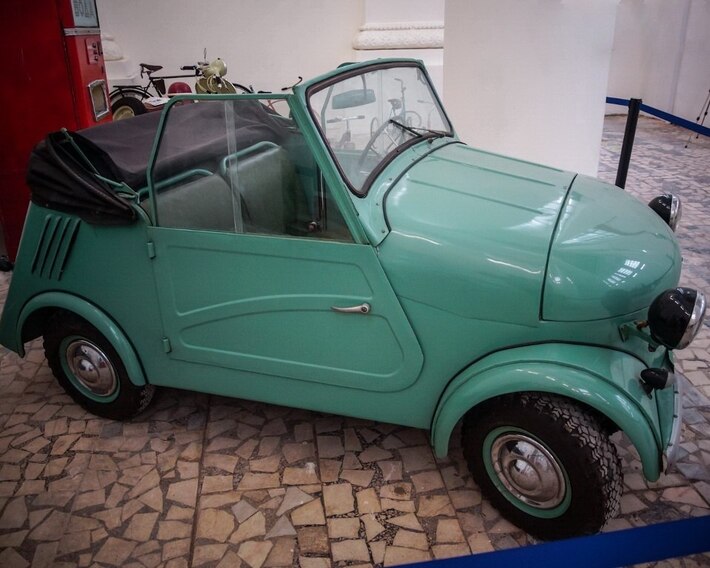
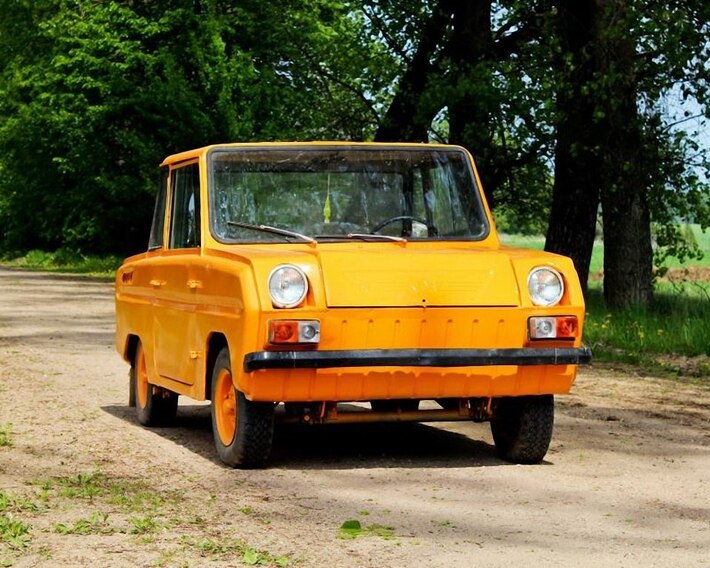
Production Models
SMZ's production history is defined by a remarkably narrow focus — two generations of essentially the same vehicle, refined and updated across four decades of continuous production, serving a single defined purpose for a specific category of user.
Design Philosophy & Engineering
The SMZ was not designed for performance or style — it was designed to give independence to people who had lost the physical ability to drive conventional vehicles. Every engineering decision was made in service of simplicity, reliability, and hand-control operability, resulting in a vehicle that was crude by any commercial standard but extraordinarily well-suited to its specific purpose.
- Hand control system — the S-3A and S-3D featured mechanical hand controls for throttle and braking as standard; designed to be operable by veterans who had lost one or both legs
- 650cc/750cc two-cylinder engine — motorcycle-sourced engines chosen for their simplicity, parts availability, and ease of repair; no specialist tools required for basic maintenance
- Minimal weight — the S-3A weighed approximately 650 kg; the extremely low weight partially compensated for the modest engine power and allowed hand controls to manage braking forces
- State welfare distribution system — uniquely, the SMZ was not purchased but issued; qualifying veterans received a vehicle free of charge from the Soviet Social Security ministry, with replacement issued after a set operational period
- Cultural permanence — the SMZ became one of the most recognisable vehicles in Soviet popular culture; its distinctive silhouette appeared in Soviet films, literature, and art as a symbol of veteran sacrifice and state care
SMZ in Azerbaijan
During the Soviet era, the SMZ S-3A and S-3D were distributed throughout the Soviet Union — including the Azerbaijan Soviet Socialist Republic. Azerbaijani veterans of the Second World War who qualified for state invalid carriages would have received SMZ vehicles through the republican Social Security network. Some examples likely survived into the post-Soviet period, and rare survivors may still exist in collections or rural areas of Azerbaijan.
For Azerbaijani collectors of Soviet-era vehicles, the SMZ represents an extraordinary piece of social history — a vehicle that tells the story of the Soviet state's response to the human cost of the Second World War. Unlike the GAZ, ZIL, or Volga, which symbolise Soviet power and prestige, the SMZ symbolises sacrifice and welfare — making it one of the most emotionally resonant artefacts of the Soviet automotive period. Any surviving example in Azerbaijan would be a significant find deserving careful preservation.
Why is SMZ Historically Significant?
- Soviet social history embodied: The SMZ is not merely a vehicle — it is a tangible artefact of Soviet welfare policy; each example represents the state's acknowledgement of veterans' sacrifice and its commitment to providing mobility to those the war had disabled.
- Extreme rarity outside Russia: Outside Russia and the former Soviet republics, SMZ vehicles are exceptionally rare; surviving examples outside their home territory are significant collector finds with genuine historical provenance.
- Cultural icon: The SMZ S-3D is one of the most recognisable silhouettes in Soviet popular culture — it appeared in films, was driven by veterans on parade days, and represented an entire generation's experience of postwar Soviet life; its cultural significance far exceeds its mechanical specification.
- Preservation imperative: With production ended in 1997 and many examples having deteriorated or been discarded, surviving SMZ vehicles are becoming increasingly rare; collectors who preserve these vehicles are performing a genuine service to automotive and social history.
BakuWheels uses cookies to improve your experience, analyse site traffic, and personalise content. By clicking Accept All, you consent to our use of cookies. Learn more in our Cookie Policy.