

Adler 2.5 Liter (1937–1940)
The Adler 2.5 Liter was the most elegant car Adler ever built — a sporting pre-war model powered by a 2.5-litre six-cylinder engine and available in a stunning cabriolet body crafted by the celebrated Dresden coachbuilder Gläser. Introduced in 1937 as the final expression of Adler’s pre-war ambitions, the 2.5 Liter represented the company at its most refined, combining the best engineering from its decade of development with coachwork that contemporary critics compared favourably to the finest European designs of the era.
Overview
By 1937, Adler had spent more than a decade establishing itself as one of Germany’s most technically progressive car manufacturers. The Trumpf and Trumpf Junior had demonstrated that front-wheel drive was not merely a curiosity but a viable technology for everyday cars; the Diplomat had proved that Adler could compete in the luxury segment. The 2.5 Liter was something different: Adler’s most refined and beautiful car, a sporting model that combined the best of the company’s engineering maturity with coachwork that would be considered exceptional in any context.
The engine was a 2.5-litre inline six-cylinder producing 58 hp — a generous output for a car of this size in 1937. Unlike the FWD models lower in the Adler range, the 2.5 Liter used conventional rear-wheel drive, which was appropriate for a sporting car where the handling characteristics of the era’s drivers expected a rear-drive feel. The four-speed manual gearbox had synchromesh on all forward gears, making the car pleasant to drive; the independent front suspension provided good handling composure for a pre-war design.
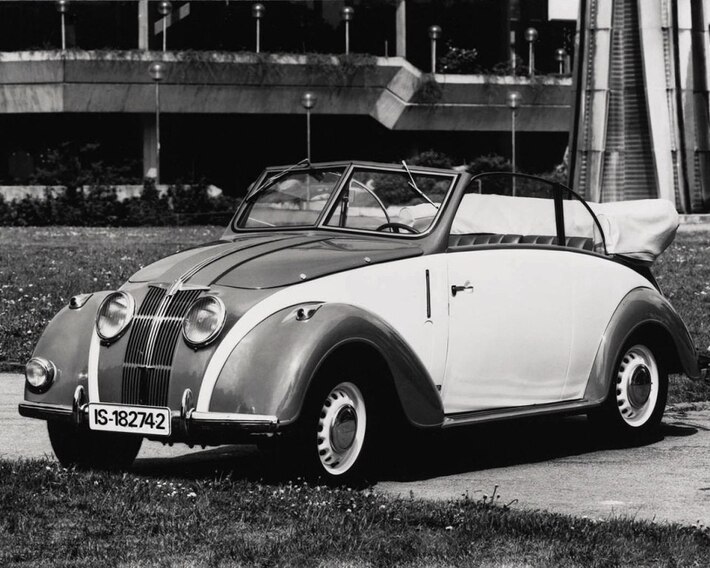
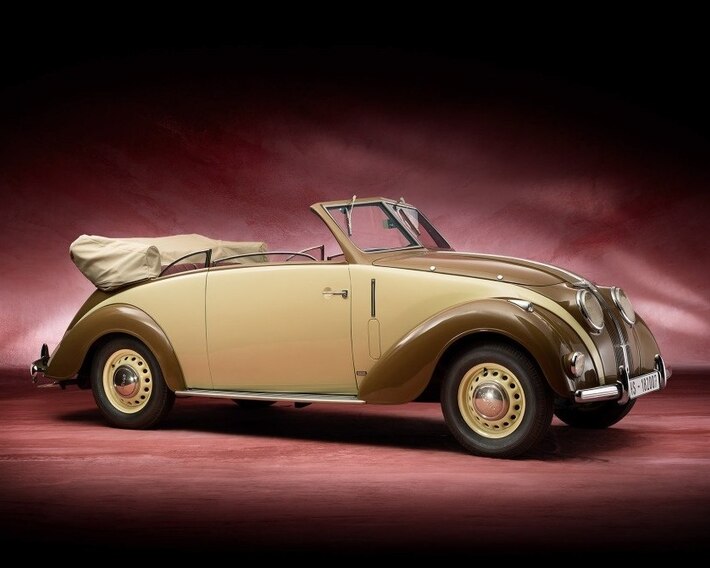
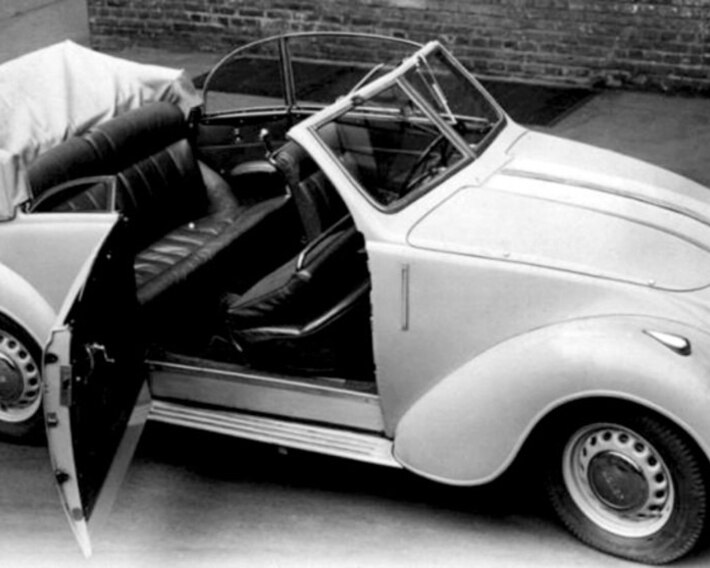
The crowning achievement of the 2.5 Liter was the cabriolet body produced by Gläser of Dresden. Karl Gläser’s coachbuilding firm had established an outstanding reputation for elegant open-car bodies on German chassis; the Adler 2.5 Liter cabriolet, with its long bonnet, sweeping wings, and beautifully proportioned open body, is considered by historians of pre-war German automotive design to be among the finest cabriolets produced in Germany before the war. The body was available in the four-seat configuration standard for luxury cabriolets of the period.
Production was brief: the 2.5 Liter entered production in 1937 and was cut short by the onset of the Second World War in 1939–1940, which ended civilian car production at Adler’s Frankfurt factory. The short production run, combined with the attrition of the war years and the post-war period, means that surviving 2.5 Liter examples are genuinely rare. Cabriolet examples are among the most sought-after pre-war German cars in the specialist auction market; well-documented examples reach significant prices when they appear.
For the collector, the 2.5 Liter Cabriolet represents the definitive Adler — the car that most completely realises the company’s ambitions as an elegant, high-quality manufacturer. It is also an important piece of European coachbuilding history: the Gläser body is a surviving example of the Dresden coachbuilding tradition that was largely lost in the post-war partition of Germany, when Gläser’s workshops ended up in East Germany and eventually ceased operation.
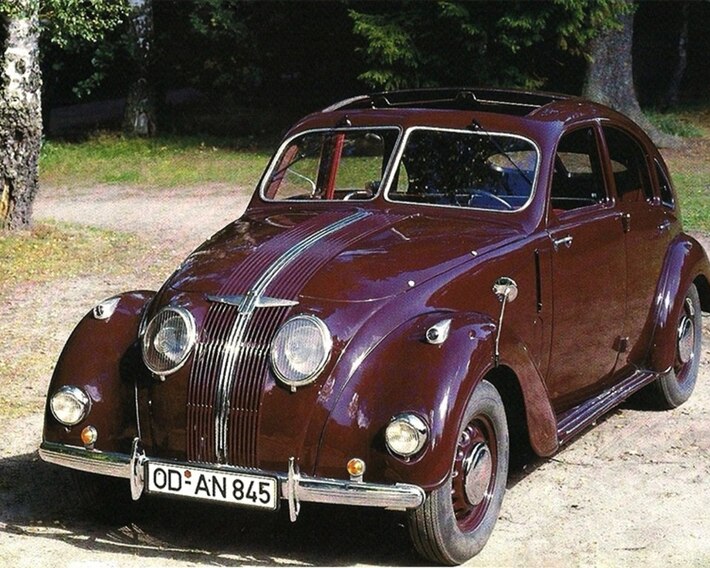
Adler 2.5 Liter in Pictures
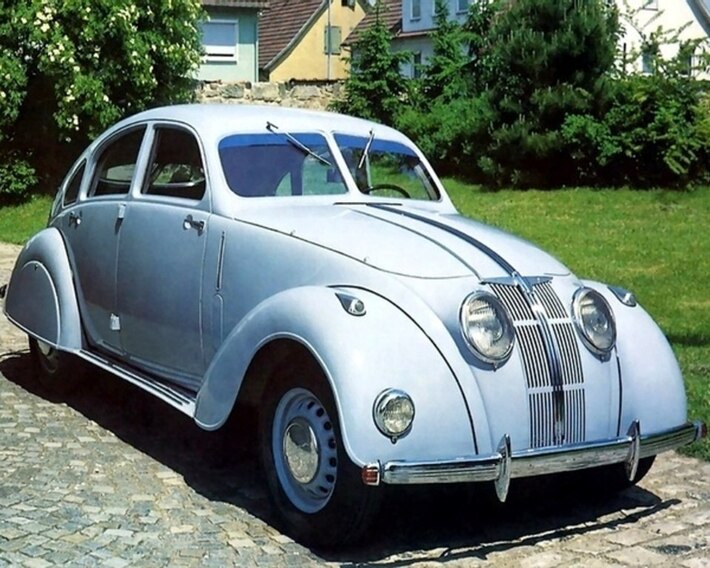
The 2.5 Liter’s proportions — long bonnet, sweeping wings, and elegant cabriolet body — represent the height of German pre-war automotive styling, comparable to the finest European coachwork of the late 1930s.

Key Specifications
- Engine: 2.5-litre inline 6-cylinder, overhead valves, single carburettor (twin carburettors on Sport variant); 58 hp at 3,800 rpm (standard); 62 hp at 4,000 rpm (Sport). Smooth, refined character with good torque at low rpm; the most advanced engine Adler produced for a pre-war civilian car.
- Drive layout: Rear-wheel drive; open propshaft to a live rear axle. Independent front suspension with transverse leaf springs; semi-elliptic rear springs. The handling character is sporty for a pre-war car, with more body control than the older Adler designs.
- Transmission: 4-speed manual gearbox with synchromesh on all forward gears; an advancement over earlier Adler models. Floor-mounted gear lever. Close-ratio gearbox on Sport variants.
- Chassis: Conventional steel ladder frame with cruciform bracing for improved torsional rigidity; a more sophisticated chassis than the Standard and earlier Adler models. Wheelbase approximately 2,950 mm; overall length approximately 4,550 mm.
- Body styles: Standard closed saloon (primary production body); Cabriolet by Gläser of Dresden (rarer and most valuable); Sport two-door (rarest). The Gläser Cabriolet uses a four-seat open body with elegant proportions that contemporary critics compared to the finest European cabriolet coachwork of the era.
- Brakes: Hydraulic drum brakes on all four wheels, servo-assisted; larger drums than earlier Adler models. The braking system is adequate for the car’s 120 km/h capability and was among the better-specified pre-war German brake systems.
- Performance: Top speed approximately 120–125 km/h; 0–100 km/h in approximately 17–20 seconds. Fuel consumption approximately 12–14 litres per 100 km. Performance that comfortably matched the best of its German competitors in 1937.
- Kerb weight: Approximately 1,350–1,450 kg depending on body style. The cabriolet body is slightly lighter than the saloon due to the absence of a steel roof structure.
- Production years: 1937–1940; the war ended production after only three years. Total production was modest — the combination of a premium price and wartime interruption ensures genuine rarity in today’s collector market.
Variant Comparison
| Variant | Engine | Power | Gearbox | Best For |
|---|---|---|---|---|
| 2.5 Liter Standard (1937–1940) | 2.5L inline 6-cylinder, single carburettor, RWD | 58 hp at 3,800 rpm | 4-speed manual, synchromesh on all forward gears | The standard closed-body version; elegant proportions with standard saloon coachwork; the most commonly surviving variant; correct specification for collectors seeking Adler's final and most refined pre-war model; well-appointed interior with leather and wood veneer as standard |
| 2.5 Liter Cabriolet (Gläser body, 1937–1940) | 2.5L inline 6-cylinder, RWD | 58 hp | 4-speed manual | The most sought-after 2.5 Liter variant; open four-seat cabriolet body by the Dresden coachbuilder Gläser; considered Adler's most beautiful pre-war car; extremely rare survivor; values significantly above the saloon at European specialist auctions; the definitive expression of Adler's pre-war elegance |
| 2.5 Liter Sport (1938–1940) | 2.5L inline 6-cylinder, twin carburettors, RWD | 62 hp at 4,000 rpm | 4-speed close-ratio manual | Higher-performance variant with twin-carburettor engine and lowered body; the most dynamic 2.5 Liter variant to drive; rarer than the standard saloon; the choice for collectors who want to participate in pre-war class historic motorsport events; striking two-tone paint options available |
What Makes the 2.5 Liter Stand Out
The 2.5 Liter represents Adler at its peak — a model that synthesised the company’s decade of technical development with the finest coachwork available in Germany in the late 1930s.
- The Gläser Cabriolet body: The open cabriolet body produced by Karl Gläser’s Dresden coachbuilding firm is one of the most beautiful pre-war German automotive designs. The harmonious proportions, elegant hood lines, and quality of execution make the Gläser-bodied 2.5 Liter a genuine work of pre-war coachbuilding art that deserves comparison with the finest open cars of the era.
- Historical connection to Gläser’s lost tradition: Karl Gläser’s Dresden workshop represents a coachbuilding tradition that was ended by the post-war division of Germany. The 2.5 Liter cabriolet is one of the most accessible surviving examples of Gläser’s craft — a tangible connection to a Dresden industrial heritage that no longer exists in its original form.
- Adler’s most refined engine: The 2.5-litre six-cylinder was the most technically advanced engine Adler fitted to a civilian car. Its smoothness, refinement, and adequate power make it the most pleasant of Adler’s pre-war engines to drive today, with a character that rewards gentle use and long-distance touring.
- Very short production run increases historical interest: The 2.5 Liter’s production was curtailed by the war after only three years. This brevity means that every surviving example is a testimony to the final flourishing of pre-war Adler engineering before the company’s automobile manufacturing was ended permanently by the 1945 bombing of its Frankfurt factory.
- The end of Adler car production: The 2.5 Liter was effectively Adler’s final pre-war model; the company never resumed car manufacturing after the war (turning instead to motorcycles and then typewriters). This gives the 2.5 Liter a poignant historical significance as the last Adler automobile — the final chapter of a remarkable story that ended at Frankfurt in 1945.
- Comparable value appreciation to other rare pre-war German sporting cars: Well-documented 2.5 Liter Cabriolets have appeared at specialist European auctions with results comparable to BMW 326 and Wanderer W23 cabriolets of similar specification and condition. The combination of genuine rarity, beautiful coachwork, and historical significance supports continued value appreciation.
Maintenance & Repairability in Azerbaijan
The Adler 2.5 Liter is a serious pre-war collector car requiring the full range of European specialist support. Its relative rarity compared to the Standard and Trumpf models makes parts sourcing more challenging, but the mechanical specification is conventional and well-understood by pre-war German car specialists.
- Six-cylinder engine service: The 2.5-litre six requires conventional pre-war service: oil changes every 2,000–3,000 km with SAE 40 classic car oil containing ZDDP additive, carburettor service annually, contact breaker replacement every 5,000 km, valve clearance adjustment every 10,000 km. Six-cylinder service requires more time than the four-cylinder models; budget accordingly for annual service costs.
- Specialist parts sourcing: The 2.5 Liter’s rarity means that parts are harder to source than for the more common Adler models. German pre-war specialist dealers and the Adler-Veteranen-Club are the primary resources. Some parts can be fabricated to original drawings by skilled engineers; budget 1–3 weeks for parts shipping from Germany to Azerbaijan.
- Gläser cabriolet hood maintenance: The Gläser cabriolet hood fabric is a specialist material requiring replacement from European hood specialists when perished. The hood framework is complex wood-and-metal construction requiring specialist skills to repair; do not attempt framework repairs without pre-war cabriolet experience. Correct hood fabric and stitching are critical to maintaining authenticity and value.
- Braking system: The servo-assisted hydraulic drum brakes require annual inspection and fluid replacement. The servo unit itself is a rare component; if faulty, specialist rebuilding is the correct approach rather than removal and conversion to non-servo specification. Brake drums and shoes are available through German pre-war specialist suppliers.
- Corrosion management: The 2.5 Liter’s body is largely handbuilt and uses traditional pre-war steel fabrication techniques. Annual wax injection of all inner body sections, prompt repair of paint damage, and dry storage are essential. Any significant body restoration should be carried out by a craftsman with pre-war German car restoration experience.
- Leather and trim conservation: The standard specification leather upholstery requires regular conditioning with quality leather preservative. Baku’s dry summers risk cracking hide if not maintained. Wood veneer trim should be treated annually; cracked or lifting veneer should be repaired before separation causes further damage to the substrate.
- Insurance and storage: A 2.5 Liter Cabriolet in good condition is a significant asset; agreed-value collector car insurance is essential. Store in a climate-controlled garage if possible; at minimum, ensure the storage environment is dry, ventilated, and protected from direct sunlight.
Adler 2.5 Liter vs. Contemporaries
| Model | Core Strength | Main Compromise (Collector Context) |
|---|---|---|
| Adler 2.5 Liter (1937–1940) | Adler's most elegant pre-war model; 2.5L 6-cylinder; 58 hp; Gläser-bodied cabriolet considered one of the most beautiful German cars of the era; sporty character distinguishing it from the more formal Diplomat; historically Adler's most refined RWD offering; considered by some historians as Adler's finest automotive achievement | Short production run of only three years; few survivors; parts rarity significant; less well-known than BMW or Mercedes equivalents of the same era despite comparable quality |
| BMW 326 (1936–1941) | BMW's elegant 2.0L 6-cylinder touring car; beautiful Ihle-designed body; well-supported by the BMW Vintage Club; better international brand recognition than Adler; excellent parts availability through BMW specialist network; lighter and more nimble than the 2.5 Liter | Smaller 2.0L engine gives less torque than the Adler's 2.5L; BMW badge commands a premium at auction making comparable condition examples more expensive; different character — the BMW is more sporty, the Adler more refined |
| Horch 830 BL (1935–1940) | Auto Union's V8 prestige marque; more powerful than the 2.5 Liter; prestigious Zwickau origins; genuine V8 character; sophisticated independent rear suspension; the aspirational choice for serious pre-war German car collectors | Significantly more expensive than the 2.5 Liter at both purchase time and today; V8 parts more complex to source; Horch rarity commands prices out of reach for most collectors entering the pre-war German market |
| Mercedes-Benz 230 (1936–1943) | Mercedes prestige with 2.3L 6-cylinder; strong brand recognition worldwide; well-supported by Mercedes-Benz Classic; available in several elegant body styles; the benchmark for German pre-war luxury in many collectors' eyes | Mercedes badge premium makes equivalent condition examples more expensive than the Adler; less elegant body styling than the Gläser-bodied Adler 2.5 Liter Cabriolet; more common in the collector market |
| Wanderer W23 (1938–1941) | Auto Union's Wanderer marque with Pinin Farina-styled body; 2.6L 6-cylinder; elegant appearance; Auto Union heritage; similar period and specification to the 2.5 Liter | Short late-pre-war production; Auto Union history during war period complicates provenance; less well-known than Adler in specialist collector circles despite comparable engineering quality |
Cost-of-Ownership Calculator (Azerbaijan)
Defaults reflect the expected usage pattern for a serious pre-war German collector car: very low annual mileage, specialist service budget, and insurance appropriate for an important and rare pre-war vehicle.
- Estimated annual fuel use: 120 litres
- Estimated annual fuel cost: $78
- Total annual ownership estimate: $5878
- Average monthly ownership estimate: $490
Used Buying Checklist
- Body authenticity (Gläser Cabriolet specifically): Verify Gläser coachwork authenticity through documentation; the hood framework construction and body seam details are distinctive and should be verified by a specialist. Incorrect body panels from other models significantly reduce both authenticity and value.
- Six-cylinder engine condition: Full cold and warm start inspection; oil pressure measurement; compression test across all six cylinders to identify any head gasket issues or worn piston rings. A six-cylinder rebuild on this model is a specialist job with significant labour costs that must be reflected in any purchase negotiation.
- Chassis integrity: Inspect all frame rails and cruciform bracing for corrosion and repair; probe all body mounting points. The 2.5 Liter’s chassis is more sophisticated than earlier Adler models but equally vulnerable to decades of moisture ingress.
- Cabriolet hood and framework: Check all hood fabric for integrity and weatherproofing; inspect the folding mechanism for complete, smooth operation; examine all hood bows and side rails for corrosion or cracking. A complete hood replacement is expensive; budget accordingly if the existing hood is perished.
- Interior condition: Assess leather quality and authenticity; check dashboard instruments for completeness and function; verify wood veneer condition. Original interior in good condition adds premium value; verify that any restoration has used period-correct materials and methods.
- Provenance documentation: Request full ownership history, any original German documents, restoration invoices, and photographic records. A well-documented 2.5 Liter with clear provenance is worth substantially more than an undocumented example of similar mechanical condition. Adler-Veteranen-Club membership provides access to registry records.
Adler 2.5 Liter FAQ
Who was Gläser and why is the cabriolet body significant?
Karl Gläser founded his coachbuilding firm in Dresden in the 1920s; the company became one of the most respected specialist coachbuilders in Germany, producing open bodies for DKW, Wanderer, and Adler chassis. The Adler 2.5 Liter cabriolet was among Gläser’s finest works. Dresden’s post-war history — the city was devastated by bombing in February 1945 and then incorporated into East Germany — effectively ended the Gläser tradition; the firm did not continue its pre-war coachbuilding work in any meaningful form. Surviving Gläser-bodied cars are thus among the few tangible remnants of Dresden’s pre-war industrial and craft heritage.
Is the 2.5 Liter the last Adler car?
The 2.5 Liter was the last Adler car in production before the war ended civilian car manufacturing. Adler’s Frankfurt factory was severely damaged in wartime bombing and the company never resumed automobile production; post-war Adler focused on motorcycles until the mid-1950s and then returned to typewriters and office equipment. The 2.5 Liter is therefore Adler’s final automotive chapter and the most historically poignant model in the range.
How does the 2.5 Liter compare to the Diplomat in Adler’s range?
The Diplomat (1934–1938) was Adler’s formal luxury limousine; the 2.5 Liter (1937–1940) was the sporting successor. The Diplomat was larger, heavier, and more formal; the 2.5 Liter was more elegant, lighter, and designed for sporting use rather than formal chauffeur service. The 2.5 Liter’s Gläser cabriolet body has no equivalent in the Diplomat range. For collectors, the two models appeal to different sensibilities: the Diplomat to those who want formal pre-war presence, the 2.5 Liter to those who want elegance and sporting character.
Should You Buy an Adler 2.5 Liter?
The Adler 2.5 Liter is the most significant and beautiful car in Adler’s pre-war range — and the final chapter of the company’s remarkable automotive story. For the collector with the resources and knowledge to maintain a genuinely important pre-war German car, the 2.5 Liter offers a combination of historical significance, visual beauty, and rarity that few other pre-war German models can match. The Gläser Cabriolet in particular is a piece of pre-war European coachbuilding history that deserves serious collector attention.
The practical demands of ownership in Azerbaijan are significant but manageable for a committed collector: European specialist support, planned parts sourcing, careful storage, and appropriate insurance are the foundations. Any acquisition should be preceded by a specialist inspection from a pre-war German car expert with Adler knowledge, and by a thorough provenance review. For the right buyer, the 2.5 Liter Cabriolet represents one of the most rewarding pre-war German car acquisitions available in the current collector market.
BakuWheels uses cookies to improve your experience, analyse site traffic, and personalise content. By clicking Accept All, you consent to our use of cookies. Learn more in our Cookie Policy.