

Adler 5/11 PS (1909–1919)
The Adler 5/11 PS was Frankfurt’s small car offering for the growing Edwardian and early Weimar middle class — a light four-cylinder tourer built in the decade before and during the First World War, when the automobile was transitioning from a rich man’s novelty to a practical, if still expensive, middle-class possession. With a 1.4-litre four-cylinder engine producing 11 hp and a light open body designed for town and country use, the 5/11 PS brought Adler’s characteristic quality to buyers who could not afford the larger touring cars in the range.
Overview
The Adler 5/11 PS belongs to the “brass era” of automobile development — the decade or so before the First World War when cars were characterised by exposed brass fittings, acetylene or oil headlamps, hand-cranked starting, and open bodies that offered virtually no weather protection beyond a detachable hood. In this context, the 5/11 PS was a typical example of the small four-cylinder light car that was beginning to make the automobile accessible to the German middle class for the first time.
The 1.4-litre four-cylinder engine used a side-valve (L-head) configuration with thermo-siphon cooling — a simple system in which coolant circulation was driven entirely by temperature differential rather than a water pump. This approach was robust and easy to maintain but required that the car not be driven hard for extended periods without overheating risks. The three-speed sliding-mesh gearbox required double-declutching for smooth operation, a skill that every early motorist had to master.
Production spanned the First World War, though civilian car manufacturing was severely curtailed during the conflict. The final examples left the Frankfurt factory in approximately 1919, by which time the design was substantially outdated; the post-war market demanded more power, better weather protection, and electric starting as standard equipment. The 5/11 PS gave way to the larger post-war touring cars and was not directly succeeded by a similar small car until much later.
Surviving 5/11 PS cars are extraordinarily rare. The combination of a long production gap (most were built before 1914), the attrition of the war years, and the passage of more than a century means that any complete, running 5/11 PS is a museum-quality piece. Most surviving examples are in German museum collections; private ownership of a running 5/11 PS outside Germany would be an exceptional occurrence.
Adler 5/11 PS in Pictures
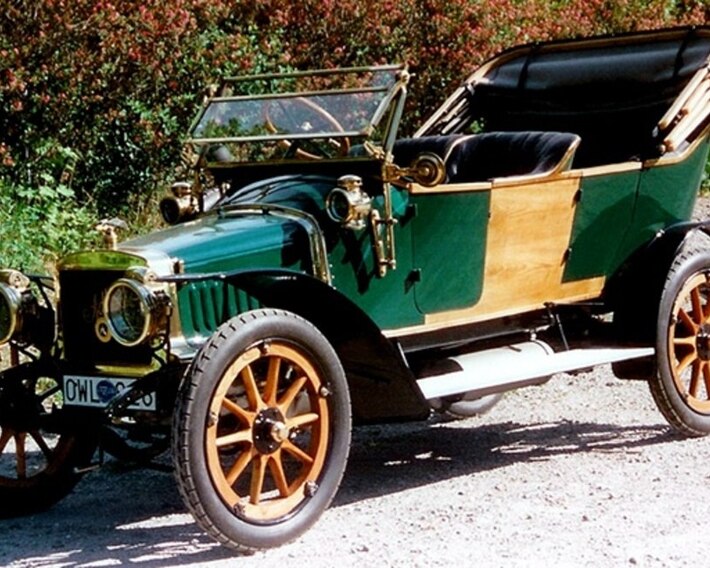
The 5/11 PS represents the brass era in its most characteristic form: high-mounted body, large-diameter wooden-spoked wheels, external headlamps, and exposed mechanical components that were the aesthetic norm of the pre-war small car.


Key Specifications
- Engine: 1.4-litre inline 4-cylinder, side-valve (L-head); 11 hp at approximately 1,800 rpm. Thermo-siphon water cooling; no water pump. Cast iron block and head. Very simple and robust construction prioritising reliability over performance.
- Starting: Hand-crank only on early examples; no electric starter. The hand-crank starting technique is essential knowledge for anyone who owns or drives a vehicle of this era. Correct procedure minimises kickback risk.
- Transmission: 3-speed sliding mesh gearbox; no synchromesh. Double-declutching required for all downshifts. Floor-mounted lever. Some runabout variants used a 2-speed epicyclic (planetary) gearbox for simplicity.
- Drive layout: Rear-wheel drive via bevel-gear rear axle. Chain drive on earliest examples; shaft drive introduced progressively. Open propshaft.
- Brakes: Rear-wheel only mechanical brakes (footbrake on transmission, handbrake on rear drums) on early examples. No front brakes. Very limited stopping capability by modern standards; maximum speed and road choice must be matched to brake capability.
- Chassis: Conventional ladder frame; beam front axle with semi-elliptic leaf springs; semi-elliptic rear springs. Very high ground clearance for unpaved roads. Wooden-spoked wheels with pneumatic tyres on later examples; solid tyres still used on earliest production.
- Lighting: Acetylene or oil headlamps; paraffin sidelamps. Electric lighting was not standard equipment on pre-WWI small cars of this class.
- Performance: Top speed approximately 55–65 km/h on good surfaces; considerably less on unpaved roads. Fuel consumption approximately 10–12 litres per 100 km.
Variant Comparison
| Variant | Engine | Power | Gearbox | Best For |
|---|---|---|---|---|
| 5/11 PS Standard Tourer (1909–1914) | 1.4L inline 4-cylinder, side-valve, RWD | 11 hp at 1,800 rpm | 3-speed manual, sliding mesh | The standard Edwardian-era light car; correct specification for pre-WWI Adler collecting; open two or four-seat tourer body; oil or acetylene headlamps; all brass fittings and hand-formed coachwork; the definitive light touring car of early Adler automobile production |
| 5/11 PS Runabout (1910–1916) | 1.4L inline 4-cylinder, side-valve, RWD | 11 hp | 2-speed manual or epicyclic | The lighter, simpler runabout body for urban use; single or two-seat specification; more manoeuvrable and less expensive than the full tourer; correct for collectors interested in Edwardian urban transport; extremely rare survivor |
What Makes the 5/11 PS Stand Out
- Brass era authenticity: The 5/11 PS is a genuine brass era automobile — built before the First World War when motorcars were still relatively new and the art of car building was developing rapidly year by year. Its period fittings, hand-formed body panels, and entirely mechanical systems represent an era of automotive history that is now over a century old.
- Extraordinary rarity: Pre-WWI Adler light cars are among the rarest of all surviving German automobiles. The combination of very early production, a decade-long world war beginning shortly after the type’s introduction, and the subsequent century of attrition means that any surviving 5/11 PS is a genuinely exceptional piece.
- Connection to the very beginning of Adler’s automotive story: The 5/11 PS was built when Adler was in the early years of its transition from bicycle and typewriter manufacturer to car maker. It connects the beginning of Adler’s automotive history with the pioneering FWD models that would define the company’s legacy a quarter-century later.
- Eligibility for veteran car events worldwide: Pre-1930 cars qualify for veteran status at virtually all international organisations; pre-1915 cars often qualify for the most historically significant events including the London to Brighton Run. A 5/11 PS would be eligible for the most prestigious veteran car events available.
- Living museum piece: A running 5/11 PS is not merely a collector car but a functioning artefact of the Edwardian era — a mechanical witness to a world before the First World War changed everything. The responsibility of ownership extends to preservation for future generations.
Maintenance & Repairability in Azerbaijan
- Specialist requirement: Only a veterancar specialist with pre-1915 German car experience should attempt major mechanical work on the 5/11 PS. No amount of general classic car experience compensates for the specific knowledge required for thermo-siphon cooling, acetylene lamp systems, and early gearbox mechanisms.
- Parts fabrication: Virtually all mechanical parts must be fabricated to original drawings. A trusted machinist in Azerbaijan working to supplied drawings can produce many components; others require German specialist foundry work. Plan all major maintenance 3–6 months in advance.
- Lubrication schedule: Early cars have extensive lubrication requirements; establish a complete map of all grease points and oil nipples before the first outing. Running a pre-WWI car without full lubrication causes accelerated wear that is very expensive to rectify.
- Storage: Climate-controlled storage is strongly recommended for a car of this significance and rarity. At minimum, dry storage with good ventilation and protection from direct sunlight. Regular inspection during storage periods prevents hidden deterioration from going unnoticed.
- Insurance: Agreed-value collector car insurance is essential; standard vehicle insurance is not appropriate for a car of this rarity and historical importance. Specialist collector car insurance providers in Europe (Hagerty, Classic Car Insurance) offer appropriate coverage for export to Azerbaijan.
- Community: The Veteran Car Club of Germany and the FIA’s FIVA organisation are the primary international resources. Membership provides access to technical knowledge, documentation support, and the specialist community essential for responsible ownership of a car of this era.
Adler 5/11 PS vs. Contemporaries
| Model | Core Strength | Main Compromise (Collector Context) |
|---|---|---|
| Adler 5/11 PS (1909–1919) | Pre-WWI Adler light car; 1.4L 4-cylinder; 11 hp; brass-era coachwork; historically significant as Adler's small car for the growing Edwardian middle class; genuine veteran car era piece; extremely rare survivor; important Adler marque history | Pre-WWI age means extreme fragility; virtually all parts require specialist fabrication; limited to very short, dry-weather, low-speed outings; strictly museum-quality collector piece in most cases |
| Opel 5/12 PS (1909–1914) | Opel's equivalent pre-war small car; 5/12 PS rating; better brand recognition; Opel club support; marginally better parts availability through the large Opel collector community; well-known in Germany | Opel badge less significant than Adler for specialist collectors; no connection to the FWD innovations that define Adler's legacy; very common by veteran car standards |
| Benz 5/12 (pre-1914) | Benz heritage connecting to the origins of the motor car; pre-war Benz light car; strong collector appeal due to Mercedes-Benz connection; better documented survivor population | Benz badge premium makes equivalent condition examples more expensive; different collector demographic (Mercedes-Benz enthusiasts vs. German veteran car enthusiasts) |
| NAG 5/10 PS (pre-1914) | NAG early small car; Berlin manufacture; interesting alternative for collectors researching Germany's early automotive industry geography beyond Frankfurt | Extremely obscure; almost no parts support anywhere in Europe; NAG ceased car production in 1934; collector community very small |
Cost-of-Ownership Calculator (Azerbaijan)
- Estimated annual fuel use: 120 litres
- Estimated annual fuel cost: $78
- Total annual ownership estimate: $5878
- Average monthly ownership estimate: $490
Used Buying Checklist
- Museum assessment: Before purchasing any pre-WWI car, consider whether the acquisition is justified by the facilities, knowledge, and resources available for its stewardship. A 5/11 PS in poor condition is better in a specialist restorer’s care than with an owner who cannot provide for it.
- Complete specialist inspection: Engage a FIVA-registered veteran car specialist for a full assessment before any purchase. The inspection should cover engine condition, chassis integrity, body authenticity, completeness of fittings, and condition of all mechanical systems.
- Body authenticity: Verify that the body is original or correctly restored to the original specification; replacement bodies from other models or periods significantly reduce both historical integrity and value.
- Engine completeness: All original engine components should be present; reproductions and later parts should be documented. Original carburetion and ignition systems are preferable to later-period replacements even if the replacements are more reliable.
- Provenance and documentation: Any documentation extending back toward the original owner is extremely valuable. German registration records, club history, restoration invoices, and photographic history all contribute to provenance that is virtually irreplaceable if lost.
Adler 5/11 PS FAQ
What does “brass era” mean in the context of the 5/11 PS?
The “brass era” refers to the period from approximately 1897 to 1915 when automobiles were characterised by exposed brass fittings — headlamps, horns, radiator trim, and other components were typically made from polished brass. This was partly functional (brass resists corrosion), partly aesthetic (brass polished beautifully), and partly a product of the era’s manufacturing traditions. Cars from this period are distinctively beautiful in their mechanical honesty; nothing is hidden or enclosed that does not need to be.
Is it possible to find a running 5/11 PS outside Germany?
Running examples outside Germany are extremely rare. The majority of surviving cars are in German museum collections or private collections within Germany and Austria. International sales of running pre-WWI German light cars are occasional events at major specialist auctions (Bonhams, RM Sotheby’s) but not frequent. Any buyer outside Germany should expect to engage an international classic car import specialist for any acquisition of a car of this type.
What is the appropriate context for using a 5/11 PS in Azerbaijan?
The 5/11 PS is strictly a display and very occasional use car in Azerbaijan. It is appropriate for indoor display at collector events, short dry-weather demonstration drives on quiet roads, and participation in historic vehicle parades. It is not suitable for road use in Baku’s traffic, for humid or wet conditions, or for any journey where the car cannot be loaded on a trailer if a mechanical issue arises.
Should You Buy an Adler 5/11 PS?
The Adler 5/11 PS is one of the rarest and most historically significant cars that could reasonably be associated with the BakuWheels marketplace. It is not a car that should be acquired without deep specialist knowledge, museum-quality storage facilities, and a commitment to responsible long-term stewardship. For the collector who meets these criteria and has a genuine passion for the very beginnings of German automotive history, the 5/11 PS offers an irreplaceable connection to the Edwardian era and to the earliest chapter of Adler’s remarkable story.
If you are seriously considering a 5/11 PS purchase, the appropriate process is: engage the FIVA (Federation Internationale des Vehicules Anciens) for guidance; contact the Veteran Car Club of Germany for specialist advice; engage a FIVA-approved appraiser for any specific car under consideration; and plan a complete conservation programme before the car arrives in Azerbaijan. This is a responsibility that goes beyond normal collector car ownership into the stewardship of history itself.
BakuWheels uses cookies to improve your experience, analyse site traffic, and personalise content. By clicking Accept All, you consent to our use of cookies. Learn more in our Cookie Policy.