

Adler 6/24 PS (1913–1919)
The Adler 6/24 PS was Frankfurt’s mid-range touring car spanning the First World War period — introduced in 1913 as a step up from the smaller 5/11 PS, it offered a larger 1.6-litre four-cylinder engine producing 24 hp in an open touring body appropriate for the prosperous middle-class buyer who wanted more capability than the light car but could not justify the largest Adler models. Its production span across the war years makes it historically distinctive as a car built in one of Europe’s most turbulent decades.
Overview
The Adler 6/24 PS entered production in 1913, the year before the outbreak of the First World War, and continued in very limited civilian production through the conflict’s end, with the final examples leaving the Frankfurt factory in approximately 1919. This span across one of history’s most transformative conflicts gives the 6/24 PS a distinctive historical context: cars built in the early years of the run were sold to German civilians enjoying the last years of the pre-war prosperity; later examples were built as Germany was fully committed to total war, with civilian production heavily curtailed.
The 6/24 PS designation indicates six fiscal horsepower (tax rating) and 24 actual brake horsepower from an engine of approximately 1.6 litres. The engine was a conventional side-valve four-cylinder, more powerful and torquier than the 5/11 PS but using the same fundamental architecture. The three-speed sliding-mesh gearbox required the double-declutching technique universal on cars of this era.
The body was the standard open tourer configuration of the period: four seats, folding hood, side screens, and the high stance appropriate for roads that were still partly unpaved in much of Germany. The Sport variant offered a shorter, two-seat body with a lighter construction for the enthusiast driver.
Surviving 6/24 PS cars are rare even by veteran car standards. The combination of a pre-war introduction, a production span across the conflict, and more than a century of attrition means that complete examples are found almost exclusively in German museum and private collections. Any acquisition outside Germany requires specialist assistance and international auction house or dealer contacts.
Adler 6/24 PS in Pictures
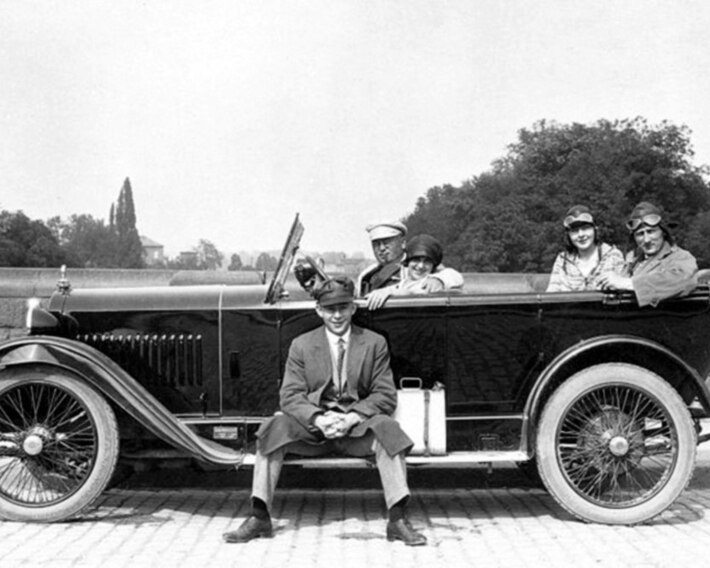


Key Specifications
- Engine: Approximately 1.6-litre inline 4-cylinder, side-valve configuration; 24 hp at approximately 2,200 rpm. Water-cooled; thermo-siphon cooling on early examples, water pump on later production. Cast iron block and head.
- Transmission: 3-speed sliding-mesh gearbox; double-declutching required for smooth operation; floor-mounted lever. Final drive via open propshaft to bevel-gear rear axle.
- Chassis: Conventional ladder frame; beam front axle with semi-elliptic springs; semi-elliptic rear springs. High ground clearance for unpaved roads.
- Body: Open four-seat tourer with folding hood, detachable side screens; Sport variant with lighter two-seat open body. Brass fittings on pre-war examples; increasingly steel fittings on wartime production due to material shortages.
- Brakes: Rear-wheel mechanical brakes on pre-war examples; four-wheel mechanical brakes progressively introduced during production.
- Performance: Top speed approximately 70–75 km/h on good surfaces. Fuel consumption approximately 10–13 litres per 100 km.
- Historical context: Production spanned 1913–1919, including the First World War period. Civilian production was minimal during 1914–1918; most surviving examples are pre-war or immediate post-war production. Wartime material shortages affected some components on 1916–1918 production cars.
Variant Comparison
| Variant | Engine | Power | Gearbox | Best For |
|---|---|---|---|---|
| 6/24 PS Standard (1913–1919) | ~1.6L inline 4-cylinder, side-valve, RWD | 24 hp at 2,200 rpm | 3-speed manual, sliding mesh | The standard mid-range pre-WWI Adler touring car; correct four-seat open tourer body with hood and side screens; the most historically representative 6/24 PS specification; appropriate for veteran car events and static display |
| 6/24 PS Sport (1914–1919) | ~1.6L inline 4-cylinder, higher compression, RWD | 26 hp at 2,500 rpm | 3-speed manual | The sporting variant with higher compression and lighter two-seat body; rarer than the standard tourer; appropriate for veteran car sporting events; the choice for collectors who want to engage in competitive veteran car activities with their Adler |
What Makes the 6/24 PS Stand Out
- Production span across the First World War: The 6/24 PS was built in the last year of pre-war normalcy and the immediate post-war period; examples built in 1913 and those built in 1918–1919 are products of very different Germanys, separated by the most destructive war in European history to that point.
- Mid-range Adler specification: The 6/24 PS occupied the crucial middle ground of Adler’s pre-war range, above the light 5/11 PS but below the larger models. This position means it served the widest range of buyers and was the most commercially significant model in the pre-war period.
- Transition from pre-war to post-war engineering: Later 6/24 PS examples show the progressive improvements that Adler was introducing as the war ended: electric lighting, better carburetion, and four-wheel brakes were progressively added during the production run, making later examples more capable than the earliest.
- Veteran car event eligibility: Pre-war and wartime production examples qualify for the most historically significant veteran car events; post-war examples (1919) qualify for veteran status at most international organisations.
- Rarity with direct Adler marque significance: The 6/24 PS predates and contextualises all of Adler’s later innovations. Owning one is to own the root of the family tree from which the revolutionary Trumpf and Trumpf Junior would eventually grow.
Maintenance & Repairability in Azerbaijan
- Veteran car specialist requirement: All maintenance must be performed by a specialist with pre-WWI German car experience. Shipping to Germany for major work, or flying in a specialist, are both viable approaches for a car of this significance.
- Parts fabrication: All mechanical parts require fabrication from original drawings; no off-the-shelf suppliers exist for 6/24 PS components. A quality machinist in Azerbaijan can produce many items to supplied drawings; others require specialist German foundry work.
- Wartime material variations: Cars produced during 1915–1918 may use substitute materials (zinc instead of brass, lower-grade steel) due to wartime shortages; these components may be more susceptible to corrosion and fatigue. Identify any wartime material substitutions during initial inspection.
- Storage requirements: Climate-controlled indoor storage; annual inspection during storage; regular preventive conservation to prevent deterioration during non-use periods.
- Community and documentation: FIVA membership, Adler-Veteranen-Club contact, and connection to German veteran car communities are all essential for responsible ownership. Document all conservation work thoroughly for provenance and future ownership records.
Adler 6/24 PS vs. Contemporaries
| Model | Core Strength | Main Compromise (Collector Context) |
|---|---|---|
| Adler 6/24 PS (1913–1919) | Pre-WWI Adler mid-range tourer; ~1.6L 4-cylinder; 24 hp; conventional touring car engineering of the era; historically significant as Adler's mid-range offering spanning the First World War; genuine veteran car with surviving Adler heritage | Pre-WWI age places extreme demands on maintenance and parts sourcing; very limited to dry-weather, very low-speed use in modern Azerbaijan; strict collector-piece status |
| Wanderer W8 (pre-1914) | Wanderer's pre-war touring car; similar specification; Chemnitz manufacture providing an interesting geographic contrast to the Frankfurt Adler; Auto Union heritage connection for collectors interested in the Auto Union story | Even more obscure than the Adler 6/24 PS for most collectors; very limited European parts and community support; Auto Union connection is post-war and does not apply to Wanderer’s pre-war models |
| Opel 10/28 PS (pre-WWI) | Opel’s equivalent pre-war mid-range model; better international brand recognition; larger surviving population through Opel’s higher production volumes; Opel club network support | Conventional engineering without Adler’s later FWD significance; Opel badge more common making the 6/24 PS more distinctive at veteran car events |
Cost-of-Ownership Calculator (Azerbaijan)
- Estimated annual fuel use: 120 litres
- Estimated annual fuel cost: $78
- Total annual ownership estimate: $5878
- Average monthly ownership estimate: $490
Used Buying Checklist
- Production date identification: Determine whether the car is pre-war (1913–1914), wartime (1915–1918), or post-war (1919) production; this affects material specifications, completeness of original fittings, and historical significance. Pre-war examples are generally more complete and original in their specification.
- Wartime material substitutions: Inspect for wartime material substitutions in fittings and mechanical components; zinc and lower-grade steel used in 1915–1918 production may show different corrosion patterns than pre-war brass and quality steel.
- Engine and drivetrain: Full inspection by a veteran car specialist; compression test across all cylinders; valve clearance and condition assessment; rear axle and gearbox inspection for play and noise.
- Chassis integrity: Frame rail inspection for corrosion and damage; all body mounting points checked; spring condition assessed for set and cracking.
- Documentation: All available provenance documentation; FIVA identity card if issued; club membership records; restoration history.
Adler 6/24 PS FAQ
How were cars built during the First World War different from pre-war examples?
Wartime production cars typically show three differences from pre-war examples: first, material substitutions where brass fittings were replaced by zinc or steel due to strategic material shortages; second, simplified specifications where some comfort features were omitted to conserve materials; and third, lower production quality in some areas due to skilled labour being diverted to military production. For collectors, pre-war examples generally represent the fullest original specification; wartime examples have their own historical interest as artefacts of Germany under industrial war conditions.
What is the correct fuel for a pre-WWI German car?
Pre-WWI side-valve engines have very low compression ratios (typically 4:1 to 5:1) and will run on the lowest octane fuel available. Azerbaijan’s 92 or 95 RON petrol is more than adequate. However, modern petrol contains ethanol which can degrade pre-war rubber fuel line components; inspect and replace fuel lines with ethanol-resistant materials during restoration. Lead substitute additives are not required for these very low compression engines.
Should You Buy an Adler 6/24 PS?
The Adler 6/24 PS is a pre-WWI veteran car requiring the highest level of specialist knowledge and commitment. For the serious collector of German veteran car history who specifically wants to represent the Adler marque from the period that spans the First World War, the 6/24 PS offers a historically significant and genuinely rare acquisition. The demands of ownership in Azerbaijan are substantial but manageable for a committed collector with European specialist contacts.
Any purchase should be preceded by a full specialist inspection, FIVA documentation review, and a comprehensive first-year conservation budget. The 6/24 PS is a collector piece in the fullest sense — not a car for driving but for preserving, studying, and occasionally displaying as a witness to one of history’s most consequential decades.
BakuWheels uses cookies to improve your experience, analyse site traffic, and personalise content. By clicking Accept All, you consent to our use of cookies. Learn more in our Cookie Policy.