

Adler 6/25 PS (1924–1926)
The Adler 6/25 PS was the post-war update to the pre-war 6/24 PS line — a brief two-year production model introduced in 1924 as Adler refined its mid-range offering in the stabilising economy of the mid-Weimar Republic period. Using an enlarged and improved approximately 1.7-litre four-cylinder engine producing 25 hp, the 6/25 PS bridged the gap between the wartime-era touring cars and the fully modern Standard family that Adler would introduce in 1927.
Overview
The 6/25 PS arrived in 1924 during the brief period of relative stability that followed Germany’s catastrophic hyperinflation of 1921–1923. The Rentenmark had replaced the worthless Papiermark, the Dawes Plan had restructured Germany’s reparations burden, and for the first time since before the war, German consumers had money to spend on a car. Adler’s response was the 6/25 PS — an updated mid-range model that improved on the pre-war 6/24 PS specification in several meaningful ways while retaining the proven architecture that buyers trusted.
The engine was enlarged slightly to approximately 1.7 litres and fitted with an improved cylinder head; carburetion was updated; and the electrical system was modernised with electric starting as standard. The body remained the open tourer format but with a more modern roofline treatment that acknowledged the trend toward integrated bodywork becoming fashionable by the mid-1920s. Four-wheel brakes were now standard on all examples, a significant safety improvement over the rear-only braking of the earliest Adler touring cars.
The production run was extremely brief: just two years, from 1924 to 1926. This brevity was intentional — Adler had already decided that a substantially new model family (the Standard, introduced in 1927) would replace the entire PS-designation range, and the 6/25 PS was in essence a holding model to keep the mid-range offering current while the new generation was developed. This short production span makes the 6/25 PS even rarer than its predecessor; the surviving population is minimal.
For the collector, the 6/25 PS occupies a historically interesting transitional position: it is the last of the Adler PS-designation mid-range models, the final expression of an engineering philosophy that traced back to the pre-war era, and the car that preceded by just one year the Standard family that would eventually fund Adler’s revolutionary FWD programme. It is a car for the specialist who wants to understand the complete Adler story, not just its most famous innovations.
Adler 6/25 PS in Pictures
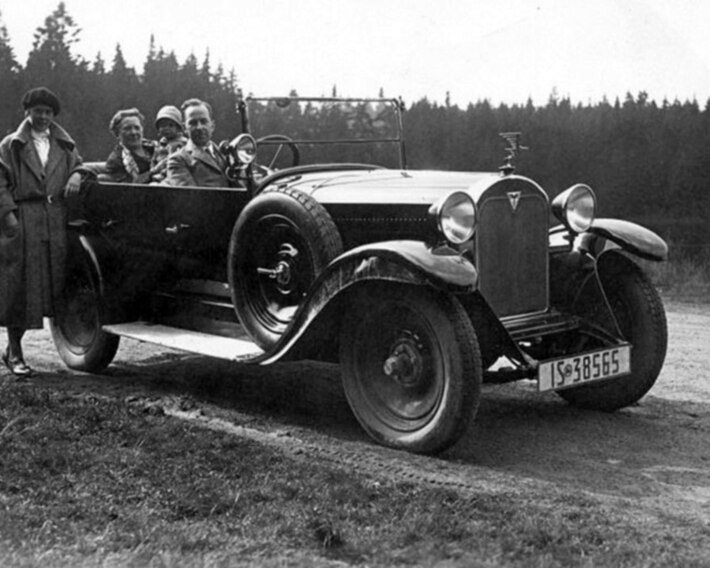
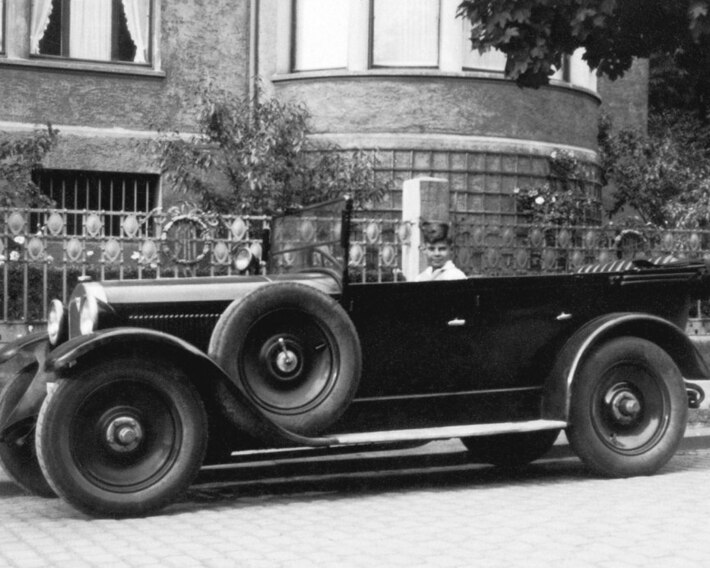


Key Specifications
- Engine: Approximately 1.7-litre inline 4-cylinder with improved cylinder head over the 6/24 PS; 25 hp at approximately 2,400 rpm. Electric starting standard. Four-wheel brakes standard. Updated carburetion for improved fuel economy.
- Transmission: 3-speed manual gearbox; improving synchromesh on 3rd gear; floor-mounted lever. The same fundamental layout as the 6/24 PS with incremental improvement. Double-declutching still beneficial for 1st and 2nd gear engagement.
- Chassis: Conventional ladder frame; more refined spring rates than the pre-war models; improved shock absorber provision on some examples. Four-wheel mechanical brakes standard on all 6/25 PS production.
- Body: Open four-seat tourer with more modern styling cues than the 6/24 PS; Sport variant with two-seat lighter body. The trend toward enclosed body styles was beginning by 1924–1926; some custom bodies with partially enclosed rear quarters were available.
- Performance: Top speed approximately 75–80 km/h; fuel consumption approximately 11–13 litres per 100 km. Marginal improvement over the 6/24 PS in most parameters; the improvement in braking with four-wheel drums is the most significant safety advance.
- Production years: 1924–1926 only; the shortest production run of any Adler PS-designation model. Total production was modest even by pre-war Adler standards.
Variant Comparison
| Variant | Engine | Power | Gearbox | Best For |
|---|---|---|---|---|
| 6/25 PS Standard Tourer (1924–1926) | ~1.7L inline 4-cylinder, updated cylinder head, RWD | 25 hp at 2,400 rpm | 3-speed manual, improving synchromesh on 3rd | The post-war update to the 6/24 PS line; improved power and reliability; correct four-seat open tourer specification; historically significant as the transitional model between the wartime-era 6/24 PS and the modern Standard family; the most commonly encountered 6/25 PS variant |
| 6/25 PS Sport (1924–1926) | ~1.7L inline 4-cylinder, tuned, RWD | 27 hp at 2,700 rpm | 3-speed manual | The sporting variant for enthusiast use; slightly increased output and lighter two-seat body; appropriate for veteran car sporting events; rarer than the standard tourer |
What Makes the 6/25 PS Stand Out
- The last of the Adler PS-designation models: The 6/25 PS was the final car Adler built under the traditional German PS-designation system. When the Standard 6 arrived in 1927 with its modern 2.1-litre six-cylinder engine, the era of the PS-rated Adler touring cars was permanently over. The 6/25 PS is thus the end of an era — the last chapter of a story that began with Adler’s earliest pre-war cars.
- Mid-Weimar economic recovery context: The 6/25 PS was built during the “Golden Twenties” — the brief period between Germany’s hyperinflation crisis and the Wall Street Crash that would trigger the next economic catastrophe. Owning a 6/25 PS is to own a piece of Germany’s most creative and energetic inter-war cultural period.
- Four-wheel brakes as standard: The 6/25 PS’s standard four-wheel brakes represent a meaningful safety advance over the earlier Adler touring cars. This makes the car slightly more practical for careful veteran car use than its predecessors.
- Extreme rarity: Two years of production at Adler’s modest volumes for mid-range models means that fewer 6/25 PS cars were built than virtually any other Adler model. Surviving examples are exceptional finds even by veteran car standards.
- Transitional engineering significance: The 6/25 PS represents Adler’s engineering at the precise moment of transition between the PS-era touring cars and the modern Standard family. Its specifications reflect what Adler had learned from the entire pre-war and post-war touring car experience.
Maintenance & Repairability in Azerbaijan
- All veteran car maintenance protocols apply: Specialist knowledge essential; all parts must be sourced from German specialists or fabricated; annual service by a veteran car expert is required regardless of mileage.
- Four-wheel brake maintenance: The 6/25 PS’s four-wheel mechanical brakes represent an improvement over earlier Adler models but require balanced adjustment across all four corners; uneven adjustment causes pulling. All four brake mechanisms should be inspected and adjusted at the start of each season.
- Electric starting system: Standard electric starting requires 6-volt system maintenance: battery condition check, starter motor brush inspection, and ignition switch integrity testing at each annual service. Carry a manual crank regardless of the electric starter’s condition.
- Parts sourcing: German veteran car dealers, the Adler-Veteranen-Club, and European veteran car parts fairs (Techno-Classica Essen, Automedon Paris) are the primary sourcing channels. Shipping to Azerbaijan takes 1–2 weeks via international courier.
- Conservation priority: Given the 6/25 PS’s extreme rarity, conservation of original components is strongly preferable to replacement. An original but worn component has more historical value than a perfect reproduction; document all replacement decisions thoroughly.
Adler 6/25 PS vs. Contemporaries
| Model | Core Strength | Main Compromise (Collector Context) |
|---|---|---|
| Adler 6/25 PS (1924–1926) | Post-WWI update to the 6/24 PS line; improved 25 hp output from ~1.7L 4-cylinder; transitional model leading toward the Standard family; Adler build quality and historical significance as part of the marque's development; vintage car era (post-1918) with good veteran car event eligibility | Very short production run of only two years; extremely rare survivors; veteran car specialist maintenance essential; limited to collector use only in Azerbaijan |
| Wanderer W9 (1924–1926) | Wanderer's equivalent post-war mid-range offering; ~2.0L 4-cylinder; more powerful than the Adler; Auto Union heritage for collectors interested in the pre-merger Wanderer story; good documentation through German specialist sources | Wanderer brand less well-known than Adler outside specialist German circles; different collector community; RWD without the FWD historical significance that makes later Adlers special |
| Opel 8/25 PS (mid-1920s) | Opel’s equivalent vintage touring car; larger production numbers; Opel club network support; better parts availability; well-known German brand | Very common by vintage car standards; no FWD innovation significance; Opel badge less distinctive at veteran car events where a rare Adler stands out significantly more |
Cost-of-Ownership Calculator (Azerbaijan)
- Estimated annual fuel use: 120 litres
- Estimated annual fuel cost: $78
- Total annual ownership estimate: $5878
- Average monthly ownership estimate: $490
Used Buying Checklist
- Specification verification: Confirm that the car is a genuine 6/25 PS rather than an earlier 6/24 PS with updated components; the improved cylinder head and electric starting are the primary distinguishing features.
- Four-wheel brake condition: Test all four brakes individually; check cable condition at each wheel; assess drum wear and adjustment. A car with non-functional front brakes should be treated as having rear-only braking capability until repaired.
- Engine condition: Full veteran car specialist assessment; compression test; oil pressure measurement; valve condition assessment. Budget for engine work if any compression variance is detected.
- Body and chassis: Full corrosion probe; chassis frame rail inspection; body panel authenticity verification. Any significant structural corrosion is a major cost driver.
- Documentation: All available records including German registration documents, club history, and restoration invoices. The 6/25 PS’s extreme rarity makes provenance documentation particularly valuable.
Adler 6/25 PS FAQ
Why was the 6/25 PS only produced for two years?
The 6/25 PS was a planned transitional model, not a long-term product. Adler’s engineering team was already developing the Standard family — a modern, six-cylinder range with enclosed body options — when the 6/25 PS was introduced. The two-year production run was intentional: enough to provide dealers with a current product while the new generation was finalised, but not so long as to establish customer expectations for a model that was already earmarked for replacement.
How does the 6/25 PS relate to the Standard family that followed?
The 6/25 PS and the Standard 6 (1927) are philosophically linked: both are mid-range Adler cars intended for the German professional and business buyer. However, the Standard 6 was a generational leap forward — a modern 2.1-litre six-cylinder in a more contemporary chassis with an enclosed body option — while the 6/25 PS was the last refinement of an architecture that traced back to 1913. The transition from 6/25 PS to Standard 6 is the most significant single model change in Adler’s automotive history.
Should You Buy an Adler 6/25 PS?
The Adler 6/25 PS is a specialist acquisition for the collector who specifically wants to represent the transitional period in Adler’s history between the PS-era touring cars and the modern Standard family. Its extreme rarity, interesting historical context in the mid-Weimar period, and position as the last of the PS-designation Adler models give it a unique appeal that more common veteran car types cannot offer.
Practical ownership in Azerbaijan follows the same pattern as all Adler veteran car models: European specialist support, careful storage, low mileage use, and a realistic conservation budget. Any acquisition should be treated as a long-term stewardship commitment rather than a driving proposition.
BakuWheels uses cookies to improve your experience, analyse site traffic, and personalise content. By clicking Accept All, you consent to our use of cookies. Learn more in our Cookie Policy.